GM Craft
Tavern Names: 6 Formulas, d20 Tables and 60+ Name Ideas
Six formulas for naming a tavern mid-session, d20 tables to roll on, names by mood and ancestry, and shop names that say what's for sale.
How many spell cards each class really needs, why 2014 cards go wrong at a 2024 table, how to print them at the right size, and a simple system for using them mid-fight.
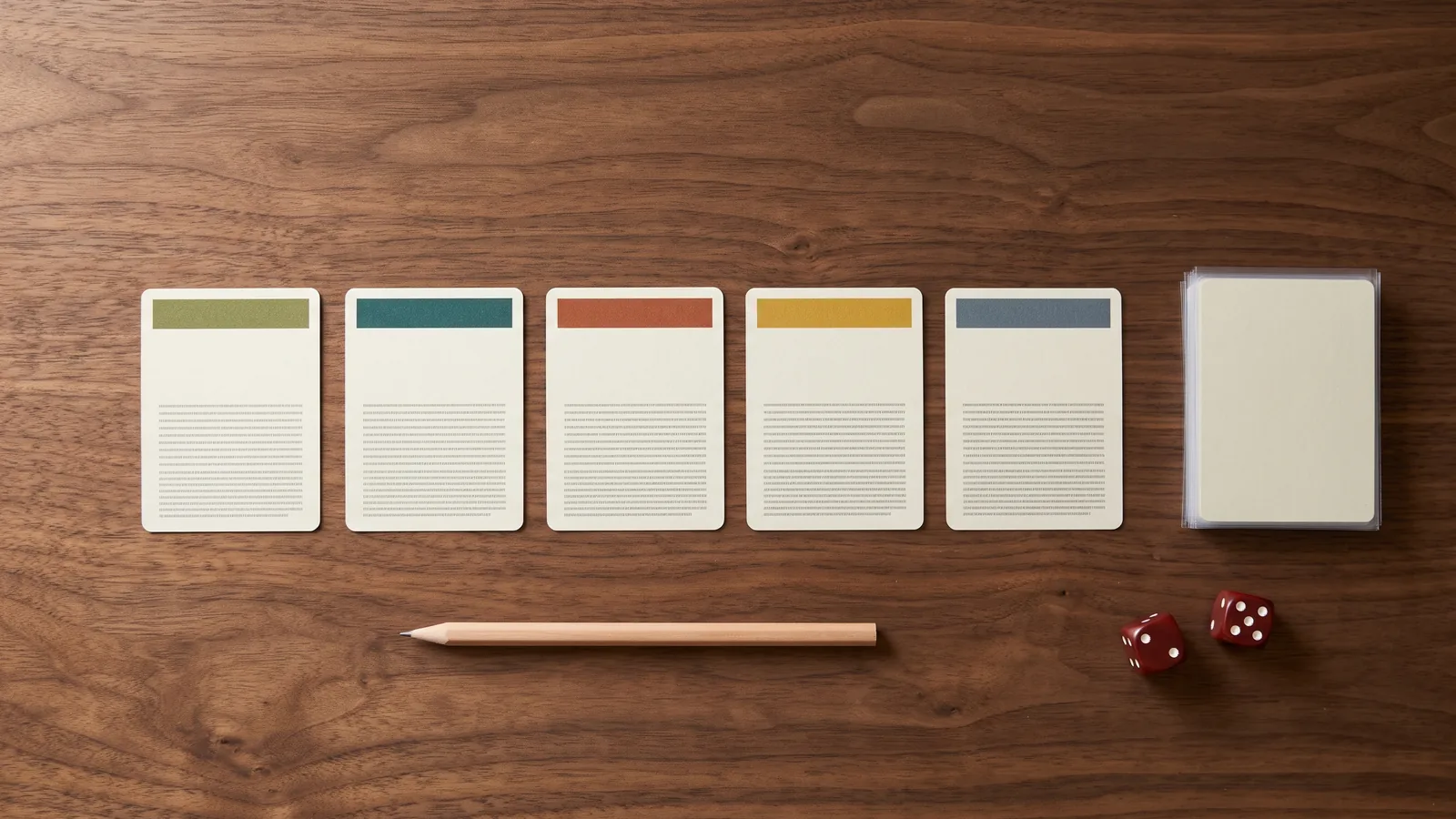
Your turn comes up, you cast Hold Person, and nobody at the table remembers when the target gets to repeat the save. D&D spell cards fix that by putting one spell on one card: level, casting time, range, components, duration, the Concentration and Ritual tags, and the full rules text, so a caster can take their turn without opening the book. Two decisions make the difference between a deck that helps and one that gets in the way: printing from the rules version your group plays (2024 or 2014), and printing only the cards your character can actually use. Almost nobody should print every spell in the game.
| If you are… | Print this |
|---|---|
| A new player with a level 1 caster | Your cantrips and prepared spells, from 2 cards (Paladin) to 9 (Wizard) |
| A Cleric or Druid | Your class list up to your highest spell slot level, since you can swap after every Long Rest |
| A Wizard | Your spellbook, not the whole class list |
| A Bard, Sorcerer or Warlock | Only your current list, plus a few spares for your next level |
| A Paladin or Ranger | Your list, plus the always-prepared spells your class gives you |
| The GM | The spells your villains cast, in a separate stack |
Looking up a spell in the book is slow because its details are spread across a page you have to find while four other people wait. Nobody needs a card for Fireball; the problem spells are the ones you cast twice a campaign: the exact shape of Wall of Force, what Hold Person lets the target do at the end of each turn, whether that cantrip needs a free hand.
Cards also fix a quieter problem. A sheet with “Bless, Shield of Faith, Spiritual Weapon” written on it doesn’t remind you that all three need Concentration (Spiritual Weapon only since 2024), so you can hold just one at a time. A C badge on each card does. New players gain the most: choosing between six cards on the table is easier than choosing from a list of names they haven’t read yet.
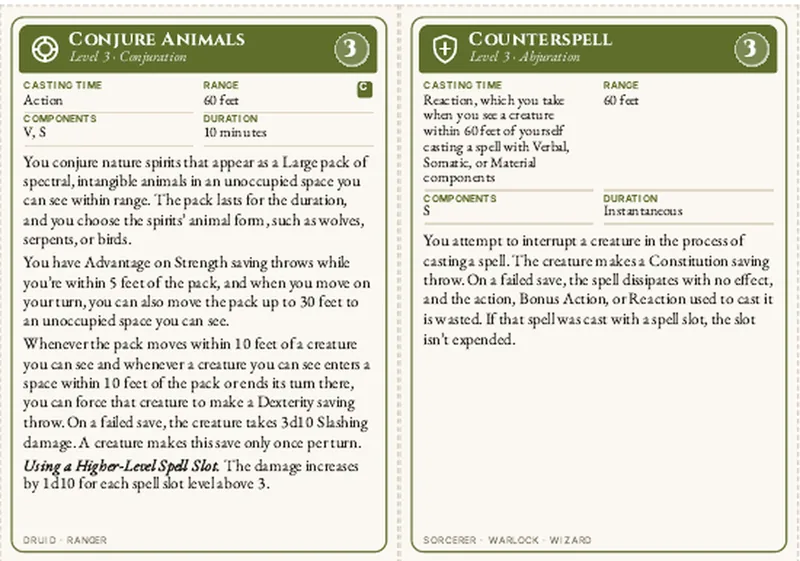
Most cards get the top block right; the arguments mid-fight come from the details. Before you print a set, check three spells you know well against this list.
If a set fails on 2, 5 or 6, skip it.
The fifth edition rules were revised in 2024 and many spells changed, so a deck built on the old text is wrong in small ways at a 2024 table, and vice versa.
Wizards of the Coast publishes the System Reference Document (SRD), the part of the rules anyone can reuse, under the Creative Commons Attribution 4.0 license. SRD 5.1 follows the 2014 rules. SRD 5.2 follows the 2024 core rules; the current SRD 5.2.1 came out on May 1, 2025. Wizards’ FAQ on that page says all its content “has been updated to 5.5e core rules wording and mechanics” and lists 20 spells new to the SRD, among them Hex, Chromatic Orb, Divine Smite and Ice Knife.
Three changes show why old cards cause trouble at a 2024 table:
A note on names: the SRD renames a few spells to keep trademarks out, so “Black Tentacles” is the spell your rulebook names after a wizard, with the same rules.
If your group mixes both rulebooks, settle it before anyone prints, ideally at session zero: “Are we using the 2024 or the 2014 versions of spells?” Then print every card from the same version.
The 2024 rules make every caster prepare spells, and the number is printed in each class table. Add cantrips and always-prepared spells and you have today’s card count. The counts below come from the class tables in SRD 5.2.1 and leave out subclass and feat spells, so add those yourself.
| Class | Level 1 | Level 5 | Level 10 | When you can swap spells |
|---|---|---|---|---|
| Bard | 6 | 12 | 19 | One spell when you gain a level |
| Cleric | 7 | 13 | 20 | Any number after a Long Rest |
| Druid | 7 | 13 | 20 | Any number after a Long Rest |
| Paladin | 2 | 8 | 11 | One spell after a Long Rest |
| Ranger | 3 | 7 | 10 | One spell after a Long Rest |
| Sorcerer | 6 | 14 | 21 | One spell when you gain a level |
| Warlock | 4 | 9 | 14 | One spell when you gain a level |
| Wizard (spellbook) | 9 | 18 | 29 | Any number from the spellbook after a Long Rest |
Paladin numbers include Divine Smite from level 2 and Find Steed from level 5, Druid numbers include Speak with Animals, and Ranger numbers include Hunter’s Mark, since those classes always have them prepared. The Wizard row counts cantrips plus a spellbook that starts with six spells and gains two per level, with nothing copied from scrolls (the prepared list is smaller: 7, 13 and 20 cards). A spell that runs onto a second card adds one more. Nine poker-size cards fit on a sheet, so a level 5 Sorcerer (14 cards) prints two sheets and a level 10 Wizard (29 cards) prints four.
What the last column means for printing:
That last option is what we built. The Complete Spell Card Deck has all 339 spells in SRD 5.2 on 391 poker-size cards, levels 0 through 9, plus eight separate class decks (from 38 Paladin spells up to 218 for the Wizard). It covers the SRD only, so spells that appear only in the Player’s Handbook or other books aren’t in it; write those on a few blank cards. The index marks Concentration and Ritual spells so you can tick off your list before printing, and long spells run onto a second card at full size. It comes in A4 and US Letter, and a class deck matched to a friend’s character makes an easy gift (more ideas in our gifts for dungeon masters). It’s an unofficial, 5E compatible product based on SRD 5.2 under the CC-BY-4.0 license, and isn’t affiliated with Wizards of the Coast.
Spell cards are usually poker size, 2.5 × 3.5 inches (63.5 × 88 mm), so they fit standard card sleeves and deck boxes. Most of what goes wrong happens in the print dialog.
Order your stack by level, then alphabetically inside each level. The colored header on most decks makes this quick, and it matches how you think mid-fight: “I have a level 2 slot left, what can I do with it?”
Then split it into three sections, with a divider card or a blank card between each:
For a Cleric or Druid, the Long Rest swap then takes two minutes while the GM reads the morning’s events.
Lay your cards in a row above the character sheet, lowest-level spells on the left, highest on the right.
In 5E, casting a spell uses up the slot, not the spell. With Cure Wounds prepared and three level 1 slots, you can cast it three times. Don’t flip a card when you cast it. Track your slots with one coin or token per slot, set on the level header of your sheet and moved aside when spent. A card is out only when every slot at or above its level is gone.
When you cast a Concentration spell, turn its card 90 degrees. Only one card can be sideways at a time, because starting another Concentration spell ends the first one. When you take damage, the sideways card is the GM’s cue to ask for the Constitution save. If an ally is the target of something with ongoing rules, like Fly or Haste, hand them the card and leave a token turned sideways in its place, so the GM still sees you’re concentrating.
Some spells come with free casts that return after a Long Rest: a Paladin’s Divine Smite (and Find Steed from level 5) and a Warlock’s Mystic Arcanum. Flip those face down when used, and back up after the rest. A Ranger’s free Hunter’s Mark casts come in a batch (two at level 1, three at level 5, four at level 9): put that many tokens on the card.
Outside combat, slide your Ritual cards (R badge) to the front. Detect Magic, Identify and Comprehend Languages get forgotten because they never come up in a fight.
A small stack of your villains’ spells saves looking up Hold Person while the party waits; the lazy prep method works the same way.
If this is your first deck, work through it in this order:
GM Craft
Six formulas for naming a tavern mid-session, d20 tables to roll on, names by mood and ancestry, and shop names that say what's for sale.

GM Craft
How to find out what your GM already owns without spoiling the surprise, then gift ideas sorted by the way they run the game, by budget, and a list of what to skip.
GM Craft
How to run a horror one-shot for your D&D table in a single evening: a run sheet, a safety talk script, visible clocks, the rule of escalation and six premises you can prep this week.