GM Craft
D&D Horror One-Shot: How to Run It, Plus 6 Ready Ideas
How to run a horror one-shot for your D&D table in a single evening: a run sheet, a safety talk script, visible clocks, the rule of escalation and six premises you can prep this week.
A DM prep checklist you can finish before the doorbell rings: a 20-minute version, a copyable prep sheet with a worked example, and a ten-minute habit after each game.

It’s 6:40 on a Thursday, your DM prep is zero, and your players arrive at 7:30. You haven’t opened your notes since last session, and all you remember is that the party was about to do something important in a swamp.
Fifty minutes is enough. Good DM prep is a short checklist you answer for the next session only: how the game opens, and what the players might discover or run into. Below you’ll find that checklist ready to copy, a 20-minute version for bad weeks, a one-page DM prep sheet with a worked example, and the ten-minute habit after each game that makes the next prep faster.
Less than you think, and less than a lot of GMs do. In April 2020, Mike Shea of Sly Flourish (author of Return of the Lazy Dungeon Master) asked DMs on Twitter how long they prepped for a roughly four-hour game. Of 3,663 responses, 29% said three hours or more and 43% said about an hour or less. Shea’s own number is 30 minutes to an hour for a three-hour game, usually closer to 30 when he’s partway through a published adventure. A single session built from scratch takes him one to two hours. When he tried a full day of prep for one campaign, reading the whole adventure and connecting it to the characters paid off, while playlists and big printed poster maps barely did.
Shea’s test is to ask how much better the game will be because of each prep task. Our rule of thumb follows from that: when you could improvise the opening scene and you know what the players might find out tonight, you’re done. Anything after that point is a hobby, which is fine, as long as you don’t mistake it for prep you needed.
This is the checklist we’d tape inside a GM screen. The backbone is Shea’s eight steps, laid out in his 2023 review of the method and in the free Lazy GM’s Resource Document (released under a Creative Commons license). Around them we’ve added the bits busy GMs tend to forget: what happens before you sit down, and what you do after.
| Step | What you write | Time | Skip it when |
|---|---|---|---|
| Read last session’s notes | Where you stopped, open threads | 3 min | One-shots and first sessions |
| Review the characters | One hook per character | 3 min | One-shots with pregens |
| Strong start | One or two sentences: something happens | 5 min | Never |
| Potential scenes | Three to five one-line scenes | 3 min | You’re running a dungeon room by room |
| Secrets and clues | Five to ten one-sentence facts | 7 min | Never |
| Fantastic locations | One line plus up to three features each | 5 min | The published adventure covers it |
| Important NPCs | Name, one line, one mannerism | 5 min | No new NPCs tonight |
| Monsters | A short list, not tied to rooms | 3 min | No fights likely |
| Treasure | One or two rewards that fit a character | 2 min | Nothing to find tonight |
| “If they do nothing” | What the villain does next | 2 min | The world is quiet |
The times add up to just under forty minutes, and you will rarely need every row. Shea is explicit that the steps are modular: running a published adventure, you may not need locations at all. If you only keep one step, keep secrets and clues. He calls it the heart of the method.
The last row is ours. Players stall more often than they sprint, and one line about what the opposition does in the meantime gives you something to throw at a quiet table.
Here’s the checklist applied to the swamp session. The party is hunting a missing bell-ringer in a drowned village called Marrowfen.
For each character, ask Shea’s question: what hook can I put in this session for them? The cleric’s order once kept the Marrowfen chapel, so one clue will mention it. The rogue owes money to a smuggler who uses the swamp roads.
Then decide what happens in the first five minutes. Not “you arrive at the village and look around,” but: the drowned chapel’s bell rings at dusk, and there’s no one left in the village to ring it. A fight is the classic strong start and the Resource Document’s fallback (“when in doubt, start with a fight”), but a strange event gives players more to react to.
Scenes are a safety net. Shea says this step exists mostly to make you feel prepared, and that you should expect to throw scenes away.
Secrets are short facts the players might discover, and you don’t decide where they find them. During play you hand them out wherever the players happen to be looking, whether that’s a slip of the tongue or a dying cultist’s last words.
Shea used to recommend ten fresh secrets per session. Now he suggests carrying forward the ones the players haven’t found yet and adding a few new ones, which is less work and keeps threads alive.
One evocative line per place, plus up to three features players can interact with: flooded graveyard, tilted headstones, a rowboat chained to a crypt, will-o’-wisps that move against the wind. Those features are what turn “I attack” into “I kick the rowboat into the zombie.”
For NPCs, Shea notes that the hardest part is often remembering their names, so write them down. Old Hesk, the villager who stayed: deaf in one ear, always turns his head to listen.
Monsters go on a list you can drop in anywhere (bog zombies, a leech swarm, the smuggler’s thugs). Treasure works best when it also delivers a secret, like a waterlogged prayer book with a name scratched inside the cover.
The Resource Document has a section called “The 5-Minute Reduced Checklist” for when you have almost no time: a strong start, secrets and clues, and fantastic locations. That’s the smallest kit that still lets you improvise a whole evening. With twenty minutes, split it like this:
Then stop, even if the clock says you have time for one more stat block.
Paper helps here, because a sheet with the boxes already printed removes the “where do I start” moment. Our Lazy DM Companion is a set of blank printable and fillable sheets: ten session prep pages with eight boxes each (strong start through session notes), a quick 20-minute mode (strong start, three potential scenes, five secrets), a full 60-minute mode, and session recap pages. It’s our own independent set of templates. It isn’t affiliated with Mike Shea or Sly Flourish, who publish their own books, including a different Lazy DM’s Companion.
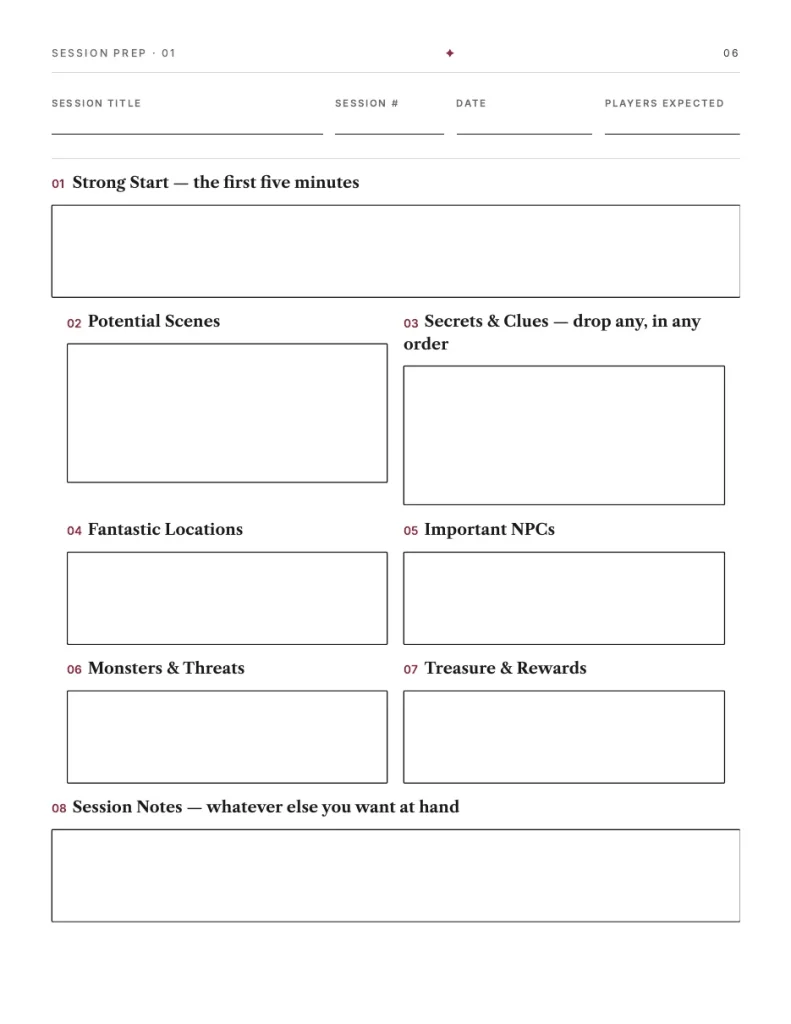
If you’d rather work in a notebook or a text file, this is the template. Copy it once, then fill a fresh copy every session.
SESSION #___   DATE ______   PLAYERS ______

LAST TIME WE STOPPED:
CHARACTER HOOKS (one per PC):
STRONG START:
POTENTIAL SCENES (3-5):
SECRETS & CLUES (5-10, no locations attached):
LOCATIONS (name + up to 3 features):
NPCs (name / one line / mannerism):
MONSTERS:
TREASURE:
IF THEY DO NOTHING, THE VILLAIN...:
And here’s the Marrowfen session filled in, the way it would actually look:
LAST TIME: Party reached the edge of Marrowfen at sunset
HOOKS: Cleric - her order kept the chapel / Rogue - smuggler creditor
STRONG START: The chapel bell rings at dusk. No one is left to ring it.
SCENES: Hesk's hut / flooded graveyard / causeway ambush / bell tower
SECRETS:
- Bell-ringer went into the tower willingly
- Bell recast 50 yrs ago from sunken-shrine metal
- Someone is paying villagers to leave
- Smugglers avoid the chapel at night
- Cleric's order sealed something under the floor
LOCATIONS: Graveyard (tilted stones, chained rowboat, wisps against the wind)
           Bell tower (rotten stairs, rope still wet, cold draft from below)
NPCs: Old Hesk (deaf in one ear, turns his head to listen)
      Vell the smuggler (owes the rogue's creditor a favor)
MONSTERS: bog zombies, leech swarm, smuggler thugs
TREASURE: waterlogged prayer book, name inside the cover
IF THEY DO NOTHING: the bell rings again, and Hesk's lamp goes out
Filling in a sheet like this takes fifteen to twenty minutes.
Lean prep has one real failure mode: the players miss the clue that holds the evening together, and everything stalls. Justin Alexander’s Three Clue Rule is the classic fix: for any conclusion you want the PCs to make, include at least three clues. He treats each clue as a plan and the other two as backups, because plans never survive contact with the players.
Floating secrets make this cheap. If “someone is paying villagers to leave” matters, you don’t need three clues pre-placed in three rooms. Keep it on your list and look for three chances to reveal it: Hesk mentions a stranger with silver coins, the empty houses all have identical new locks, a smuggler brags about a “relocation contract.”
They will, most weeks. The GMs who seem to prep in ten minutes usually did the rest months ago, as reusable tools.
Keep a names list. Twenty first names and twenty surnames or business names, crossed off as you use them. Shea’s prep toolkit lists a “curated random name list” next to the dice and index cards, and the Resource Document includes one to start from.
Keep improvised numbers on an index card. The Resource Document’s guidelines: pick a DC from 10 (easy) to 20 (very hard), and if failure isn’t interesting, don’t roll. For a trap or a creature you never statted, decide a challenge rating and use AC and DC of 12 + half the CR, hit points of 20 × CR, and damage of about 7 × CR against one target or 3 × CR against several.
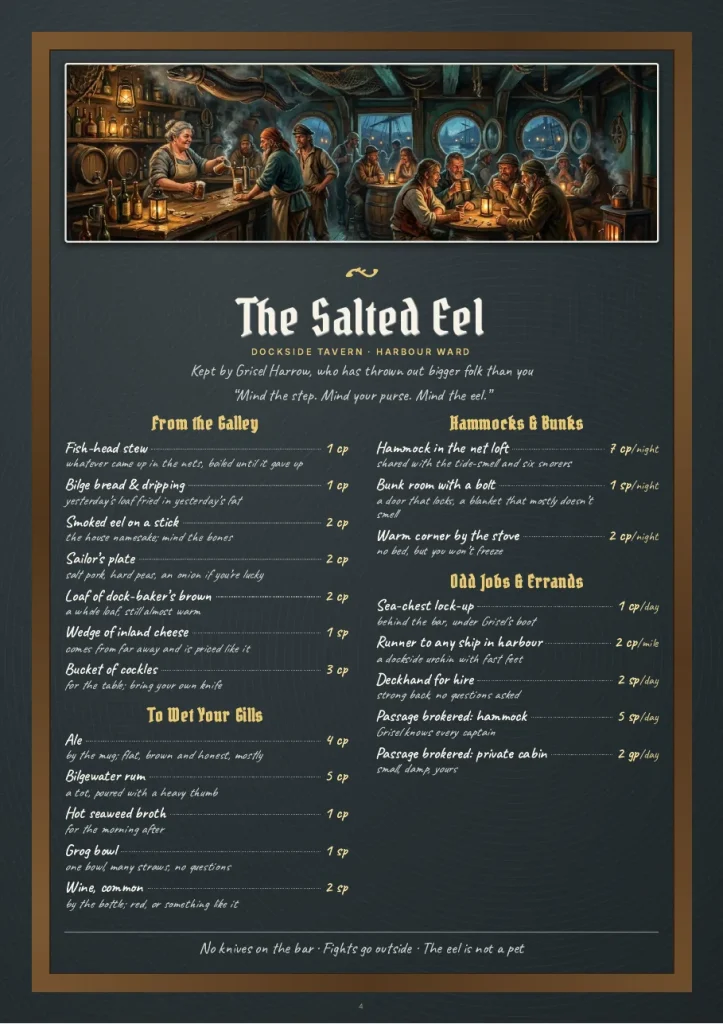
Keep random tables for the places players wander into, like who’s in the tavern or what the shopkeeper wants. Taverns and shops come up so often that they’re worth a dedicated kit. Our Tavern & Shop Kit covers that moment with six tavern menus, six shop price lists, twelve NPC cards and a d20 “Who’s in the Taproom?” table. Roll a 9 and you get “a hooded stranger brooding in the corner who is, disappointingly, just very shy.”
Keep five or six hooks in reserve for the night the players ignore everything. A town job board still works because it lets the players choose. Our Quest Board has 26 printable notices and bounty posters, each with a twist for the GM on a separate page, so a lost prize pig can fill an evening.
At the table, put the rules you look up most in one place: conditions, cover, common DCs, travel pace, death saves. Shea also suggests keeping the characters’ passive Perception, Insight and Investigation on a cheat sheet, so you can describe what they notice without stopping the scene for a roll. Our GM Screen Inserts condense the 2024 rules (SRD 5.2, 5E compatible) into four GM-side panels if you’d rather not build that sheet yourself.
A published adventure already gives you the locations and the stat blocks, so the weekly work shrinks. Read the whole book once, at the start of the campaign (that was the part of Shea’s full prep day that paid off). After that, read only the next chapter, or the part the players are likely to reach, and pull your checklist out of the text: five to ten secrets, the two or three locations they’ll probably visit, and the monsters already written there. Your own writing is the strong start, the character hooks and the “if they do nothing” line.
The checklist changes a little when there’s no last session to read.
For a one-shot, the character review takes seconds, and the scenes matter more because you have one evening to reach an ending. Write three to five scenes in order, and note which one you’d cut if the game runs long. If it’s a scary one-shot, our guide to running a horror one-shot covers what changes when the goal is to scare the table.
For the first session of a campaign, most of the prep happens in conversation with the players. Run a session zero first (here are the questions and the checklist we use), then prep session one with the checklist above, with one hook per character pulled straight from what the players told you.
This is the part that makes next week’s prep take twenty minutes instead of sixty. Do it the same night: Scot Newbury’s guide to session notes at Roleplaying Tips argues for writing post-session notes while the game is still fresh, and the Alpine DM’s session prep guide suggests 5 to 10 minutes of bullet points at the end of a session.
Answer five questions:
Then think for a minute about what the villains and NPCs are doing now. The Resource Document lists exactly that question (“Ask what the villains and NPCs are doing right now”) under thinking about your game.
At the start of the next session, ask the players to recap what happened last time. The Resource Document recommends it too. You learn what they remember, which tells you what they care about, and you get two minutes to settle in.
If your players arrive in under an hour: read last session’s notes, write the strong start, write five secrets (carry over the unfound ones), and jot three names. Print a blank prep sheet or copy the template above for next week, and leave ten minutes after the game for the five after-session questions. That’s the whole routine, and you might even eat dinner before the doorbell rings.
GM Craft
How to run a horror one-shot for your D&D table in a single evening: a run sheet, a safety talk script, visible clocks, the rule of escalation and six premises you can prep this week.
GM Craft
A complete session zero checklist split into the week before, the meeting itself and the follow-up, with the questions to ask your players, a 90-minute agenda and a two-minute version for one-shots.

Murder Mystery Hosting
Format by headcount, five settings for grown-ups, a December timeline with a ready save-the-date, and a dinner schedule built around the rounds.