
Murder Mystery Hosting
How to Host a Murder Mystery Party: Guests, Dinner, Timing
How many guests to invite, a planning timeline that starts four weeks out, three ways to fit dinner into the rounds, and how to run the reveal.
Format by headcount, five settings for grown-ups, a December timeline with a ready save-the-date, and a dinner schedule built around the rounds.

A Christmas murder mystery party for adults comes down to two decisions: the format and the calendar. With 8 to 16 guests, pick a character party where everyone plays a suspect over three rounds and dinner fills the gaps between them. With 2 to 6 people, skip the costumes and open a cold case file at the kitchen table. Then plan backward from the date, because in December your real competition is every other party your friends have been invited to.
This guide covers only what changes at Christmas. For the basics that apply to any murder mystery (how rounds work, running the reveal, drawing in quiet guests) see our complete host’s guide. Nothing below spoils any game.
In December the headcount is the least reliable number you have: count the people who will realistically come after their office party, then choose.
| Guests | Format that works | Host effort | Why adults like it |
|---|---|---|---|
| 2-6 | Cold case file: documents in envelopes, solved together | Low, about 15 minutes of prep | Real deduction, no performing, fits a quiet night between holidays |
| 6-8 | Small character party, or a cold case played in two teams (print two copies) | Medium | Everyone has a big role, one conversation around one table |
| 8-16 | Character party with core and optional roles | Medium, 30-45 minutes of prep | Costumes, secrets, lying to your friends over the roast |
| 17-24 | A kit written for bigger casts, or characters played in pairs | Higher | Room to mingle, but you need a firm schedule |
| 25+ | Team mode or a hired company | High | Works for big venues; at home it gets loud fast |
The words “for adults” change less in the game than in the evening around it. Plenty of printable kits, ours included, are rated for teens and up and have no gore. Adult parties run later, the bar is open, the secrets and grudges of a period whodunit land differently when the players have in-laws of their own, and nobody needs to be home by nine. If a 16-year-old nephew does turn up, a well-written kit still works. If your Christmas table is mostly kids, our Christmas game night ideas cover family formats instead.
The setting decides the dress code and the drinks, so pick it before you write a single invitation. These five work well for grown-ups because each one gives people a reason to be stuck in the same room on a winter night. Use the table to choose a kit by its setting, or to theme the drinks and dress code of a kit you already own.
| Setting | Dress code | What to pour | Works best for |
|---|---|---|---|
| A snowed-in English country house, Christmas Eve in the 1920s | Evening dress plus one Twenties detail | Champagne cocktails, sherry | 8-16, dinner party |
| A Dickensian Christmas in Victorian London | Waistcoats, shawls, a top hat or a bonnet | Smoking bishop: port and red wine warmed with roasted oranges and cloves | 8-14, dinner party |
| A department store after closing time, 1980s | Shoulder pads, loud Christmas sweaters, big hair | Eggnog, Irish cream on ice | 2-6, table game |
| A ski chalet cut off by a storm, 1960s | Ski sweaters, turtlenecks, après-ski boots | Glühwein, hot toddies | 6-12, fireside evening |
| Backstage at a live Christmas TV special, 1950s | Cocktail dresses, narrow ties, a little stage glamour | Martinis, a punch bowl for the crew | 12-24, standing party |
The Victorian drink has a pedigree: smoking bishop is the punch Scrooge promises Bob Cratchit at the end of A Christmas Carol (Wikipedia). Whichever setting you choose, keep the music, drinks and dress code in the same decade.
The country house is the classic setting: it keeps everyone indoors and makes every guest a suspect, which is why Golden Age writers kept coming back to it. The period even has a December story of its own: in 1926 Agatha Christie vanished for 11 days, from the evening of December 3 until she was found on December 14 at a hotel in Harrogate (Wikipedia).
That is where we set Murder at Hollyfield Manor: Christmas Eve, 1926, a toy magnate who promised an announcement at midnight and never made it, a closed road and a dead phone line. Eight core characters carry the evidence and eight optional ones are added in a fixed order, so it runs with anywhere from 8 to 16 guests. If a character isn’t being played, the others simply ignore any mention of them, and the case can still be solved.
The Emily Post Institute advises sending holiday invitations four to six weeks before the party, because December calendars fill up fast. That’s about two weeks earlier than we’d suggest for a murder mystery in any other month. It is only the first step: you still need firm RSVPs before you cast, and character invitations about a week out.
This is the plan for a party on Saturday, December 19, 2026, the weekend before Christmas:
| When | Date | What to do |
|---|---|---|
| 6 weeks out | Sat Nov 7 | Choose and buy the kit, then send the save-the-date (text below) |
| 4 weeks out | Sat Nov 21 | Nudge anyone who hasn’t answered; print one test page |
| 2 weeks out | Sat Dec 5 | RSVP deadline; ask about allergies and who’s driving |
| 10 days out | Wed Dec 9 | Cast the game and line up one standby friend for a core role |
| 1 week out | Sat Dec 12 | Send character invitations: who they are, plus a costume idea |
| 2-3 days out | Wed-Thu Dec 16-17 | Print, cut, fold and sort; send a short reminder with arrival time |
| On the day | Sat Dec 19 | 45 minutes of game setup, done before you start cooking |
A save-the-date you can paste into the group chat as it is, changing only the bracketed parts:
Save the date: Saturday, December 19, 7 pm, at [our place]. Someone at our Christmas party is going to be murdered, and everyone else will be a suspect. It’s a murder mystery dinner set in [1926], so dress for the period if you can (one detail is enough). Characters go out a week before. Please tell us by [December 5] if you’re in, so we can cast you properly. Dinner is on us; the alibi is your problem.
Three notes for this season in particular. Don’t book Christmas Eve itself with adults who have families: many will leave early, and you’ll lose half the cast before the last round. The weekend before Christmas is safer, and the days between December 26 and New Year’s Eve are an underrated slot, when many people are off work and have fewer parties to get to. December also brings flu, snow and office parties that “might run late,” so expect at least one cancellation and keep the core roles for your most reliable guests.
The usual rule still applies (big roles to the people who want them), but with old friends or adult siblings you can cast with more mischief. Most period mysteries draw on the same handful of character types, so match the guest to the type. The friend who wins every poker night gets the gambler, the heir with debts or the card sharp. Whoever reads crime novels and will try to solve it in Round 1 should play a character who is also a mystery fan, or the journalist with a notebook. Give the retired officer or the explorer with tall tales to the friend who tells the same three stories at every party, and the butler or housekeeper to your quietest, most observant guest, since servants see everything. The person who always ends up running your kitchen makes a natural cook or lady of the house, and the flirt belongs in the young spouse’s shoes.
In Hollyfield, for example, the poker player gets Oliver Ashcombe, the prodigal son: “Excellent at cards, terrible at paying for them.” The crime reader gets his sister Rosalind, who “reads detective novels under the table.”
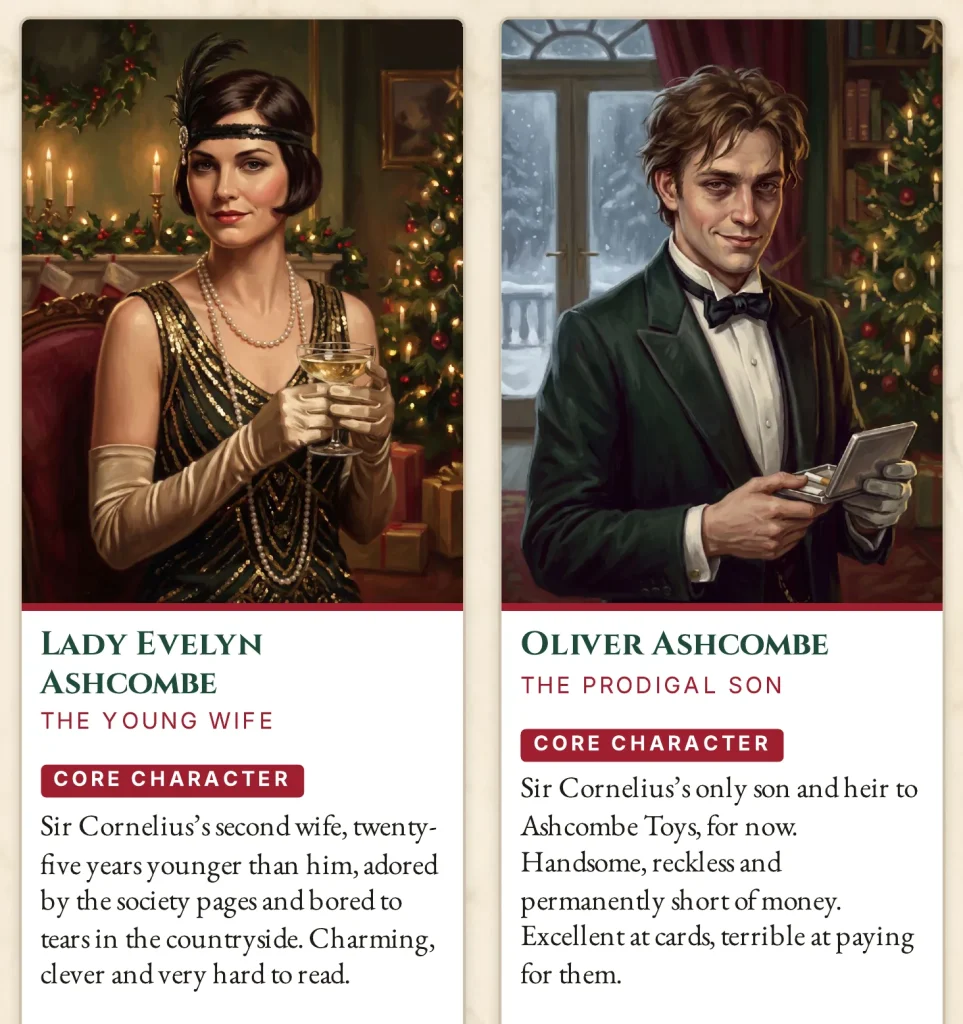
Cast only after the RSVPs are in, and use the optional roles for the guests who said “probably.” Give an optional character to anyone who might arrive late from another party, never a core one. Split couples across different storylines so they have to work the room instead of comparing notes. The rest of the usual casting advice is in the host’s guide.
In December most adults already own something festive and slightly too formal, so don’t ask for a full costume. Ask for “what you’d wear to a nice Christmas party, plus one period detail.” For the Twenties that could be:
The best costume lines also include something to act rather than buy. One butler costume line we wrote ends with “an expression of polite disapproval.”
Christmas dinner already comes in courses, so the game slots into it: guests compare notes over each course while you plate the next one. Move on to the next round as soon as the energy drops. The dinner table will be full of plates, so put the floor plan on a sideboard and lay each round’s clue pile next to it when the round starts.
| Time | Game | Table |
|---|---|---|
| 7:00 | Arrivals, name tags, Round 1 booklets | Mulled wine or champagne cocktails, mince pies |
| 7:20 | Opening script, then Round 1 | Guests mingle standing up |
| 8:00 | Round 1 ends | Sit down for soup |
| 8:25 | Round 2 | Clear the soup, roast in the oven |
| 9:00 | Round 2 ends | Main course |
| 9:40 | Round 3 | Clear plates, coffee on |
| 10:15 | Written accusations, read aloud | |
| 10:30 | The solution, awards | Christmas pudding |
| 10:45 | White elephant swap, if you’re doing one | Whatever’s left in the good bottle |
The gift swap goes at the end on purpose. Run it between rounds and it kills the momentum; after the awards, people want to keep talking anyway.
Watch the bar. Three rounds of clues need people who still remember Round 1 by the time they reach Round 3. Serve the lighter drinks early, open the good bottle with dessert, and keep a real alcohol-free option on the table all night: hot cocoa or sparkling apple juice both suit the season.
Then plan the menu around the game. If dinner depends on you basting something every twenty minutes, the game will run without its host, and you will miss Round 2. Cook dishes that hold (braises, a roast that rests happily under foil, a pudding made the day before) or hand the game to a co-host who only runs the clock and the clue cards.
For decoration, your house is already dressed for Christmas. Switch off the overhead lights and let the tree and a few lamps do the work.
The formula is the same for almost every party kit: per guest, 1 invitation, 1 character booklet, 1 name tag and 1 accusation card; then, shared, the clue cards, a floor plan, the awards and the host’s pages. Print at 100% (“actual size”), plain paper for anything people read, card stock for anything handled all night. Use the printer-friendly version if your printer struggles with large dark areas.
For 12 guests, using Hollyfield’s layout as the example (most kits are close):
| Item | Quantity | Paper | Sheets |
|---|---|---|---|
| Invitations (skip if you send them as photos) | 12 (four to a sheet) | Plain | 3 |
| Character booklets | 12 (two pages each) | Plain | 24 |
| Accusation cards | 12 (four to a sheet) | Plain | 3 |
| Floor plan | 1 | Plain | 1 |
| Host pages: guide, background, opening script, solution | 1 set (seven pages) | Plain | 7 |
| Clue cards | 1 set (18 cards, four to a sheet) | Card stock | 5 |
| Name tags | 12 (eight to a sheet) | Card stock | 2 |
| Award certificates | 1 set (six, two to a sheet) | Card stock | 3 |
| Total | 38 plain + 10 card stock = 48 sheets |
A 25-sheet pack of card stock covers it with room for a misprint. Cut each booklet’s later sections apart and fold them closed, so nobody reads ahead. If you have relatives staying over for the holidays, keep the solution envelope somewhere other than the coffee table.
Over 16, use a game written for a bigger cast rather than stretching one past its limits. If the crowd is mostly colleagues, our office party mystery Season’s Grievings goes up to 20 players, or 40 when characters are played in pairs. For a friends’ party of 18 or so, a house rule that works with most kits is to let two or three couples share an optional character and play it as a pair. Keep the core roles for single players, so the evidence doesn’t get split between two people who are both in the bathroom queue.
Under 8, don’t force a party game. A cold case gives a small group the deduction without the dress code, and a printable escape room is another good option if your group prefers puzzles to suspects. In Cold Case: Who Killed Santa? the department store Santa was found dead in the stockroom on Christmas Eve, 1987, and the file was closed in two days. You reopen it through three envelopes of police reports, witness statements and receipts, for 1 to 6 detectives, in 90 to 150 minutes, with three hints per envelope if you get stuck. It’s a good fit for two couples on December 27, with leftovers and a pot of coffee.
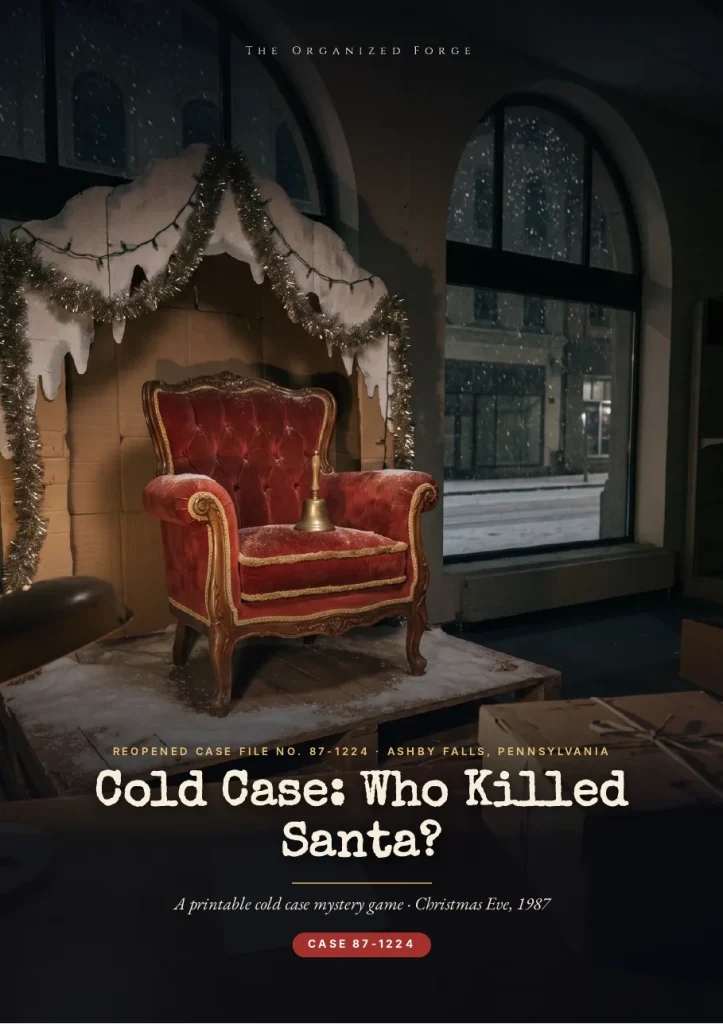
If you want a whole season of it, The Christmas Mystery Collection puts both games together with an Advent mystery and a no-murder family game for Christmas Eve.
Pick the date, count your likely guests and choose the format from the first table. Then choose the setting and buy the kit, paste the save-the-date above into the group chat with your own date and RSVP deadline, and put the print run in your calendar for the Wednesday before the party. Everything else can wait until the yeses come in.
Murder Mystery Hosting
How many guests to invite, a planning timeline that starts four weeks out, three ways to fit dinner into the rounds, and how to run the reveal.

Holidays & Parties
24 Christmas games with the rules in a few lines each, sorted by who is playing: the whole family with no supplies, little kids, grandparents and grandkids, teens, and adults.
Planning & Productivity
A paper quest system for real life: a character sheet, quests, XP tiers, a weekly boss and a Sunday recap, with the research on what works and the rules that stop burnout.