Printable Escape Room: How to Choose and Host One at Home
How to pick a printable escape room for your group's ages, what a good kit contains, how to print and prep it, and how to run the hints, plus a three-puzzle mini escape to try tonight.
,
11 minute read
You download a PDF, print it at home and play it around the table: a story read aloud, puzzle pages in numbered envelopes, hint cards and an answer key that only the host sees. That’s a printable escape room. You don’t need padlocks or a spare room.
What decides whether the night works is the choice of game and the way you run it. This guide covers how to pick a printable escape room for your group, how to prep it and how to run the hints, plus a three-puzzle escape you can make tonight and tips for writing your own.
What’s inside a printable escape room kit
Free printables and paid kits share the same basic shape. The difference is how much of the hosting work has been done for you. Before you download anything, check that the file includes:
A read-aloud story or intro letter that sets the goal and the deadline.
Puzzle pages, one per envelope, with clear answer boxes.
A final lock or meta-puzzle that uses an answer from every earlier puzzle, so the ending feels earned.
Hint cards in two strengths for each puzzle (more on this below).
An answer key for the host and, for games without a host, a check page that confirms an answer without showing it.
A host guide with players, ages, time, prep and what to do when time runs out.
US Letter and A4 versions, plus an ink-saver version if you print in black and white.
A single free worksheet is fine for a classroom warm-up. For a party, the hint cards and host guide are what keep the game moving when you’re also refilling drinks. You supply the printer, paper, envelopes, pencils and a timer, plus any odd item the supply list asks for.
How to choose a printable escape room for your group
Start with the people, then the theme. A gorgeous heist that’s too hard for your crowd is worse than a simple game they finish with ten minutes to spare. Treat the listed age as a minimum, and pick the difficulty for your quietest player, not your sharpest.
For a reality check, Scott Nicholson’s 2015 survey of 175 escape room facilities found an average success rate of 41%, and most of those rooms had a game master watching on camera. Pick a game your group can win with a few hints.
Your group
Look for
Avoid
Kids 6 to 8
Picture puzzles, counting, a grown-up on each team, free hints
Long text riddles, strict timers
Kids 8 to 12
A clear story, 6 to 8 short puzzles, certificates at the end
Ciphers that need a lot of writing
Mixed family (kids, teens, grandparents)
Several puzzles open at once so everyone has a job
Single-file sequences that leave four people watching
Teens
Spooky or heist themes, a final meta-lock, a real timer
A game designed for two with a check page, no host needed
Games that assume a separate game master
Match the puzzle flow to the group size
Nicholson puts the average commercial team at 4.58 people, and many printables are written for 2 to 8. Three to six is the comfortable range. Past that, look at how the puzzles connect:
In a sequential game, each envelope opens the next. It suits 2 to 4 players; with eight, half the table spectates.
In a path-based game, several puzzle chains run side by side and meet at a final lock. Nicholson found this was the most common structure, at 45% of the games described. Its advantage is that a team can split up and still meet at the finale.
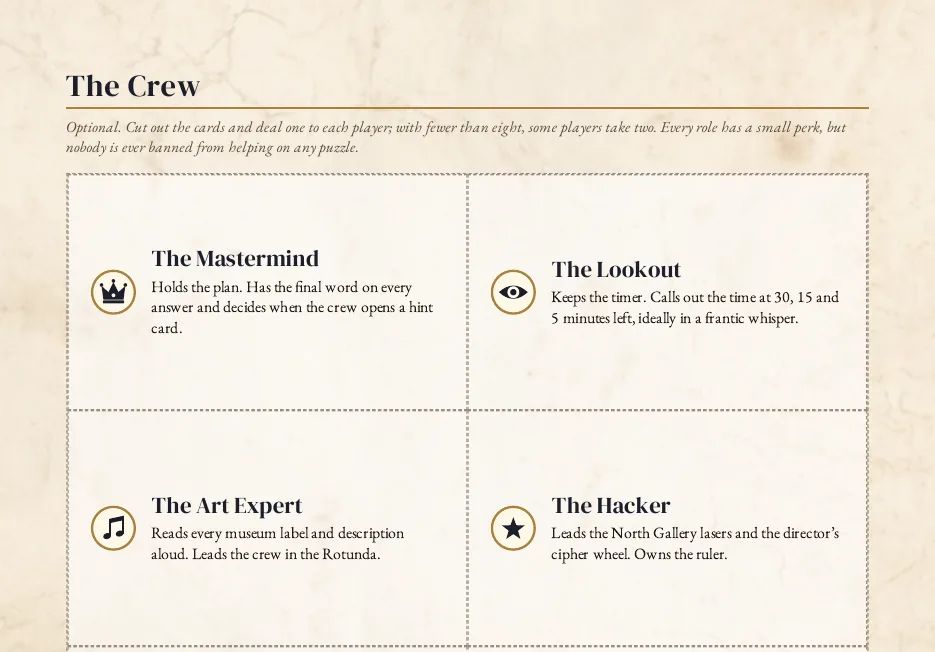
With ten guests, print two copies and race two teams, or hand out jobs, like a timekeeper and someone to read the dramatic letters aloud. Some kits do this for you. The Vesper Heist, a museum heist for 2 to 8 adults, includes optional crew role cards, and each role comes with a small perk, like the Fixer’s one free hint per game.
Try a mini printable escape room tonight
Before you host a full game, run this one at the kitchen table. We wrote it for this article: three printable escape room puzzles, about ten minutes, ages 7 and up. Copy only the puzzle lines below, each onto its own sheet, put the sheets in envelopes 1, 2 and 3, and put a treat in envelope 4. The answers come in a separate block at the end of this section: fold that part away, or don’t print it at all.
The story to read aloud: “Someone has locked the pantry with a three-digit padlock, and the cookies are inside. Each envelope hides one digit. Put them in envelope order to open the lock.”
Envelope 1, the shopping list. Write this list on its own, one item per line:
Flour
Oats
Unsalted butter
Raisins
Add a note at the bottom: “The first digit is hiding in plain sight.”
Envelope 2, the animal sum.“Take the legs of a spider. Take away the wheels of a tricycle. Take away the legs of a dog. What’s left is the second digit.”
Envelope 3, the backwards note. Write the word XIS in big letters and add: “Mirrors and backwards readers welcome.”
Envelope 4 says “Pantry lock” on the front and only opens when the team tells you the right three digits.
For teens or adults, swap envelope 3 for a shifted code: write TJY and add “Every letter took one step forward.”
Hints for envelope 1, as a two-step ladder:
Nudge: “What if this list isn’t really about shopping?”
Push: “Read only the first letter of each line, top to bottom.”
Host only, fold this part away. The shopping list spells FOUR. The animal sum is 8 minus 3 minus 4, which leaves 1. XIS read backwards (or TJY shifted back one letter) is SIX. The pantry code is 4-1-6.
Make your own printable escape room
The mini escape above uses three puzzle types that work on paper with no props. If you want to write a full game for your own family, these five are a reliable kit to build from:
An acrostic hides the answer in the first letters of a list, poem or letter, like the shopping list.
A shift cipher moves every letter the same number of steps along the alphabet. Tell players the direction, and give the number only if you want it easy.
Mirror writing is a word or line written backwards. Leave a hand mirror on the table as a quiet hint.
A logic grid gives three or four suspects, pets or rooms plus a few clues (“The cat isn’t in the kitchen”). The one cell left over is the answer.
A number sum asks players to count things in a picture or the story, then add or subtract. Kids love these, and the result is a digit you can feed straight into a lock.
Write five to seven puzzles, make each answer feed the final lock, and write the two-step hints at the same time as the puzzle, because you won’t think clearly about them on the night. Then test the whole thing on one person who didn’t write it. If they get stuck for more than ten minutes on a single puzzle, rewrite that puzzle rather than adding a hint.
Printing and prep: the checklist
Most printable escape rooms that fail at home fail here. A missing page at minute forty can’t be fixed by improvising.
Two days before
Read the host guide all the way through, including what happens if time runs out.
Pick your version: color for anything players study closely, ink-saver for hint cards and answer sheets.
Print one test page at “actual size” or 100%, not “fit to page”. Anything that has to line up, rotate or be cut out breaks when it’s scaled.
Gather supplies: numbered envelopes (puzzles plus one for the finale), one pencil per two players, scissors, scrap paper, a phone or kitchen timer, and whatever odd item the guide asks for.
On the day
Print everything and count the pages against the contents list.
Cut the hint cards and keep them in a separate envelope by your seat. They never travel with the puzzles.
Stuff and number the envelopes in order. Write the number big on the front.
Keep the answer key folded in your pocket. Players read upside down.
Clear one table, add good light, and set out pencils and scrap paper.
Budget 15 to 20 minutes for all of this, more for your first game. If you’re running several teams, prep one full set per team of 3 to 6.
Turn your living room into an escape room at home
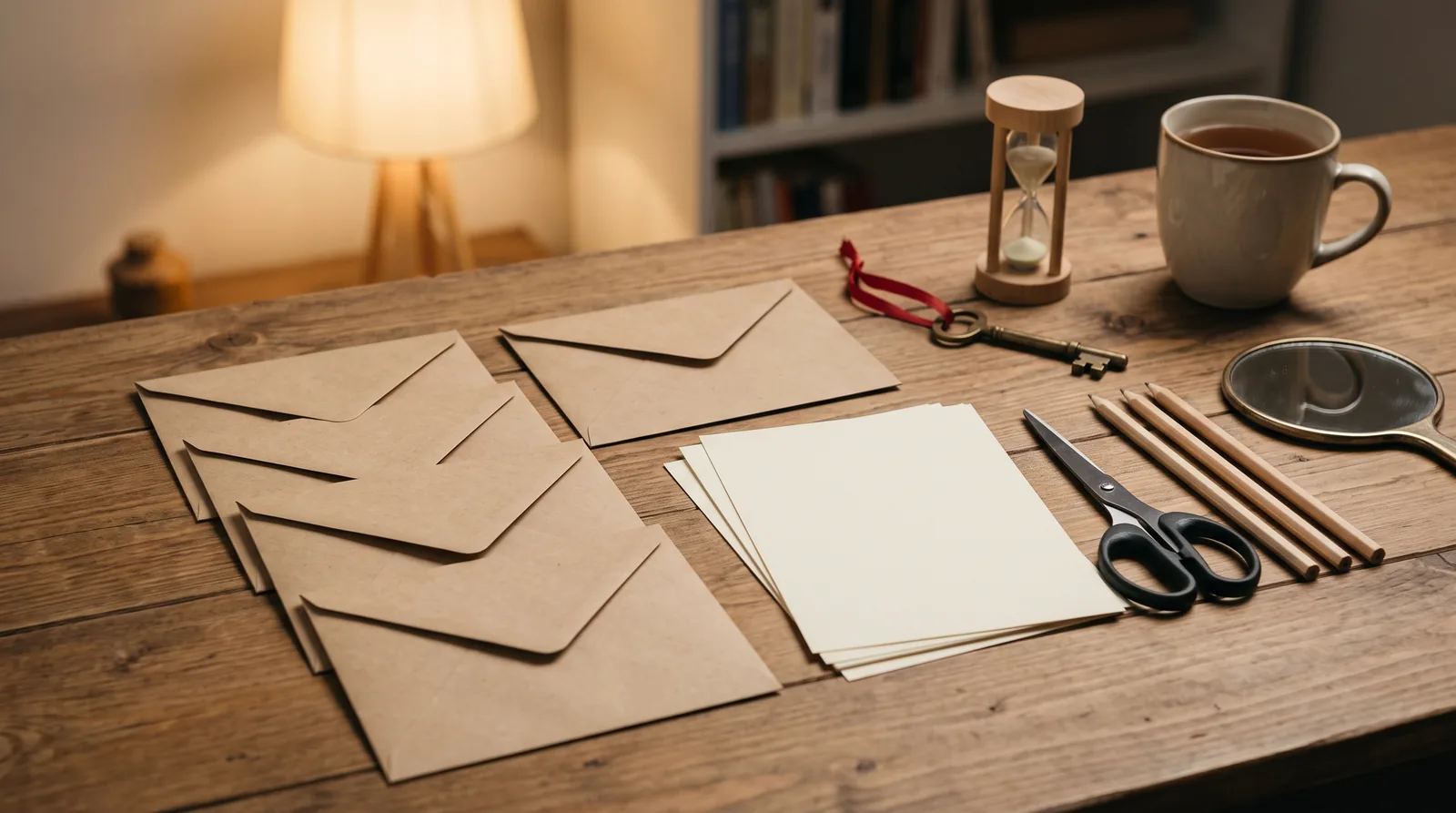
Dim the overhead light and use lamps, with one bright lamp over the puzzle table, and put on a playlist that fits the theme. Add one prop that sells the story, such as an old key on a ribbon in the final envelope, and clear away the rest. Nicholson notes that players will take anything in the room as being important, even when the designer never meant it as a red herring.
If you hide the envelopes around the house, keep it to one room with kids under ten, and write down where everything is.
Running the game: clock, hints and endings
A two-minute briefing
Gather everyone and say something like this before the story:
“Everything you need is on paper. You don’t need to move furniture or take anything apart. Hints are next to me, and asking for one is part of the game.”
Then read the intro aloud, in a voice, and start the timer on the last line. Call the time at 30, 15 and 5 minutes left, in character if you can.
Give first-timers and kids 15 extra minutes or no timer at all. If time runs out and they’re close, let them finish. Good printables include a second ending for teams that run late.
Use two hints per puzzle. The Nudge points at the right place (“Have you looked at the drawing, not just the text?”). The Push names the method but never the answer. If they’re still stuck after the Push, check the answer with them and move on.
Watch the table more than the clock. Offer help when the same wrong answer is tried twice or when phones come out. A workable default is about 5 minutes without progress for kids and about 10 for adults.
Give hints a small price, like two minutes off the clock, and make them free for young children. Never cap the total. A Room Escape Artist reader who ran out of hint coupons described having to wander around helplessly until time ran out.
When you hint, ask instead of telling. “What do these four pictures have in common?” works better than “Count the cats.” When they get it, react as if they did it alone.
Kids, teens, adults and couples
Kids 6 to 12
Before you look for an easier game, change how much help you give. Escapology’s Kids Mode keeps the same room and the same puzzles and changes the support instead: the game master steps in earlier with more guided clues. At home, that means:
Read every puzzle text aloud, so reading speed doesn’t decide who gets to play.
Give each child a job, such as envelope keeper or timer watcher.
Make hints free and offer them sooner.
Keep spooky themes theatrical, never gory, with a lamp on.
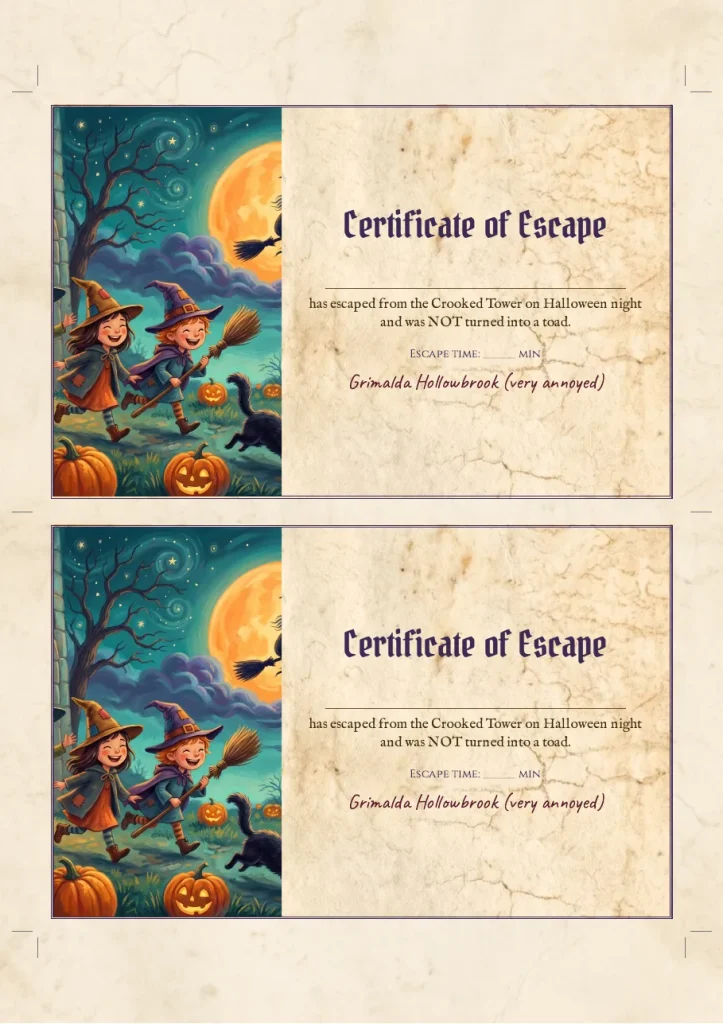
Print certificates at the end.
For October, Escape the Witch’s Tower is built for this age: 2 to 8 players aged 8 and up, 15 minutes of prep, and a grumpy witch who will turn everyone into toads if they’re still in her tower at midnight. Its guide makes hints free for younger players and lets the clock run over, because the witch is late, as usual. For December and children as young as 6, there’s Save Christmas! The Locked Workshop, and our Christmas game night ideas cover what to play before and after it.
Teens and adults
Adults want to feel clever, so hold the hints longer and let them argue. A dress code or a crew name helps. With mixed ages, pair a younger player with an adult on each puzzle and make the child the one who writes the answer down, so the adults can’t simply take over. If your group enjoys the story side more than the locks, a murder mystery is the natural next step, and hosting one uses many of the same habits.
Two players
A game for two has no host and no audience, so it needs a built-in way to check answers and take hints without spoiling anything. Look for a check page. For a date night, The Lost Love Letters of Villa Rosa follows a 1927 love story through a villa above Florence, and its hint rule is half the fun: a Nudge costs two minutes or a sincere compliment, and the partner who didn’t ask picks the price.
The finale and the reset
Give the last lock a moment. Have the team say the final answer out loud together, read the ending in your best voice, then take the team photo. Leave five minutes to talk it through: which puzzle made you feel smartest and which one you hated. Nicholson notes that this kind of shared after-game discussion is what a good escape room creator seeks to generate. If they didn’t escape, walk them through what they missed.
To replay with a new group, keep the PDF and reprint the puzzle pages rather than erasing pencil. Never replay a game for the same people. Make the last group’s winners your assistant hosts instead.
Mistakes that sink a home escape room
Hosting and playing at the same time. Pick one, or choose a game with a check page.
Hinting the answer instead of the method.
Treating the timer as sacred. Let a close team finish.
Leaving the answer key on the counter.
If your game night is this week, copy the mini escape above onto three sheets tonight and run it with whoever is home. Ten minutes will tell you how early your group needs hints and whether to pick an easy or a medium game for the real thing.