Christmas Escape Room for Kids: Ages, Setup, and Hints
A practical plan for ages 6–12, with reading-level adjustments, a host script, hint rules, and a classroom printing example. Keep younger players involved without letting adults solve the game.
,
10 minute read
For a Christmas escape room for kids ages 6–12, start with a cheerful mission, a small team, and a grown-up who handles hints. At home, keep the puzzles at one table for the simplest setup. In a classroom, give each team its own materials so children spend their time solving rather than waiting to see a page.
Choose the game by reading level as well as age. A six-year-old who needs instructions read aloud and a twelve-year-old who loves codes can share a story, but they need different jobs. Give younger children a task they can solve before an older teammate takes over, and pause the timer if it starts causing arguments.
Choose the challenge before you decorate
Before choosing, look at a sample player page if one is available. Check whether your children could read the instructions and keep track of the clues without you. If reading would take most of their effort, plan to read aloud or choose a lighter reading level.
These are hosting suggestions, not developmental benchmarks or promises about every child in an age group:
Players
Start with
Your role
Adjustment to make first
Ages 6–7 or children who want reading support
Picture matching, counting, short instructions
Read aloud without explaining the solution
Keep the timer out of sight and give free hints
Ages 8–9 who read independently
A mix of observation, simple codes, and logic
Ask children to explain their attempts
Hand over one task at a time if the table gets cluttered
Ages 10–12 who enjoy puzzles
Clues that require combining information
Check answers and keep quieter players involved
Ask for a reason before accepting a guess
Mixed ages 6–12
A game with separate difficulty levels, or tasks children can share
Protect the younger children’s turns
Let one child spot evidence and another record it; swap next puzzle
Read the theme description too. Saving a workshop suits a different afternoon from a story about being trapped by a monster. For this age range, choose a problem children can fix without threats aimed at them. Check unfamiliar stories before presenting them to the group.
Math can be one part of the game without becoming the entire afternoon. Think Academy’s Christmas math guide includes counting and shape matching alongside more demanding number tasks. For your own group, alternate number work with observation or a word clue rather than choosing six versions of the same calculation.
Pick a format that fits the afternoon
A printed game works well when you want everyone looking at paper together. A digital game is an option when you cannot print: The Suburban Mom’s Christmas virtual escape room uses Google Forms and is described for elementary-age children playing individually or in teams. Open any digital option on the device and school network you will actually use before promising it to a class.
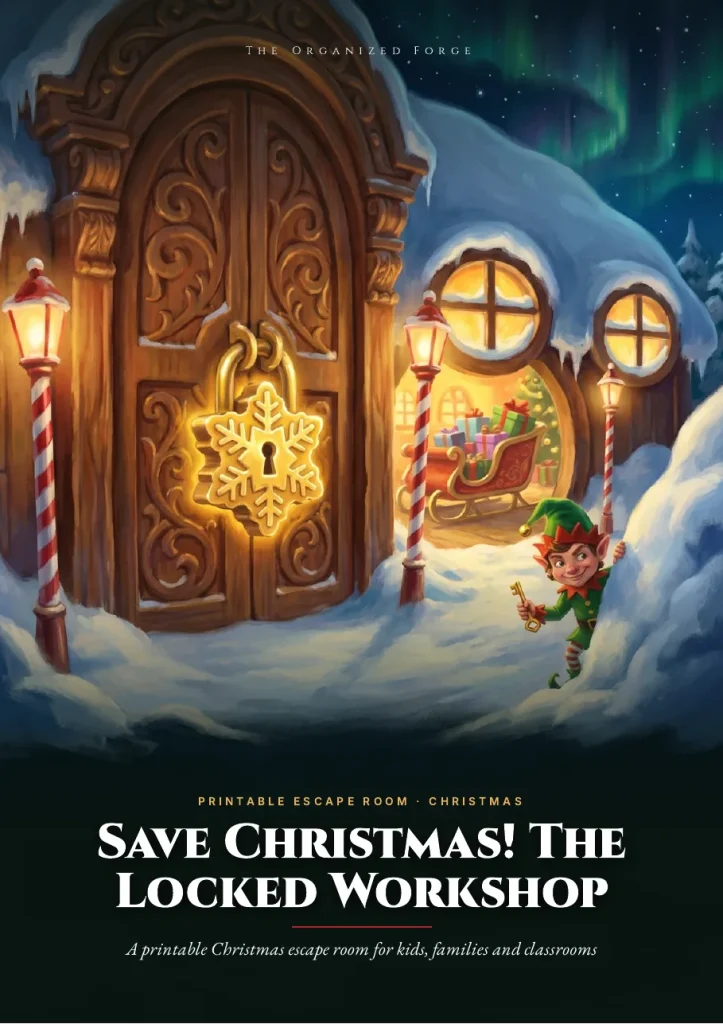
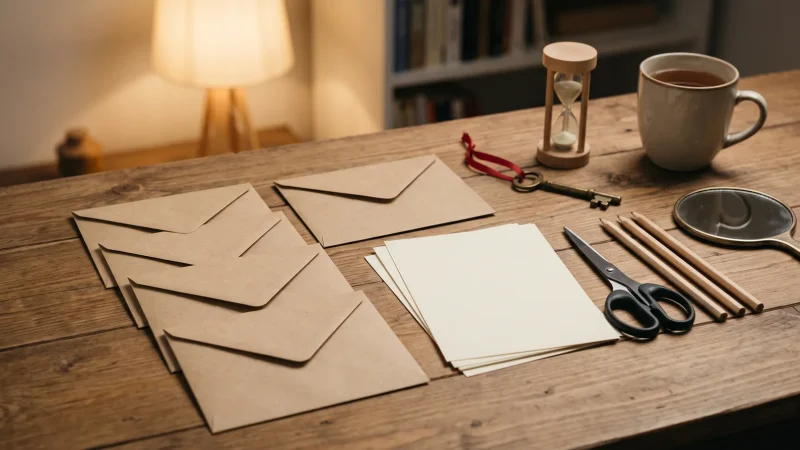
For a ready-made paper game, our Save Christmas! The Locked Workshop is designed for 2–8 children ages 6–12, with grown-up help for younger players. It has seven illustrated puzzles, hint cards, and certificates; the stated play time is 45–60 minutes with about 15 minutes of preparation. That makes it a fit for a family group with an adult available to host. Have eight envelopes, pencils, a small mirror (or phone camera), and a timer ready.
Mixed-age siblings may need more than a different job at the same puzzle. Our Around the World by Midnight has separate Snowflake puzzles for ages 6–7 and Star puzzles for ages 8–11 within the same passport adventure. Allow its stated 45–75 minutes of play and about 20 minutes of prep. Its classroom mode supports up to 30 children in teams rotating between eight country stations. It is an option when younger children need their own version instead of watching an older sibling finish.
For a three-puzzle game you can copy onto paper tonight, plus paper sizes and download checks, use our printable escape room hosting guide. Here, the decisions are about the children: who reads, who gets a turn, and how you help without taking over.
Set up a Christmas escape room for kids at home
Keep your first game in one room. You can add a search around the house later, but hiding every envelope creates another job for the host and another place for children to get stuck.
For a basic envelope-based setup, gather:
The player pages specified by your chosen game, plus a separate host copy of its answers and hints.
Envelopes or folders in the quantity the instructions require.
A pencil for each child and spare paper for working things out.
Any puzzle-specific tools listed in the kit, checked before play.
A timer you can pause, if you decide to use one.
Keep the answer key in a closed folder beside you. Children should not have to sort player pages from adult-only pages. If a PDF contains alternate difficulty levels or paper sizes, select the pages you need rather than printing every file.
Do a private run-through. Solve each puzzle using only the materials players will receive, then check how its answer leads onward. Test any mirror, cutout, or code wheel in advance. A missing piece can look exactly like a difficult puzzle to a child.
Set a clear search boundary if you hide envelopes. Use reachable, visible places away from heaters, fragile ornaments, and electrical cords. Keep doors unlocked and exits clear. A paper workshop door can be locked in the story while the real kitchen door remains open.
Leave enough light to read comfortably. Put snacks on another surface until the game ends; a wet clue sheet is an avoidable plot twist.
Give them the rules before the story
Use this original hosting script with your chosen game’s own introduction. It establishes the table rules without borrowing any product puzzle or answer:
“You are a team. Everyone gets a chance to look before anyone writes an answer. Keep the clues on this table, and ask me before opening the next envelope. You can ask for a hint whenever you need one. Nothing in this room needs to be forced open or taken apart. You can leave the game for a break at any time.”
Then read the game’s story. Show children where completed pages go and how to submit an answer. For an envelope game, have one child explain the team’s reasoning before you release the next envelope.
Rotate the reader and the pencil after each puzzle. A child who dislikes reading aloud can point to evidence, check a pattern, or carry the completed page to the host. Let children take part without reading aloud.
For a mixed-age team, tell the older child: “Ask what your teammate noticed before you explain your idea.” If they already know the answer, ask them to hold it while the younger child tries. Giving a younger sibling permanent responsibility for carrying envelopes does not give them much of a puzzle game.
Use hints before frustration takes over
Watch for a change in behavior instead of waiting for a set number of minutes. Children who are comparing clues are still working. Children repeating the same guess, pushing the paper away, or arguing about whose fault it is need help.
Try this sequence, written for hosting rather than for any particular kit:
Ask, “Show me what you’ve tried.” You may discover a misunderstood instruction rather than a hard puzzle.
Point to the relevant part of the page: “Read this instruction again together.”
Offer a method without the answer: “Could you mark the ones you’ve already checked?”
If needed, demonstrate one part and let the children finish the rest.
When a kit supplies hints, use its gentler hint first. For younger players, start with free hints. If the game offers optional time penalties, leave them off unless your group actively wants that rule.
Adult helpers need a rule too: ask before touching a player’s pencil. “Would you like me to read it?” gives the child a choice. Silently writing the answer ends their turn.
For children who prefer a quieter setup, lower the music or turn it off, explain the sequence before starting, and make a break seat available. Read instructions aloud on request. Check whether any clue depends on distinguishing colors before choosing a printer-friendly version. These are options to discuss with the child or caregiver, not a substitute for their individual support needs.
Reserve enough time for the ending
Use the following as a sample 75-minute family-party slot for a game advertised at 45–60 minutes. It is a suggested schedule, not a claim that every group will finish on cue.
Minutes
What you do
0–5
Seat the team, explain boundaries, and assign the first reader
5–10
Read the story and show how hints and answer checks work
10–55
Host the puzzles; rotate jobs and offer help when progress stalls
55–65
Give more direct help if needed and reach the finale
65–75
Read the ending, give certificates if supplied, and clear the table
If a game lists up to 75 minutes of play, reserve a longer slot or use a split-session option the instructions support. Do not squeeze it into this schedule by skipping random puzzles: a later answer may depend on them.
Keep the clock optional. You can say, “We’ll see how far we get before the bell,” without making the children responsible for Christmas disappearing if they miss a deadline. If your group becomes distressed by a countdown, turn it away or stop it.
At the scheduled end, help them complete the mission or follow the game’s alternate ending. Save the final few minutes for closure rather than announcing cleanup in the middle of the last clue.
In a classroom, duplicate the materials before the decorations
For a seated classroom game, start with teams of three to five and a separate player set per team, subject to the game’s instructions and permitted use. Keep one shared answer-checking point at your desk.
For 24 children in teams of four, plan six player sets, provided the kit’s classroom mode and copying terms allow this setup. Team sets, individual passports, and shared station materials are different print jobs.
Put a team name on each folder and use matching trays for finished pages. Ask teams to raise a hand for a hint instead of forming a queue around your answer key. If several teams can reach the same puzzle together, have the relevant hint ready to give quietly at their desks.
Station play needs its own plan. Follow a kit’s route and rotation instructions when supplied; sending every team to the first station at once creates a line. Avoid inventing a rotation for a game whose puzzles must be solved in order.
Give early finishers a quiet task that cannot reveal answers: draw a team badge or write a thank-you note to a character. Ask them to keep completed clues inside their folder. Shouting the answer across the room is remarkably efficient at ending everyone else’s game.
For a school party, confirm that the Christmas theme fits your setting and the children attending. A Nativity activity belongs in an explicitly faith-based session; a Santa story should not be treated as a theme every family shares.
Fix the problem you can see
What happens
Change during play
One child answers everything
Let that child listen while another explains the next idea; rotate the pencil
The group cannot read the instructions
Read them aloud exactly, then ask a child to describe the task
Children search drawers instead of solving
Restate the boundary and return all active materials to the table
A correct answer is rejected online
Check the required answer format before treating it as a reasoning error
Children argue over the timer
Pause it and continue cooperatively
A team finishes early in class
Give a quiet drawing task and keep its solved pages out of sight
The online-format issue is worth checking in advance. In the comments on The Suburban Mom’s virtual game, the creator specifically points readers to the required response format, such as a written number versus a digit. Read the instructions with the child before supplying another solution.
If your group mainly wants to move around and find things, a Christmas scavenger hunt may fit better. You can use one as a separate activity without stretching a puzzle game into a search it was not designed to be.
Before the children arrive
Print the selected player pages, prepare the envelopes in the order the game specifies, and put adult-only material in your host folder. Check your tools and decide where children may search. Choose whether the clock will be visible.
Read the opening script once and mark the finale in your host copy. When the children sit down, you should be able to explain the mission without looking for a missing page.