Christmas Scavenger Hunt Ideas for Teens, Adults and Groups
Five ways to run a Christmas scavenger hunt for teens and adults, with eight original riddles, a lights checklist for the neighborhood and real prep times.
,
10 minute read
The Christmas scavenger hunt ideas that work for teens and adults come in five shapes: a riddle trail through the house, a team photo and video hunt, a 15-minute find-it race, a Christmas lights hunt around the neighborhood, and a bigger team version for the office or a 30-person party. Pick the shape first, then the clues. A riddle trail needs a quiet house and one or two teams, while a lights hunt needs warm coats or a car and nothing else.
Christmas scavenger hunt ideas, sorted by who is playing
Your group
Best hunt
Teams
Play time
Prep
Teens (13-17) at home
Photo and video hunt, or teens vs. adults riddle race
2-4 teams of 3-4
45-60 min
25 min (photo hunt)
Adult friends at a party
Photo hunt, or a hard riddle trail
Teams of 3-5
45-60 min
25 min (photo hunt) to 1.5 hours (riddles)
Mixed family, ages 6 to 80
Riddle trail with two difficulty levels, mixed teams
2 teams
30-45 min
About 2 hours (15-20 min with a printable)
A couple or two players
Short riddle trail ending at a small gift
1
20-30 min
About 1 hour
Any age, out of the house
Christmas lights scavenger hunt, by car or on foot
1 car or walking groups
30-45 min
25 min
Office or 20+ guests
Team photo hunt plus find-it stations
Teams of 4-6
30-45 min
1.5-2.5 hours
After dinner, zero prep
Find-it race
2-6 teams
15 min
5 min
Teams of three or four keep everyone busy; at six, two people end up holding coats. The office is the exception: with 20+ players, go to four to six. Set a hard end time before you start: once a hunt runs past the hour, people drift off.
1. A riddle trail through the house
Each clue is a short riddle that names a place in the house. Players solve it, go there, find the next card, and the last card leads to a prize or a gathering point. For a Christmas scavenger hunt for adults or teens, aim for 10 to 15 stops: fewer feels thin, more and the last third becomes a slog.
How to build one without losing track:
Walk the house and list 12 hiding spots in a sensible route, upstairs and downstairs mixed (or opposite ends of the apartment). For two teams, see the loop setup below.
Write a riddle for each spot. The riddle for spot 4 goes on the card you hide at spot 3, and the card at spot 12 sends players to the prize. That makes 13 cards for 12 spots.
Number the cards on the back in pencil with the spot where they go, and keep a master list with spot, riddle and card number.
Hide them in reverse order, starting with the card at spot 12 and ending with spot 1. The card with the riddle for spot 1 you hand out yourself.
Walk the trail once in order before anyone arrives. You will find at least one card that fell behind a radiator.
For two teams on one trail, use a loop instead of a line. Hide two colored sets of cards in the same 12 spots: red runs from spot 1 to spot 12, green starts at spot 7, goes to 12, then carries on from 1 to 6. Both teams cover the whole house while staying roughly half a trail apart, and the last card of each color sends them back to you.
Writing 12 riddles takes about an hour, and hiding the cards and walking the trail another 20 to 30 minutes. Write them the week before and hide them half an hour before guests arrive.
When a team is stuck, the first hint is the first letter of the place.
Christmas scavenger hunt riddles to use tonight
We wrote these for this article. The first four are easy; the last four are harder, with less obvious places and a double meaning or two, for adults and teens who like a puzzle.
Easier:
“Report cards, menus, a photo from the beach: I hold them on my door with a magnet each.”
“Under the branches, round and flat, I catch the needles and the cat.”
“When cookies come out hot and new, I take the heat instead of you.”
“I’ve got four legs but no feet, and every night you gather round me to eat.”
Harder:
“Six coats at once and I never leave the hall; by Christmas Eve you can’t see me at all.”
“I rule the room without a vote, I wear more buttons than your coat, and when the movie’s done each night, I slip away and start a fight.”
“Batteries, rubber bands, a key that fits no door: every house has one of me, and no one knows what I’m for.”
“Muddy boots tramp across me all day, yet ‘welcome’ is the only word I say.”
Answers, in order: the fridge door (slip the card under a magnet on the outside), the tree skirt, the oven mitt (on its hook, with the oven off), the dining table, the coat rack (tuck the card in among the coats), the TV remote (tape the card to its back), the junk drawer, the doormat.
To make any riddle harder, drop the rhyme that gives the answer away or add a double meaning (“I rule the room without a vote”). For a last twist, give each card one letter of a password that teams must assemble before they can claim the prize.
For a mixed group, write each stop twice: an easy version and a hard version leading to the same place. Give the teens and adults the hard set, the younger cousins the easy one, and race them. Our Christmas Scavenger Hunt for Teens & Adults is built on that idea: 15 rhyming riddles in a Classic and an Expert level that share the same hiding spots, plus blank editable cards for spots of your own. With the clues already written, prep drops to the 15 to 20 minutes it takes to print, cut and hide.
2. A photo and video hunt in teams
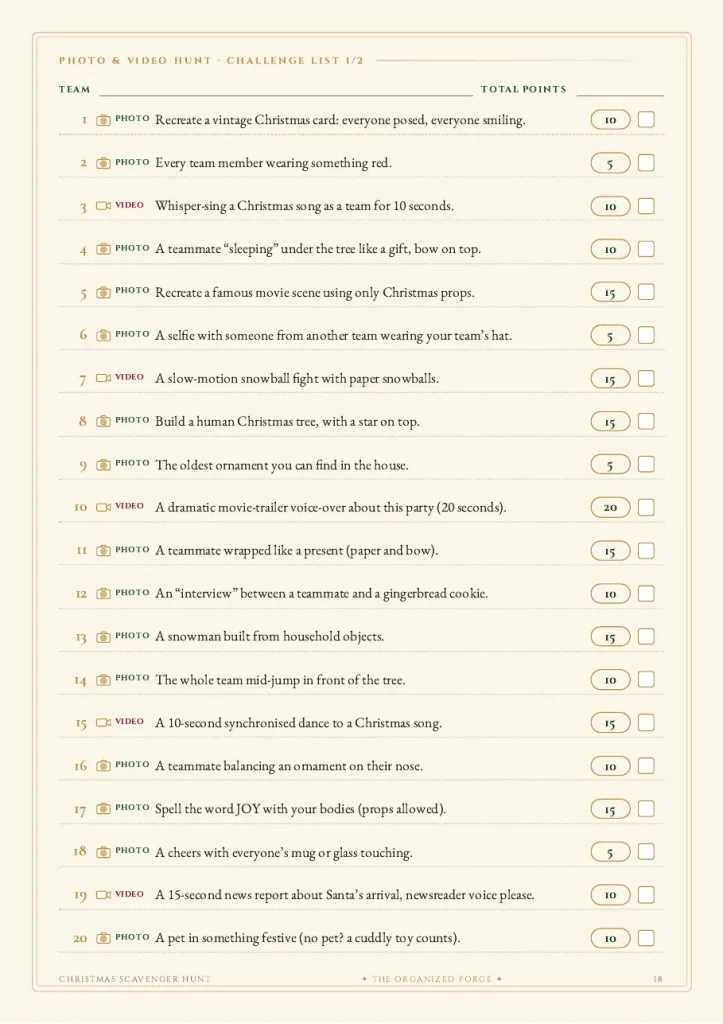
This is the one that gets loud. Teams get a list of challenges worth points, one phone per team, and 45 to 60 minutes. Everything is photographed or filmed, then the whole party watches the results on the TV while a judge awards points.
House rules that keep it fair:
Points from 5 to 20 depending on effort, so teams have to choose.
Teams return by the deadline. Every minute late costs 5 points.
Every person in a photo has to agree to be in it, and nothing gets posted online without everyone’s OK. This matters more with teens.
Writing and balancing a list of 20 to 30 challenges takes about 20 minutes; print one copy per team. A starter list of eight:
A photo that looks like a snowstorm, with no real snow (5)
A Christmas sweater worn by as many teammates at once as it will hold (10)
A 10-second silent movie: someone discovers the last cookie is gone (10)
A cooking show segment explaining how to open a candy cane wrapper (15)
The oldest person at the party teaching the team a dance move (15)
A crime-scene photo of a toppled snowman figurine, with evidence markers made from sticky notes (10)
The cover of a Christmas album your team would never release, title written on a napkin (15)
A 15-second ad for a useless Christmas gadget made from kitchen tools (20)
If you would rather not write your own, the printable has 40 challenges from 5 to 20 points (the first page is above) and a fillable score sheet.
3. A find-it race when you have 15 minutes
The fastest format: each team gets the same list of 12 to 15 things that should be somewhere in the house, and 15 minutes. One point per item brought back or photographed if it can’t be moved. We covered the basic version in our Christmas game night ideas, so here is a tougher list built on descriptions instead of objects. Copying it onto a sheet per team takes five minutes.
Something that would survive a fall from the roof
A word written in a language nobody at the party speaks
Something red smaller than a thumbnail
A receipt from December
Something that was a gift last year
A lid without its container
A pen that doesn’t write
Something you could wear as a hat in an emergency
A button that has come off something
A food label with an expiration date that has already passed
Something with the name of a city printed on it
Something shaped like the first letter of your team name
A number higher than 1,000 printed on anything
Something that bends without breaking
Descriptions start arguments (“does a colander count as a hat?”), so name a judge before the timer starts and make their ruling final.
4. A Christmas lights scavenger hunt in the neighborhood
Families drive or walk past decorated houses after dark and tick off what they spot. It works for every age and needs no hiding.
Copy this onto a clipboard and score as you go.
Common (1 point each):
A wreath on a front door
Icicle lights along a roof line
A lit-up snowman, inflatable or wire
A tree in the yard wrapped in lights
Candy-cane stakes lining a path
A candle (real or electric) in a window
Harder to spot (2 points each):
An inflatable taller than the front door
A reindeer that moves its head
Snowflakes projected on a wall
A lit archway or tunnel over a path
A nativity scene
A Santa on a roof or climbing a ladder
Rare (3 points each):
A display with lights timed to music
A dog wearing a light-up collar
A front door wrapped like a present
One lone string of lights that has given up
A house with more inflatables than windows
By car, the driver never holds the list. One passenger is the navigator and scorekeeper, everyone else calls out what they see, and the first person to call an item gets the point. Plan a 30- to 45-minute loop in advance so nobody is reading a map at a crossroads. Copying the checklist takes ten minutes and planning the route about fifteen; drive the main streets the night before to check they are lit.
On foot, stay on the sidewalk and look from there: lawns and driveways are people’s homes. NHTSA’s pedestrian safety tips say to walk facing traffic where there is no sidewalk, and that children under 10 should not cross a street alone. Bring a flashlight per group. With teens walking without an adult, agree on a route, a group of at least three, and a fixed time to be back.
5. The office or big-party version
With 20 or more people, one trail through one house falls apart: teams queue at the same drawer. Switch to the team photo hunt (minus anything that needs a Christmas tree in the room) plus a few find-it “stations” on tables, where each team gets two minutes to find five things in a tray of clutter.
At work, mix teams of four to six across departments, keep the hunt in shared spaces (desks and drawers are off-limits), and drop anything involving alcohol or touching colleagues (so skip the sweater challenge). Anyone who would rather not run gets a real job, like judging or playing the photos on the big screen. Cap it at 45 minutes. Results go up on the screen while the food comes out.
Writing it all takes one to two hours, setting up the stations another 30 minutes. Book the room and announce the teams a week ahead.
For a remote team, run the find-it race on a video call: the host reads one item at a time from the section 3 list, and the first person to hold it up to the camera within 60 seconds scores.
Where to hide the cards when the players are grown-ups
Adults and teens search fast and know the usual spots. Hide where things belong, so the card looks like part of the house:
Inside the sleeve of a coat on the hook
Taped under a dining chair seat
In the cookbook, at the page with the Christmas cookie recipe
Inside an empty ornament box in the decorations stash
Rolled inside a tube of wrapping paper
Under the bathroom scale
Where not to hide anything: inside appliances that someone might switch on (tape the card to the outside of the washer or microwave instead), near heaters, and anywhere near candles or tucked in among the tree lights. The NFPA reports that in December candles started 49% of home decoration fires, and a paper clue on the mantel is exactly the kind of thing that ends up next to one. Nothing that needs a chair to reach, either. Close any room that is off-limits with a sticky note on the door.
Adapting a Christmas scavenger hunt for age and group size
A Christmas scavenger hunt for teens works when it gives them something the adults would struggle with. Let them run the phone in the photo hunt or put them against the adults in a riddle race. Older teens can also design a short hunt for the grown-ups.
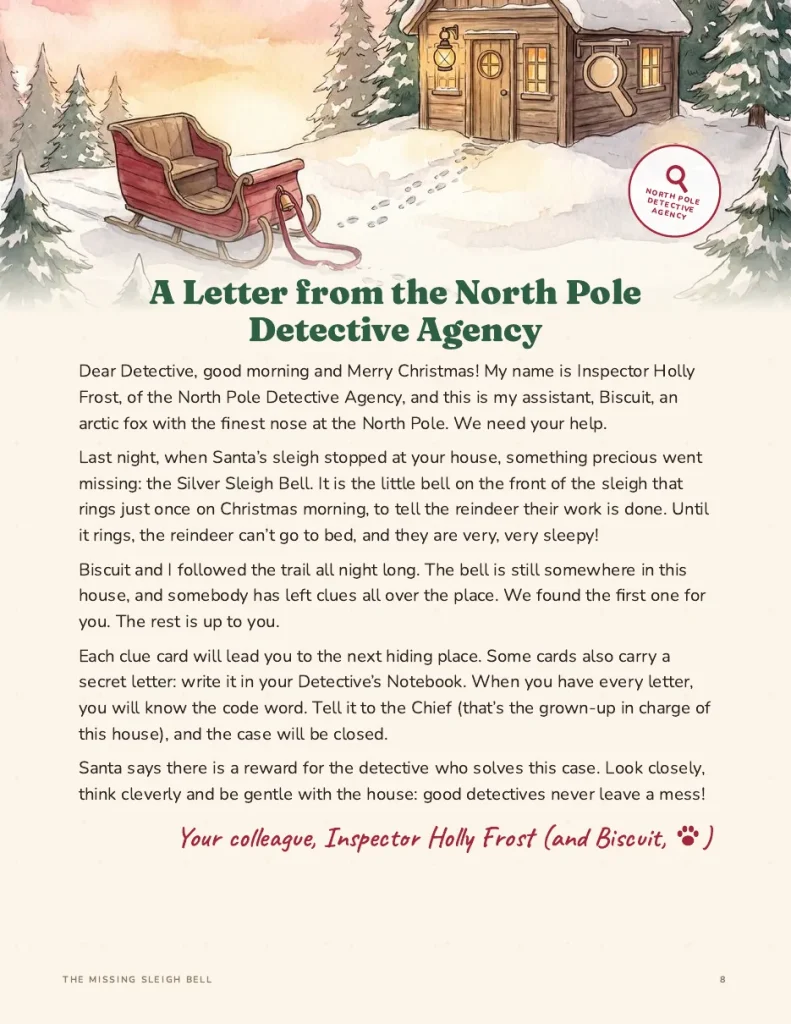
For a family with small children and teenagers, run two trails at once in different parts of the house, or give the little ones their own short hunt with picture clues while the older ones tackle riddles. For children from 4 up, The Case of the Missing Sleigh Bell does this in one download: a letter from Inspector Holly Frost sets up the case, and three levels (picture clues for ages 4 to 6, rhyming riddles for 7 to 10, a secret code on every card for 11 to grown-up) each have 12 cards and run from about 15 to 45 minutes.
For two players, keep it to eight stops with riddles about shared jokes. A Christmas morning hunt built around one present is a separate design problem.
Christmas scavenger hunt prizes that keep it friendly
Prizes should be small and a little bit ridiculous. Big prizes make adults competitive in a way that sours the evening.
First pick from the gift pile, or first slice of dessert
A night off dish duty
Control of the TV remote for the rest of the evening
A trophy: a spray-painted gold ornament on a jam jar, handed down every year
For the office, a team breakfast or the right to choose the next team lunch spot
Give the losing teams something too, even a candy cane each, or a printed certificate with the team name and finishing time.
Three mistakes that stall a hunt, and the fix for each
A card disappears mid-trail. Someone tidied it away, and the team is stuck at spot 6. Keep the master list and a few blank cards in your pocket to rewrite the missing riddle in a minute.
One player solves everything. The fastest reader grabs every card and the others just follow. Rotate the card: a different player reads it aloud at each stop, and the reader can’t be the one who names the answer.
A team stalls on one riddle and goes quiet. For a cryptic riddle, the first letter isn’t always enough. After five more minutes, name the room. After ten, walk them there and let them do the searching.
If you are hosting this week, pick the format from the table at the top and copy the riddles or the lights checklist onto paper tonight. If the adults want a full evening of puzzles rather than a hunt, a printable escape room at home or a Christmas murder mystery party is the next step up.