
Planning & Productivity
Gamify Your 2027 Goals: Turn Your Year Into a Real-Life Quest
Turn your 2027 goals into quests with XP, levels, boss battles and weekly reviews, plus what the research really says about gamifying your life.
Christmas game night ideas organized by who you are actually hosting: little kids, teens, grandparents, coworkers or adults-only, plus a prep timeline and a printing checklist.
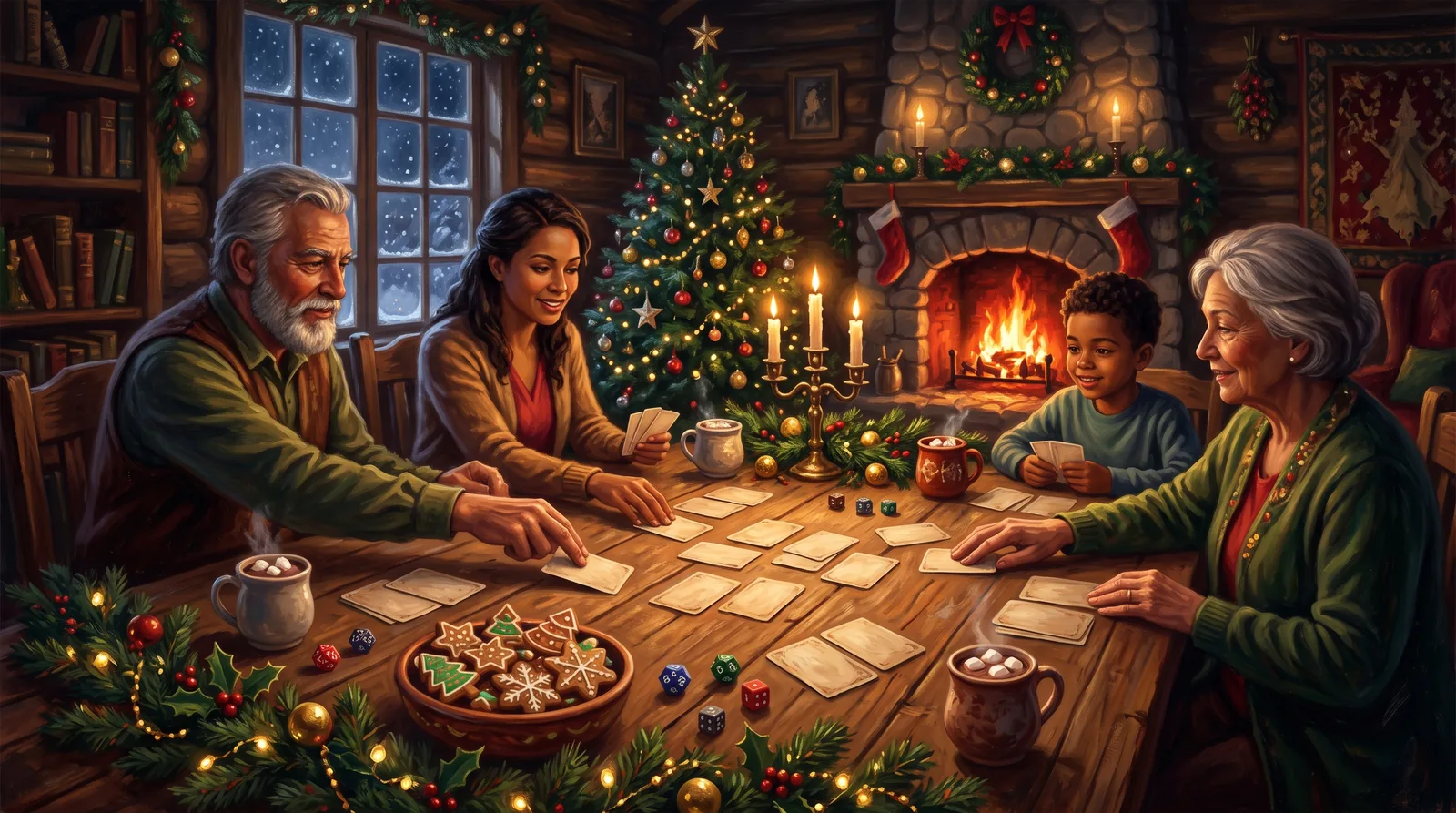
Every December the same thing happens. Someone volunteers to “just organize a few games,” and three weeks later they are standing in a living room full of people aged six to eighty-six, holding a stack of trivia questions that only half the room can answer, while the teenagers quietly migrate to the stairs.
The games were fine. The match between game and group was not.
This guide is built the other way around. Instead of a list of fifty random games, you get ideas organized by the people you are actually hosting: families with small kids, teens, mixed generations, office parties, adults-only nights, and the long game of December advent activities. Then we cover timing, printing, and the small inclusive choices that decide whether everyone has a good night or just the loudest three people.
It is October. That is exactly the right time to read this.
Before you choose anything, answer three questions about the evening:
That last one matters more than it sounds. The holidays already come with plenty of pressure: in the American Psychiatric Association’s 2024 holiday poll, 28% of Americans said they felt more holiday stress than the year before, and 35% named challenging family dynamics as a worry. The same poll found that 41% were looking forward to seeing family and friends. Your game night should feed that second number, not the first. That means a plan simple enough that you get to enjoy it too.
The best Christmas game is not the cleverest one. It is the one where the quietest person at the table laughs out loud at least once.
Printable games make December easier, but only if the printing happens before the week of the party. Here is the rhythm we recommend:
| When | What to do |
|---|---|
| Early November | Pick your format for each gathering on your calendar. Anything that runs from December 1 (advent activities) must be chosen now. |
| Mid-November | Print, cut and test. Play one round with your household to catch confusing rules. |
| Last week of November | Assemble kits: one envelope or zip bag per game, labeled, with pencils and any props. |
| Week of the party | Send invitations or character info if your game needs them. Buy prizes. |
| Day of | Set out the first game before guests arrive, so the room already says “we are playing tonight.” |
Two weeks of buffer sounds excessive until your printer runs out of cyan on December 18.
Small children are wonderful players with one firm limit: attention. A common rule of thumb from child development specialists puts focused attention at around 8 to 12 minutes for 4-year-olds and 12 to 18 minutes for 5 to 6-year-olds. Every child is different, but the lesson for hosts is clear: plan several short games, not one long one, and end each game while the kids still want more.
What works at this age:
Keep prizes tiny and plentiful: a candy cane, first pick from the cookie plate, or the right to choose the next game. That last one is gold, because it makes winning about power, not stuff.
If you would rather not assemble all of that yourself, our Christmas Party Games Mega Bundle puts eleven printable games in one matching set, from picture bingo with 30 unique cards to charades in three difficulty levels and a read-aloud left-right gift exchange, and it even includes a suggested party flow from warm-up to grand finale.
Some of the best Christmas games are not played in one evening at all. A daily advent activity gives kids a reason to run to the kitchen every morning, and it gives you a ten-minute ritual instead of another big event to plan.
A few ways to run one:
Borrow a little folklore while you are at it. In Iceland, the thirteen Yule Lads arrive one per night starting on December 12, each one a trickster with his own particular mischief. A “visitor a night” countdown from the twelfth is a great structure if a full 24 days feels like too much.
The single most important tip: build in forgiveness. You will miss a day. Everyone does. Decide now that a missed day simply means two pages tomorrow, and nobody feels guilty.
For kids aged 5 to 10, The Missing Reindeer turns this into a 24-day mystery: Pip, the youngest reindeer at the North Pole, has vanished, and each day brings a short story chapter plus a puzzle or a fun activity, with a Detective Board of six elf suspects that lives on the fridge all month. It only needs 10 to 15 minutes a day, but it does need to be printed before December 1.

Teenagers are not anti-game. They are anti-cringe. The fastest way to lose them is to hand them a game obviously designed for their seven-year-old cousin, or to force them to perform in front of adults they barely know.
What tends to land:
The secret weapon is giving teens a role instead of a turn. Make one the official scorekeeper, one the timekeeper, and one the photographer or DJ. Teens who will not play charades will happily run the charades, and ten minutes later they are usually playing anyway.
This is the hardest group to host and the most rewarding one. Your youngest player might be six and your oldest might have trouble hearing the table across a noisy room. A few rules make it work:
Cooperative formats shine here. A family mystery is a great example: everyone plays a character, clues come out in rounds, and the whole table works on the puzzle together.
Our Who Stole the Golden Star? is built exactly for this: a cozy Christmas Eve mystery for 4 to 8 players aged 8 and up, where the family’s beloved Golden Star vanishes from the mantelpiece before it can go on the tree. There is no murder and nothing scary, younger players can team up with a grown-up “detective partner” who helps them read, and the whole thing runs about an hour and a half to two hours.
Work parties have a different job: they signal how the team treats people. The goal is a game that lets colleagues who rarely talk discover they are both secretly ruthless at trivia, without making anyone uncomfortable.
The guidance from Great Place To Work is a useful compass. Their advisors recommend focusing the party on the team and its year rather than on a specific holiday (“be holiday neutral; your company doesn’t have to be the bearer of Christmas”), not centering the event on alcohol, offering quieter spaces away from the crowd, and planning properly for remote colleagues, for example with breakout rooms.
In practice, for games:
A murder mystery is a surprisingly good office format, because it hands everyone a character to hide behind. Shy people find it much easier to be “the IT Manager who speaks fluent sarcasm” than to be themselves at a party.

That is the idea behind Season’s Grievings, our office party murder mystery: the CEO raises a toast at the company’s rooftop holiday party, begins “And now, about the merger…” and collapses. It handles 8 to 20 guests, or up to 40 when characters play as duos, keeps the humor office-friendly with no gore, and includes tips for running it on a video call.
With no kids and no HR policy in the room, you can turn up the competition and the theatre:
Even with adults, keep an eye on pacing. Play the most demanding game first, while people are sharp, and save the silly, low-effort game for after dessert.
Printable games are cheap, fast and customizable. They are also excellent at going wrong at 11 p.m. the night before. Our prep checklist:
Inclusion at a game night is mostly about small, invisible decisions:
Write down every December gathering you are hosting or helping with. Next to each, note the youngest and oldest guest and the real game time you have. That one page will tell you more about which games to choose than any list could.
Then print early, cut the night before, and keep a candy cane in your pocket for the first person who laughs too hard to finish their charades. Show up to the table prepared, and you get to enjoy the night too.
Planning & Productivity
Turn your 2027 goals into quests with XP, levels, boss battles and weekly reviews, plus what the research really says about gamifying your life.
GM Craft
Your players are not afraid of your monster. Here is how to build real dread in a single session: visible clocks, the rule of escalation, sensory description, safety tools and endings that linger.

Murder Mystery Hosting
Choosing a game for your group size, casting on purpose, a timed run of the evening, food that keeps you out of the kitchen and a reveal your guests will talk about for weeks.