
Murder Mystery Hosting
Christmas Murder Mystery Party for Adults: How to Plan It
Format by headcount, five settings for grown-ups, a December timeline with a ready save-the-date, and a dinner schedule built around the rounds.
How many guests to invite, a planning timeline that starts four weeks out, three ways to fit dinner into the rounds, and how to run the reveal.

To host a murder mystery party, pick a game written for your exact headcount, send each guest a character invitation one to two weeks ahead, and print and sort everything the day before. On party night, run three rounds of 30 to 40 minutes around dinner, collect written accusations and read the solution last.
No spoilers for any game below, ours included.
| Question | Short answer |
|---|---|
| How many guests? | 6 to 8 is the easiest first party. Exactly 4 works with a host-free dinner game; 8 to 16 needs a kit with optional roles. |
| How long does it take? | Most printable kits play in 2 to 3 hours. Add 20 minutes for arrivals and 15 for the reveal, so block out about 3 hours, 3.5 if dinner runs long. |
| How far ahead should I plan? | Pick the game 3 to 4 weeks out, send character invitations 1 to 2 weeks out, print the day before. |
| When do we eat? | During the game. Round 1 over drinks and appetizers, the main course with Round 2, dessert after the reveal. |
| Do I have to play? | No. Many kits let the host take a character, but if you are cooking, just host. |
Most printable kits share the same shape. Each guest plays a suspect, and one of them is secretly the murderer. Play runs in rounds. Each round, guests get new information about their character: what they saw and what they must now admit. Clue cards go on the table and people question each other. At the end everyone writes down an accusation and the host reads the solution.
The rule to say out loud at the start: everyone may lie about anything, except what their booklet tells them to reveal. That line makes the game solvable. Innocent people get to be shifty, and the truth still leaks out round by round.
Your job as host is to keep time and keep the solution sealed until the end, not to be the cleverest person at the table.
Most hosts pick a theme first and then try to bend the guest list to fit. Do it the other way around. As Mystery Enterprises points out, a game written for twelve played by eight leaves clues pointing at suspects who don’t exist. Treat the player count as a requirement.
Count the yeses, not the invites, and plan for one late cancellation. Then match the format to the number:
| Guests | Format that works | Why |
|---|---|---|
| 2 to 6, would rather solve than act | A cold case or evidence-file game | Everyone plays detective together; no acting needed |
| Exactly 4 | A host-free dinner game | Sealed envelopes run the evening, so nobody sits out |
| 6 to 8 | A classic character party | Every role matters and the table stays in one conversation |
| 8 to 12 | A kit with core and optional roles | You can add or drop guests without breaking the plot |
| 13 to 16 | A large-cast kit, or pair guests on one character | Two people sharing a role keeps the cast inside the game’s limit |
For exactly four, the envelope format is what lets the host play too. In A Vintage for Murder, set at a 1962 Tuscan harvest dinner, three sealed envelopes run the evening course by course and a fourth holds the truth.
If your crowd likes puzzles more than performing, a printable escape room may suit them better than a character game. If they love dressing up, read on.
Two practical details matter more than the theme.
First, look for a scalable cast. Good kits tell you which characters are essential and which you can drop. Murder at the Friendsgiving Feast has six core characters who carry the evidence and six optional ones added in a fixed order, so it plays with anywhere from six to twelve. For a big December group, Murder at Hollyfield Manor works the same way with eight core roles and up to sixteen guests. That structure is what saves your evening when someone drops out the morning of the party.
Second, decide whether you’re playing or hosting. If you play, take a character the host guide confirms is safe for the host, and leave the solution in its envelope until the end.
The UK shop Murder Mystery Store puts it well in its advice for first-time hosts: a month of preparation is ideal, two to three weeks is comfortable, and three days is still doable. Here is how a comfortable version breaks down.
| When | What to do |
|---|---|
| 3 to 4 weeks out | Pick the game and the date. Send a save-the-date that says clearly it’s a murder mystery, with the start time, dress code and an RSVP deadline. |
| 10 to 14 days out | Confirm the headcount and send character invitations. |
| 1 week out | Plan the menu and the playlist; ask about allergies if you haven’t. |
| 2 to 3 days out | Send a reminder with arrival time, parking and anything guests should bring. |
| The day before | Print, cut and sort everything (checklist below). |
| On the day | Set the table and lay out the envelopes (30 to 45 minutes) before you start cooking. |
On character invitations, Night of Mystery recommends sending them at least a week in advance, two if you can, so guests have time to plan a costume. Keep the invitation short: a name, a one-line personality and a costume idea built from clothes people already own. “A flannel shirt, a flour-dusted apron, a rolling pin” is a costume anyone can assemble in ten minutes.
Don’t send secrets in advance. In most kits the booklets stay with you until the night, and a guest who reads ahead can spoil things by accident.
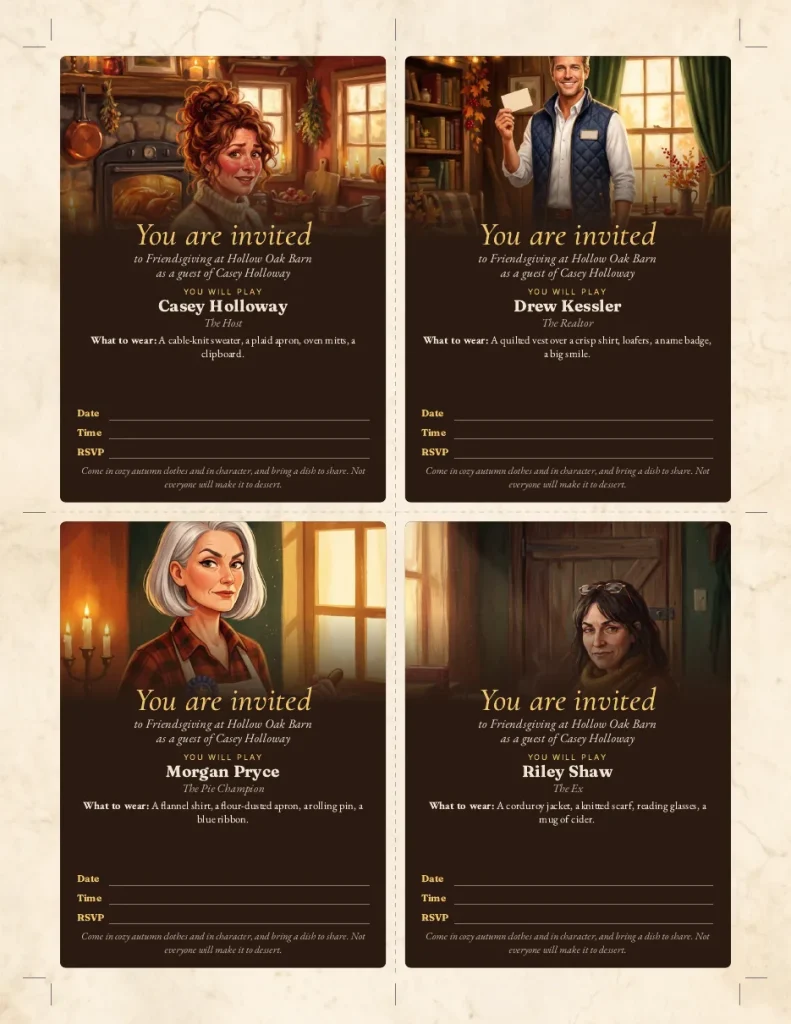
You know your friends better than any kit does, so use that. In the Friendsgiving kit, hand the Pie Champion to the friend who already argues about crust; give the Plus-One to the one who listens.
Put one line in every invitation: Nobody has to do a voice. Reading your lines counts.
Food is where most first-time hosts get stuck. The trap is an ambitious four-course menu: you vanish into the kitchen during Round 2 and miss half the revelations. Pick one of three formats before you plan the menu.
The most elegant option, and the one that suits 4 to 8 guests at one table. Appetizers with Round 1, the main course with Round 2, dessert with Round 3 or after the reveal. Choose dishes that wait well: stews, braises and roasts can be served in one move.
Better for 8 or more, or for a crowd that mingles. People eat while they investigate, and nobody is pinned to a chair. Refill from the fridge instead of leaving one platter out all night: the USDA says perishable food shouldn’t sit out more than two hours, or one hour above 90°F, and a three-hour party crosses that line easily.
Built into themes like Friendsgiving. Each guest brings a dish, which gives them a small job and something to talk about before the game starts.
Here is a sit-down timeline for a three-round game that starts at 7 p.m.:
| Time | What happens | Host’s job |
|---|---|---|
| 7:00 | Arrivals, drinks, name tags | Hand out name tags and Round 1 booklets only |
| 7:20 | Opening script and the rules in two minutes | Read with feeling, lights down a notch |
| 7:25 | Round 1: introductions over appetizers | Lay out Round 1 clues; nudge quiet corners |
| 8:05 | Round 1 wraps | Clear appetizers, bring out the main course |
| 8:10 | Main course + Round 2: new booklet section, new clues | Hand out Round 2 sections; a sound cue helps |
| 8:50 | Round 3: final secrets come out | Last clues; announce “ten minutes to accusations” |
| 9:25 | Accusations in writing | Collect every sheet before saying a word |
| 9:35 | The reveal, then dessert and awards | Read the solution slowly and enjoy the groans |
Keep each round to 30 to 40 minutes. That’s the guidance in our kits, and it holds for most games: when the energy drops, move on. A round that ends a little early beats one that drags.
Mark each round with a ritual. Ring a bell or change the music. A Halloween game might ring a bell twelve times; Murder at the Friendsgiving Feast cuts the music at the start of Round 2. The signal tells people something just changed, so they stop chatting about work and turn back to the mystery.
Tie the menu to the story where you can. A pie named after the baker character costs nothing and people love it. Some kits plan the food for you: A Vintage for Murder builds each round around the courses of a Tuscan harvest supper, with an alcohol-free option.
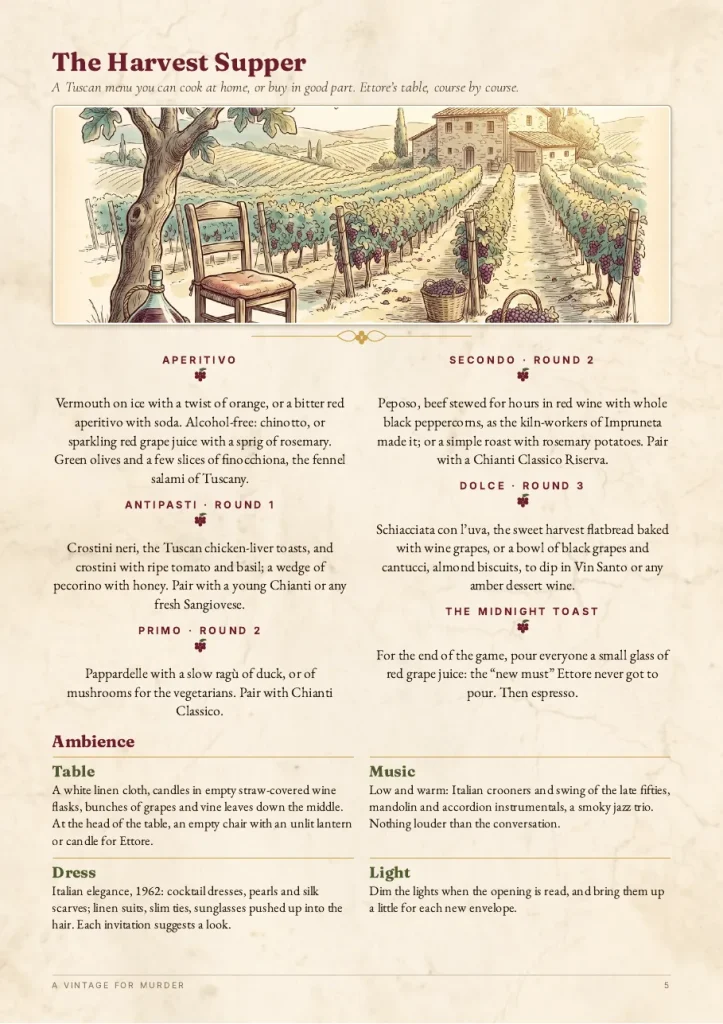
A signature cocktail plus a proper alcohol-free option is plenty. Give the mocktail a theatrical name and a nice glass so it doesn’t feel like a consolation prize: Temperance Tea in teacups for a 1920s party, hot spiced cider with sparkling apple cider for an autumn one.
Murder mysteries love poison plots, which is exactly why real food safety matters. Ask every guest about allergies when they RSVP and label every dish. The FDA lists nine major food allergens: milk, eggs, fish, crustacean shellfish, tree nuts, peanuts, wheat, soybeans and sesame. A small card next to each dish with its name and allergens takes five minutes. As the Friendsgiving host guide puts it, the only deadly thing at your party should be the gossip.
You don’t need a themed venue. Turn off the overhead lights and use lamps, string lights and candles (LED ones if you have kids, pets or curtains near the table). Keep a themed playlist low; the rule in A Vintage for Murder is nothing louder than the conversation.
Then add one memorable detail. A sign on a door that says “Cellar.” An empty chair at the table for the victim.
If the theme gives you a playful ritual, use it. Murder at the Gilded Orchid, a 1920s speakeasy game, has guests whisper a password at the door and includes a raid drill: a bell rings, the lights dim and everyone has thirty seconds to swap their drinks for teacups. It takes about a minute.
Every table has someone who would rather watch. That’s fine, because watching is detective work. A few things help:
What not to do: put someone on the spot with “come on, do the accent.”
The ending is what people remember, so don’t rush it.
Then bring out dessert and let the table pick the evening apart. If people want to keep playing, have a quick party game ready; in December, these Christmas game night ideas are a good place to find one.
The same method works in December, with two changes: calendars fill up, so the save-the-date goes out earlier, and the menu has to survive a busy week. Our guide to a Christmas murder mystery party for adults has a December timeline and a dinner schedule built around the rounds.
Count your realistic guest list, pick a game that fits that number, and choose a date at least two weeks away. Send the save-the-date tonight. Next weekend, cast the roles and send the character invitations. The day before the party, print, fold and seal everything, and put the solution envelope where you can’t reach it without getting up.
Murder Mystery Hosting
Format by headcount, five settings for grown-ups, a December timeline with a ready save-the-date, and a dinner schedule built around the rounds.
Holidays & Parties
24 Christmas games with the rules in a few lines each, sorted by who is playing: the whole family with no supplies, little kids, grandparents and grandkids, teens, and adults.

Planning & Productivity
A paper quest system for real life: a character sheet, quests, XP tiers, a weekly boss and a Sunday recap, with the research on what works and the rules that stop burnout.