
Holidays & Parties
Christmas Game Night Ideas for Every Kind of Group
Christmas game night ideas organized by who you are actually hosting: little kids, teens, grandparents, coworkers or adults-only, plus a prep timeline and a printing checklist.
Turn your 2027 goals into quests with XP, levels, boss battles and weekly reviews, plus what the research really says about gamifying your life.

Every December, a lot of us roll a new character. We give them big ambitions, a fresh notebook and a vague plan to “be better this year.” By February, half of those characters are sitting in the tavern, waiting for a session that never gets scheduled.
A good campaign has what most resolutions lack: a clear quest, visible progress, a boss worth fighting, earned rewards and a regular recap. This guide borrows those mechanics for 2027, honestly: what the research says, a working system and a sample setup you can copy on December 28.
Short answer: it can help, modestly, and the design matters more than the points.
The best-studied area is physical activity. A 2022 meta-analysis in the Journal of Medical Internet Research pooled 16 randomized trials with 2,407 participants and found a small-to-medium effect of gamified interventions on activity (Hedges g = 0.42). Gamified programs beat waitlists and also beat comparable non-gamified programs, though by less (g = 0.23). The catch: about 14 weeks after the programs ended, the effect had shrunk to very small (g = 0.15).
That’s the honest headline. Game mechanics push you while you use them; they don’t install permanent motivation. So use the game to get through the hard early months while the behaviors become habits.
Three well-replicated findings do most of the heavy lifting:
There’s also a real risk. A classic meta-analysis of 128 experiments by Deci, Koestner and Ryan found that expected, tangible rewards made contingent on doing a task tended to reduce intrinsic motivation, while positive feedback increased it. Read only for the gold, and you might stop enjoying reading.
Points are feedback, not wages. The moment XP becomes the reason you do something you used to love, change the rules.
Researchers at Wharton described a “fresh start effect”: searches for “diet,” gym visits and goal commitments all rose after temporal landmarks such as a new week, month or year, a birthday or a holiday. Landmarks push past failures into a “previous chapter.”
New Year is the biggest landmark of all, so use it on purpose. But every Monday and every first of the month is also a fresh start. A good quest system builds in dozens of small “new chapters” so one bad week doesn’t end the campaign.
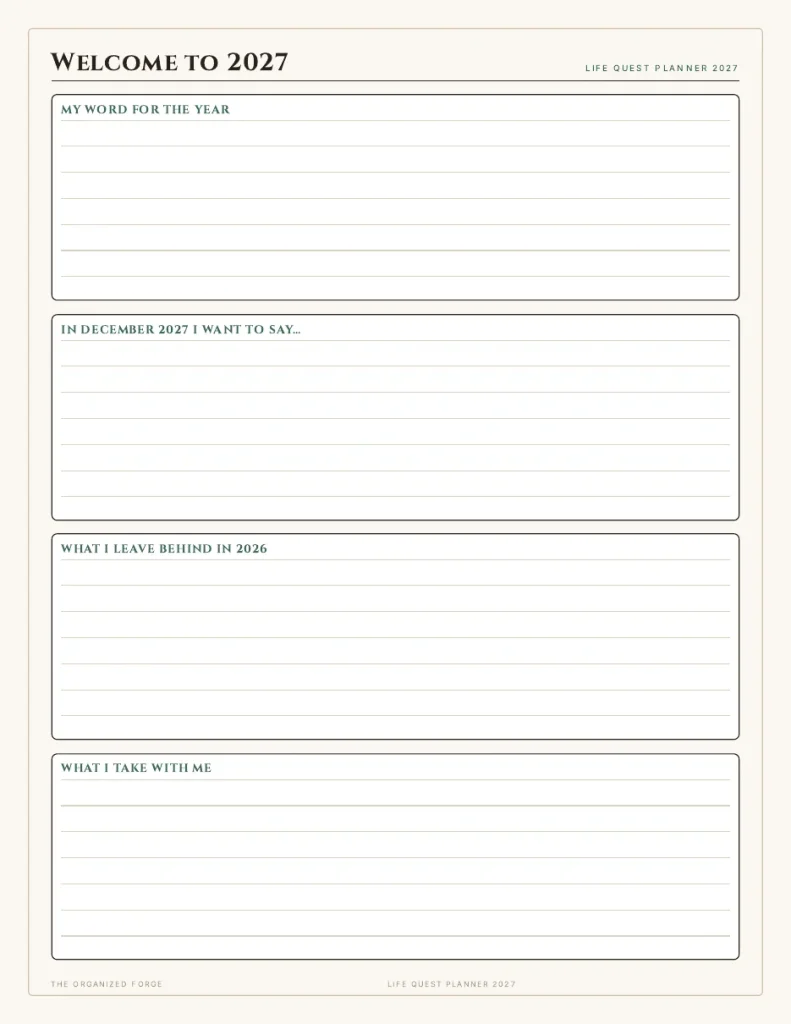
A simple opening ritual helps: before you set a single goal, pick one word for the year and write down what you leave behind and what you take with you.
Most goal lists start with “what should I do?” instead of “where am I now?” Start with the character. Take your six real-life stats and rate yourself honestly from 1 to 20, now and where you’d like to be in December. One mapping that works well:
| Stat | Life area | Example “now vs. target” |
|---|---|---|
| STR | Fitness and body | 8 to 12: train three times a week |
| DEX | Skills and craft | 10 to 14: one painting a month |
| CON | Health, sleep, food | 6 to 11: in bed by 11:30 |
| INT | Learning and career | 13 to 15: one certification |
| WIS | Mindfulness and balance | 9 to 12: ten minutes of journaling |
| CHA | Relationships and social | 11 to 14: monthly game night |
Then answer three questions: what is my class (what I do), what are my superpowers and what is my dump stat? The dump stat is usually where your most valuable quest hides. If CON is a 6, no productivity system will save you until you sleep.
A goal is a wish. A quest has a giver, a reason, milestones and a reward. Rewrite each goal using this template:
Limit yourself to six Main Quests for the year, with only two or three active at once. Every GM knows what happens when the party chases five plot hooks: nothing gets resolved.
Then add the if-then layer, where the research is strongest. For each quest, write one or two triggers:
Scale points to effort and meaning. Four tiers cover almost everything:
This is the economy we use in our Life Quest Planner, and it makes one design point: the biggest XP isn’t for working harder, it’s for doing the scary thing. That’s where most real progress is stuck.
Make early levels fast and later levels slow, the way good games do. If Level 2 costs 300 XP, that’s about 30 daily quests: roughly a month of showing up. You feel the first ding before motivation fades.
Gold and the Loot Shop. Convert XP into currency (1 gold per 10 XP is easy math) and price real rewards in advance: a new book, a dinner out, a set of dice, a Saturday with no plans. Pricing ahead turns “I deserve this” impulse spending into a planned treat.
A few rules that keep the economy honest:
Streaks feel amazing at day 40 and devastating when they break at day 41. Keep the loop without the fragility:
Every week, name one thing you’ve been avoiding and make it the boss. Not a big project, a specific dreaded task: the phone call, the tax form, the awkward conversation, the CV update.
Break it into steps and give the boss hit points, one box per step. Then write a short battle plan:
This is where most systems quietly die, and where the progress-monitoring research says the gains are. Set a 15-minute weekly review, same day and time. Sunday evening works for most people.

Use five questions, in this order:
Once a month, run a longer campaign review: what worked, what didn’t, and next month’s boss. In December, write your greatest victories, bosses defeated, lessons from the road and next year’s main quest. That page will mean more to you than any streak.
A campaign isn’t judged by how many sessions went perfectly. It’s judged by whether the party kept showing up.
Gamers love to min-max. Great at the table, risky in real life. Watch for:
A realistic setup for a hypothetical player: a designer who wants better sleep, a finished side project and more time with friends.
Hero sheet: Class: Illustrator. Superpowers: creativity, stubbornness. Dump stat: CON (sleep). Word for 2027: “Steady.”
Main Quests (three active, two parked):
Daily Quests (10 XP each): screens off at 11:00, 20 minutes of portfolio work, a 15-minute walk, a glass of water before coffee.
If-then triggers: “If it’s 11:00 p.m., then my phone goes on the kitchen charger.” “If I finish lunch, then I open the portfolio file for 20 minutes.”
Week 1 boss: “Pick the 12 portfolio pieces.” HP: 4 boxes (shortlist 30, cut to 20, ask one friend, final 12). Reward: takeout from the good place.
Loot Shop: café coffee (20 gold), a paperback (40), a set of dice (60), a lazy Saturday (100).
It fits on a few pages, starts small and gets harder only as the character levels up.
The tool decides whether you’ll open it. Paper or a tablet PDF suits a weekly desk ritual; a database suits people who live in their laptop.
We built our planners around the mechanics in this guide. The 2027 Life Quest Planner is the dated edition: Week 01 starts on Monday, December 28, 2026, so your campaign begins before New Year’s Eve, with a Hero Sheet, up to six Main Quests, 53 weekly pages with a boss and a tavern reflection each, and a 2027 in Review page. Prefer to start any day of the year? The undated Life Quest Planner uses the same system. If Notion is your home base, The Adventurer’s Ledger handles level, XP bar and gold purse automatically, with a Quest Board that runs from Bounty to Boss Fight and a Loot Shop for real rewards.
You don’t need the perfect plan. You need session one. Before the year turns:
Then roll for initiative. The fresh start is real, but it’s not what wins the year. Showing up next Sunday for the recap is.
Holidays & Parties
Christmas game night ideas organized by who you are actually hosting: little kids, teens, grandparents, coworkers or adults-only, plus a prep timeline and a printing checklist.

GM Craft
Your players are not afraid of your monster. Here is how to build real dread in a single session: visible clocks, the rule of escalation, sensory description, safety tools and endings that linger.

Murder Mystery Hosting
Choosing a game for your group size, casting on purpose, a timed run of the evening, food that keeps you out of the kitchen and a reveal your guests will talk about for weeks.