Elf Arrival Ideas: 15 Setups Sorted by How Much Time You Have
Fifteen ways to welcome your Christmas elf, from five-minute setups to a full evening, plus arrival letters to copy, return ideas for year two and a plan for the night before.
,
10 minute read
This page is for the grown-ups who set the scene. The short version: the best elf arrival ideas are the ones a child can discover in under a minute, paired with a short letter that gives the elf a name and two or three rules. Pick one setup that fits the time you have on arrival night, write the letter in advance, and save the elaborate scenes for a December weekend. The 15 setups below are sorted by effort, with letters and a night-before plan further down.
Elf arrival ideas at a glance
#
Setup
Time
What you need
Best for
1
Luggage tag landing
5 min
Card, string
Any age, tired parents
2
Boot ride
5 min
The child’s boots
Ages 2 to 5
3
Breakfast place card
5 min
The letter, a cookie cutter
Any age
4
Coat-hood stowaway
5 min
A coat on a hook
Ages 3 to 6
5
Route map on the fridge
5 min
Paper, marker, magnet
Ages 4 to 8
6
Parachute landing
15 min
Handkerchief, 4 short strings
Ages 4 to 9
7
Passport check
15 min
Folded paper, pens or stamps
Ages 5 to 9
8
The parcel
15 min
Shoebox, brown paper, tape
Any age
9
Weather desk
15 min
Whiteboard or paper
Ages 5 to 9
10
Room inspection
15 min
Sticky note, scrap cardboard
Ages 5 to 9
11
The first-day job
20 min plus shopping
A small box, one activity
Any age
12
Hot-air balloon
30 min
Balloon, paper cup, string
Ages 8 and up, or with care
13
Three-clue arrival
30 min
3 envelopes, paper
Ages 6 to 10
14
Arrivals board
45 min
Cardboard box, paint or markers
Ages 4 to 9
15
Snowed-in cabin
60 min
Shoebox, cotton wool, card
Ages 4 to 8
Easy elf arrival ideas (about five minutes)
Built for a parent who has just finished bath time and still has lunches to pack. None needs a shopping trip.
1. Luggage tag landing
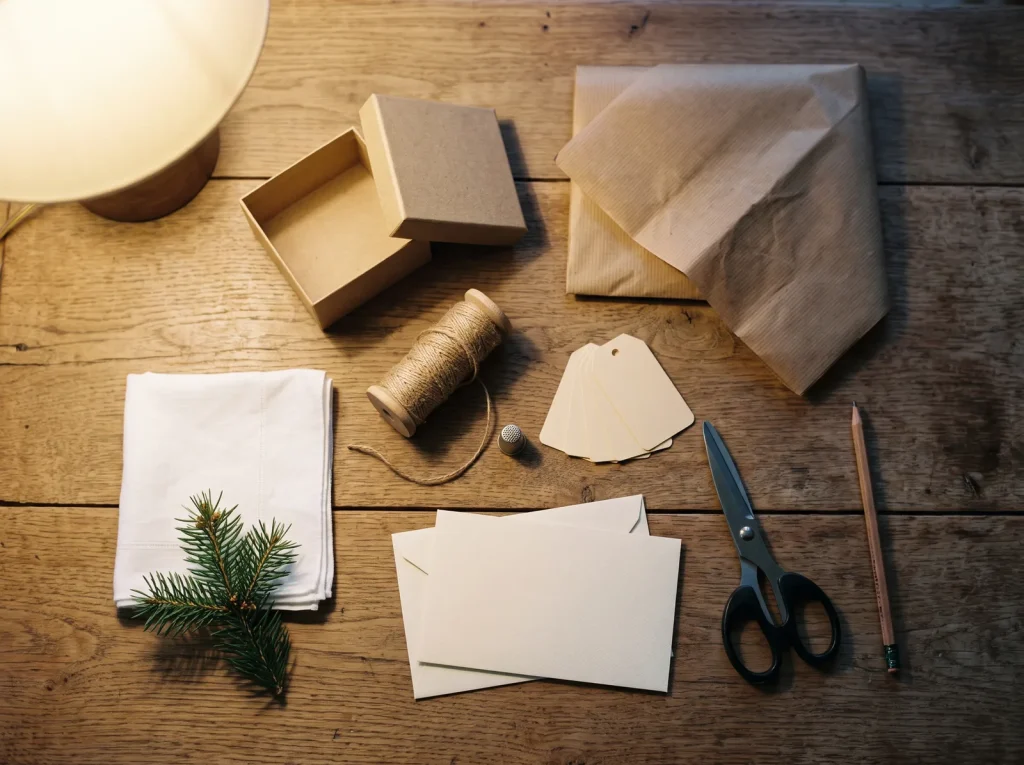
Prop the elf against a windowsill or the back of the sofa with a paper luggage tag tied loosely to one wrist. Write “Flight NP-1, landed 3:12 a.m.” on it. The oddly specific time gets a laugh, and the window suggests the route in.
2. Boot ride
Tuck the elf into one of your child’s winter boots by the front door, head and hat poking out, and roll the arrival letter into the other boot. The cold boots tell the story on their own.
3. Breakfast place card
Seat the elf at your child’s usual breakfast spot and stand the folded letter in front of it like a wedding place card, with your child’s name on the outside. In the morning, cut the toast or pancakes into stars with a cookie cutter, as if the elf brought the recipe. Skip candy toppings for toddlers (see the safety notes below).
4. Coat-hood stowaway
Put the elf inside the hood of your child’s coat on its hook, as if it hitched a ride on the last trip home. Leave a corner of the letter sticking out of the pocket.
5. Route map on the fridge
Draw a quick map: a snowflake at the top for the North Pole, a dotted line wandering down the page, and a little house at the bottom with your street name. Pin it with a magnet and perch the elf up on the fridge, looking down at it.
First night elf ideas with fifteen minutes
6. Parachute landing
Tie four short strings from the corners of a cotton handkerchief to the elf’s waist and drape the canopy over a houseplant or the top of a bookcase, as if the landing went slightly sideways. Take the strings down after the first day if you have a toddler in the house.
7. Passport check
Fold a sheet of paper into a small booklet. Inside, write the elf’s name and a few invented stops on the way (“Reindeer Ridge, refueled,” “Iceberg 14, brief nap”), stamping or doodling each one. Leave it open on the hall table with the elf sitting behind it, ready for inspection.
8. The parcel
Wrap a shoebox in brown paper, label it “Fragile. Elf inside. This way up,” and punch three air holes in the lid. Push the elf’s hat up through one hole and leave the box just inside the front door. Let your child do the unwrapping.
9. Weather desk
On the kitchen whiteboard (or a sheet taped to the wall), draw a North Pole forecast with a snow cloud and a thermometer at minus 31°F, then a note underneath: “Your house: much warmer. Staying.” Sit the elf beside it with a pencil.
10. Room inspection
Tape a sticky note to a scrap of cardboard to make a clipboard. List the rooms the elf has “checked”: “Kitchen: smells like toast. Hallway: fine. Your bedroom: not inspected yet, you were in it.” The elf sits on top of a bookcase holding the clipboard.
Big arrivals for a dedicated evening
11. The first-day job
The elf arrives holding a small wrapped box, and inside is the first family activity of the season: a plain wooden ornament to decorate together after school. Wrap it the weekend before, add a one-line card in the elf’s handwriting (“Today’s job: make this look like our house”), and set the paints or markers out the night before.
12. Hot-air balloon
Tie a paper cup under an inflated balloon with four strings and sit the elf in the cup. Hang it from a curtain rod. Keep it well out of reach if anyone in the house is under eight: the CPSC warns that children under eight can choke or suffocate on uninflated or broken balloons, and recommends picking up the pieces of a burst balloon right away.
13. Three-clue arrival
Hide three envelopes around the house. The first sits by your child’s bed, and each clue points to the next, with the elf waiting at the end. For ready-made rhymes to adapt, see our Christmas scavenger hunt clues.
14. Arrivals board
Turn a cardboard box on its side to make a tiny station or airport gate. Draw an arrivals board on the back wall: three made-up departures that are “Delayed” and one line that says “North Pole: Landed” with your town’s name. Give the elf a ticket stub cut from card.
15. Snowed-in cabin
Cut a door and two windows in a shoebox, glue cotton wool across the lid for a snowy roof, and add a card chimney. Tape a fireplace drawn on scrap paper to the back wall and stand the elf in the doorway. This one can stay up as the elf’s home base for the season.
When should your elf arrive?
There’s no official calendar for this. Two dates work well.
The first is the day after Thanksgiving. In 2026, Thanksgiving falls on Thursday, November 26, so an elf found on Friday morning, November 27, gets 28 mornings in your house, Christmas Eve included. The second is December 1, which gives you 24 mornings on the same count and lines up neatly with an Advent calendar.
For a first year, December 1 is the kinder choice for you. Four extra mornings doesn’t sound like much until you’re in the kitchen at 11 p.m. on day 19 with no ideas left. If you decorate on a set weekend, a third option is the morning after the tree goes up.
Whatever you choose, don’t announce the date unless your child copes badly with surprises. “Sometime soon” is enough.
Elf return ideas for year two and beyond
A returning elf can lean on last year. Younger kids may have forgotten most of it, so the return should prove the elf remembers them.
Postcards from the off-season. Leave two or three homemade postcards next to the elf, “sent” from a beach or the workshop’s paint room. A pinch of sand in one of its boots finishes the story.
Something from last December. If your child left the elf a drawing last Christmas Eve, keep it in a safe drawer. This year the elf comes back holding it, slightly crumpled.
A promotion. The elf returns with a new title written on a little name badge (“Senior Ribbon Inspector”), which gives you a running joke for the whole month.
Last year’s photo. Print the photo of last year’s arrival and prop it beside the elf, sitting in the same pose. Older kids enjoy spotting what’s different.
How to plan by age and family
Situation
Arrival idea
Letter
Rules to give
First year, age 2 to 3
5-minute setup, placed up high
Read aloud, under 60 words
One: “Say good morning to the elf”
First year, age 4 to 6
15-minute setup
Read together, 80 to 120 words
Two or three
First year, age 7 to 9
Clues or the arrivals board
They read it alone
Three, with a joke in each
Returning elf
One of the return ideas above
Mention last year by detail
Repeat last year’s rules only
Siblings of different ages
Aim the setup at the youngest
One line addressed to each child
Same rules for everyone
With siblings, watch out for a letter that talks to the baby and bores the eight-year-old. Write one shared letter with a personal line for each child near the end, and let the oldest read it aloud.
What to write in an elf arrival letter
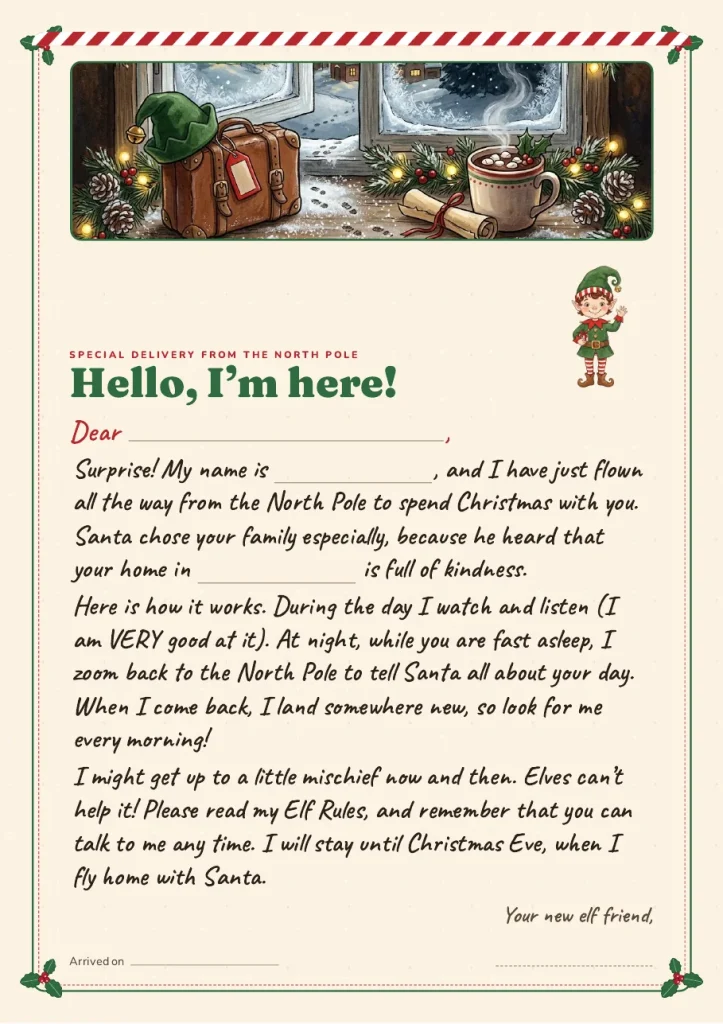
An elf arrival letter (some families call it an elf welcome letter) has five jobs: say who the elf is, say where it came from, say why it picked this house, set the rules, and say when it leaves.
Two or three rules is plenty for a child under six, since every rule is one more thing to enforce. With a two-year-old who grabs everything, skip the no-touching rule entirely and allow “gentle hands, then put it back.” The touched-elf advice further down is for older kids.
Here are three originals to copy. For a toddler, keep it short and read it slowly. This one leaves the name blank so your child can choose it:
Hi, [Name]!
I flew a very long way and my ears are still cold.
I’m staying until Christmas Eve. I get bored sitting still, so I’ll keep moving around. Say good morning when you find me.
I don’t have a name yet. Can you pick one?
Love, your elf
For ages 5 to 8, add one thing only your family would know:
Dear [Name],
You don’t know me yet, but I’ve heard about you. I heard you [finished your first chapter book / were brave at the dentist].
My name is [Elf name], and I work in the [Ribbon Room], which is the noisiest room at the North Pole. I asked for a quiet house this year. We’ll see.
I’ll be out most nights on North Pole business, so don’t expect me in the same place twice. One favor: no picking me up. I bruise like a banana.
I’ll head home on Christmas Eve.
[Elf name]
P.S. Your [dog] snores. I’ve written that down.
For a returning elf:
Dear [Name],
I’m back, and I still have [sand / snow] in my boots from the trip.
I remember last year: [the snowman you built in the yard]. I told everyone at the workshop about it.
The rules are the same as before. You know them better than I do by now.
See you tomorrow morning, somewhere,
[Elf name]
When a question has no good answer (“How does it fly with no wings?”), “What do you think?” beats an invented explanation you’ll have to remember for years.
The Christmas Elf Arrival Kit covers this if you want it printed: a fillable arrival letter, a rules page and an adoption certificate for the elf you already have, in A4 and US Letter.
The night before: a simple plan
Most arrival-night stress comes from searching for the elf at 10 p.m. Do the slow parts earlier in the week.
Three or four days before
Find the elf. Start wherever the decorations live.
Choose your setup from the table and lay the props out on a tray in a cupboard.
Write or print the letter, and check the spelling of every name.
On arrival night
Keep the normal bedtime routine. A sudden change is exactly the clue a sharp child picks up on.
About 45 minutes after lights out, check that everyone is asleep.
Give yourself 15 minutes to set up, with a kitchen timer if you tend to fiddle.
Put scissors and string away, then look at the scene from your child’s height.
Write the next three nights’ spots on a sticky note inside a kitchen cabinet.
In the morning
Be up a few minutes before the kids, and let them find it without pointing.
Read the letter together at breakfast and let your child ask questions.
If you forget to move the elf, or someone touches it
Every family forgets at some point. Don’t over-explain: a long excuse sounds made up even to a five-year-old. A shrug and “Maybe it liked that spot” covers most mornings. If your child is upset, a short note from the elf later that day helps.
When the elf gets touched, thank your child for telling you, and ask them to tell the elf what happened at bedtime, in their own words. The next morning the elf is in a new spot, and most kids take that as the all-clear. The Arrival Kit also includes a printable absence note and a note for accidental touches, if you’d rather have something ready to leave.
Safety notes for homes with small children
Food: the American Academy of Pediatrics lists marshmallows, popcorn and hard or sticky candy among the foods to keep from children until at least age 4, and the CDC’s choking list adds jelly beans and gummy candies. If the elf brings a treat for a toddler, make it something they can eat safely.
Batteries: fairy lights and flameless candles often run on button or coin batteries. The CPSC warns that swallowed button batteries can cause internal chemical burns and death, so check that battery compartments are screwed shut.
String and ribbon: take down anything with loops by the end of the first day, and never set it up near a crib or bed.
What to do this week
Choose your date and pick one setup from the table, ideally a five-minute one for the first year. Write the letter this week, while you have time to think of the detail that makes it your child’s. Put the goodbye letter for December 24 on your calendar too (the Arrival Kit includes one). If the elf is going to carry your child’s letter to Santa, our letter from Santa template covers the reply.