Letter from Santa Template: 3 Free Letters to Copy by Age
Three original letters from Santa, by age: for toddlers, for ages 5 to 8, and for a hard year or a move, plus paper, delivery and North Pole postmark notes for the grown-ups.
,
10 minute read
Below are three free letter from Santa templates for the grown-ups who help the North Pole with its mail: a short one for toddlers, a longer one for ages 5 to 8, and one for a year that was hard or involved a move. Each one is plain text, so you can drop the wording into any letterhead. Copy it into a document, fill in the square brackets with the child’s details, and print it on your own paper or on the letterhead sheet of a printable kit. Then decide how the letter will arrive.
Most of the effort goes into the brackets. A personalized letter from Santa feels real when it mentions something specific to the child’s year and answers what the child wrote.
How long a letter from Santa should be at each age
Short is safer. A toddler won’t sit through three paragraphs, and every extra sentence for an eight-year-old is one more chance to get a detail wrong. Use this as a starting point:
Age
Length
Who reads it
What to mention
2 to 4
40 to 70 words
A grown-up, aloud
One favorite thing, one small job for Christmas Eve, their name more than once
5 to 6
80 to 120 words
Read together
One thing they did this year, their wish, a reindeer or elf by name
7 to 8
150 to 200 words
The child, alone
An answer to their question, a specific moment from the year, a small joke
9 and up
100 to 150 words
The child, closely
Fewer facts, more warmth; this letter tends to become a keepsake
For the oldest group, keep it short on purpose: a nine-year-old who is starting to wonder will examine every word.
Template 1: for little ones (ages 2 to 4)
Read this one aloud, slowly, and point at their name each time it comes up. Pick one option in each set of brackets and delete the rest.
Dear [Name],
This is a short letter, because you are [two / three / four] and I am very busy.
I know you like [trucks / the color yellow / splashing in puddles]. Blitzen likes that too. He told me so himself.
Can you help me with one small job? On Christmas Eve, please [help hang your stocking / put your slippers by the door / give your grown-up a big hug at bedtime]. Then the rest is my job.
Big hug,
Santa
Keep it to that length. The job is what makes it work: a toddler who has something to do for Santa on Christmas Eve will talk about the letter for days. Pick a job you were going to do that evening anyway.
Template 2: for ages 5 to 8
At this age, the child wrote a letter (or dictated one) and expects a reply, so this sample letter from Santa answers it. This one runs longest, so trim it for a child who still reads slowly. For a five-year-old, cut it to the answer, one thing from the year and the P.S. Whatever you cut, keep the reply to something they asked or drew.
Dear [Name],
[Elf name] is in a little trouble because of you. She was supposed to spend the afternoon sanding sled runners, and instead she copied your [dragon / rocket / horse with wings] onto the wall of the Paint Shop. It is still there. Nobody has the heart to paint over it.
Now, about [reindeer and pizza]. [One or two sentences, e.g. “Reindeer do not eat pizza. Prancer tried a crust once and sulked for a week.”]
The best news I had about you this year was that you [read a whole chapter book on your own / sat with the new kid at lunch / kept going back to swim lessons even when the deep end was scary]. [Elf name] says that is harder than sanding runners, and she should know.
As for your list, I can’t make promises in a letter, because the sleigh isn’t packed until the very last night. I read every line of it, though.
If there are [oatmeal cookies / gingerbread] on Christmas Eve, I will eat them over the plate this time. Mrs. Claus has opinions about crumbs on the rug.
From Santa
P.S. [Reindeer name] wants you to know that [he has never once lost at hide-and-seek, and he would like a rematch with your cat].
A few notes on this one. If the child’s letter has no drawing, the elf copies their signature instead. The list paragraph deliberately doesn’t promise the gift, so the letter is still true on Christmas morning if the top item isn’t coming. Write the elf’s name down somewhere safe, because next year’s letter should mention the same elf. The sign-off follows the USPS instructions for the North Pole postmark, which say to sign the reply “From Santa.”
Template 3: a hard year, or a new house
Some years the usual cheerful letter doesn’t fit. It might be a move, an illness, a new school, or a lot of bedtime tears. This version tells the child the hard parts were noticed without dwelling on them. Choose the paragraph that matches.
Dear [Name],
I usually write my letters fast, with a lot of jokes in them. I’m writing this one slowly.
[For a move: We moved the toy-testing room to the other end of the workshop this spring, and for weeks half the elves walked into the broom closet by mistake. You had a much bigger move: a new house, a new bedroom, [a new school]. You kept getting up every morning and getting on with it, and I noticed.]
[For a hard year: There were sad days in your house this year, and days when you felt grumpy or worried, or both at once. You don’t have to feel cheerful to get a letter from me, and you don’t have to feel cheerful at Christmas either.]
The part of your year I keep thinking about is [one specific thing, e.g. “the first day in your new classroom, when you didn’t know anybody and went in anyway” / “the afternoon you made your grandma laugh when she needed it”]. Plenty of grown-ups would find that hard.
Christmas Eve is still on the calendar up here, same as always.
Your friend all year round,
Santa
Don’t explain the hard thing back to the child in detail, and don’t mention anything they may not know about yet; noticing is enough.
What to put in the brackets of a letter from Santa template
The template is only as believable as the details you fill in. Good details are things someone outside the family could have noticed: a teacher, a coach, the neighbor, “the elves.” Think of reading a chapter book, learning to ride a bike, helping at the food drive or being patient with a new baby.
Riskier details are the ones the child only ever said to one person. If your daughter whispered at bedtime that she’s scared of the big dog next door and Santa brings up the dog, she will quietly work out who Santa talks to. Use only what the child wrote, said in front of others, or did where others could see.
A quick test before you print: for each personal detail, ask “Who could have told Santa this?” If the only possible answer is you, cut it or make it vaguer.
Other things to keep out of the brackets:
Family nicknames and pet phrases. If only Dad calls her “Bug,” Santa shouldn’t, and if you say “super proud of you, kiddo” every day, Santa needs other words. Read the letter aloud before printing and remove anything that sounds like you.
Specific gifts. Mention the wish without saying it’s coming.
Behavior threats. If you need a gentle nudge, frame it as something Santa is cheering for (“I know you’re working on bedtime”).
Handwriting, paper, and the printer problem
Handwriting gives grown-ups away more often than anything in the letter itself. Children see your writing on lunch notes and birthday cards. The USPS supply list for the North Pole postmark even asks for “two different writing utensils”, one for the child’s letter and one for Santa’s reply. You have three options:
Ask someone whose handwriting the child doesn’t know, like a grandparent who lives far away. Send them the filled-in template and an envelope.
Print it. Type the letter into a fillable or editable template and choose a script or handwriting-style font, at least 14 pt, so a young reader can still manage it.
Mix them. Print the body and write “From Santa” by hand in red or green ink. A short signature in a disguised hand is much easier to fake than a whole page.
Paper is the second giveaway. A sharp seven-year-old will notice if the letter is on the same bright white sheets the kids draw on. Ivory, cream, or parchment-colored paper changes the feel, and a heavier sheet doesn’t wrinkle in a stocking. Keep a small pack with the wrapping paper, out of the craft drawer.
Then there’s the printer. Print when the kids are out or asleep, collect every test page, clear the file from shared downloads and recent-files lists, and check the output tray before bed.
Address the envelope to the child by first name only, in the same hand or font as the letter. A sticker or wax seal and a “North Pole” return address help, and so does a snowflake doodle where the stamp would go if it isn’t going through the mail.
How the letter arrives (and the USPS North Pole postmark)
Match the method to the age and to how much effort you have left in December.
If a Christmas elf visits your house in December, it can double as the mail carrier: the child’s letter leaves with the elf, and Santa’s reply turns up on Christmas morning. Our Christmas Elf Arrival Kit plans a mail-for-Santa setup on December 23, for the elf doll you already own.
The real postmark is the strongest option for a child who checks the envelope. USPS runs it through Anchorage, Alaska, and the steps are on its Greetings from the North Pole page: put your reply letter (or both letters) in an envelope addressed to the child, with “Santa, North Pole” as the return address and a First-Class stamp. Place that envelope inside a larger one with its own postage and mail it to NORTH POLE POSTMARK, POSTMASTER, 4141 POSTMARK DR, ANCHORAGE AK 99530-9998. The Postal Bulletin of October 29, 2026 says the outer envelope should be a Priority Mail Flat Rate envelope or box.
Because Template 2 answers the child’s own letter, work backward from the USPS dates:
Before November 23: the child writes to Santa (step 1 on the USPS page) and you write the reply.
November 23 to December 1: mail the package to Anchorage. The Postal Bulletin says this window gets the letter postmarked in time to arrive before December 25.
After December 1: USPS suggests Priority Mail Express instead.
December 17: the First-Class send-by date within the lower 48 states, if a relative mails the letter from another town so the postmark isn’t local.
USPS doesn’t give a delivery date for the reply, so don’t promise the child a particular day.
Don’t confuse this with USPS Operation Santa, where volunteers adopt children’s letters sent to 123 Elf Rd., North Pole, 88888 (postmarked by December 5 in 2026). That program is about volunteers sending gifts, not writing replies, and USPS says plainly that no letter is guaranteed to be posted or adopted.
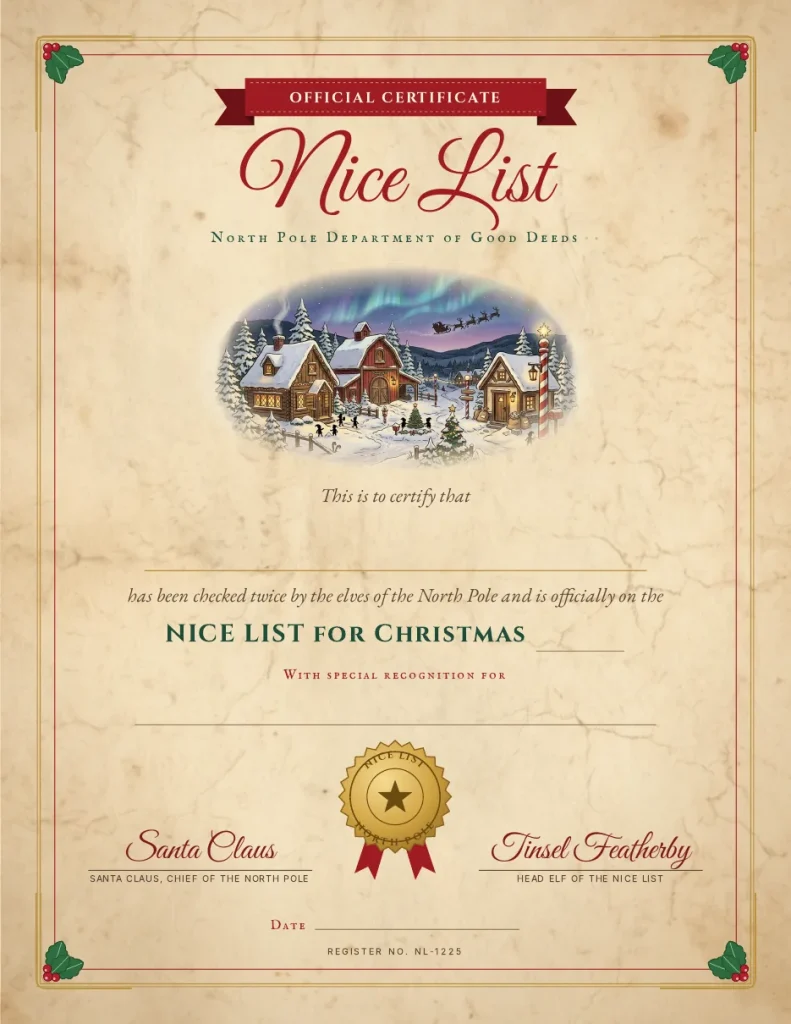
A nice list certificate is the easiest add-on. Kids under eight love having something official to pin on the wall. Two ways to use it:
On December 1, as the opener of the season, before any letters arrive.
In the same envelope as the letter, so it unfolds as a second surprise.
The certificate’s “special recognition” line is the one to fill in carefully. “For being good” means nothing to a child. Use something they will recognize: “For teaching your brother to whistle,” “For finishing the library reading chart,” “For saying sorry first.”
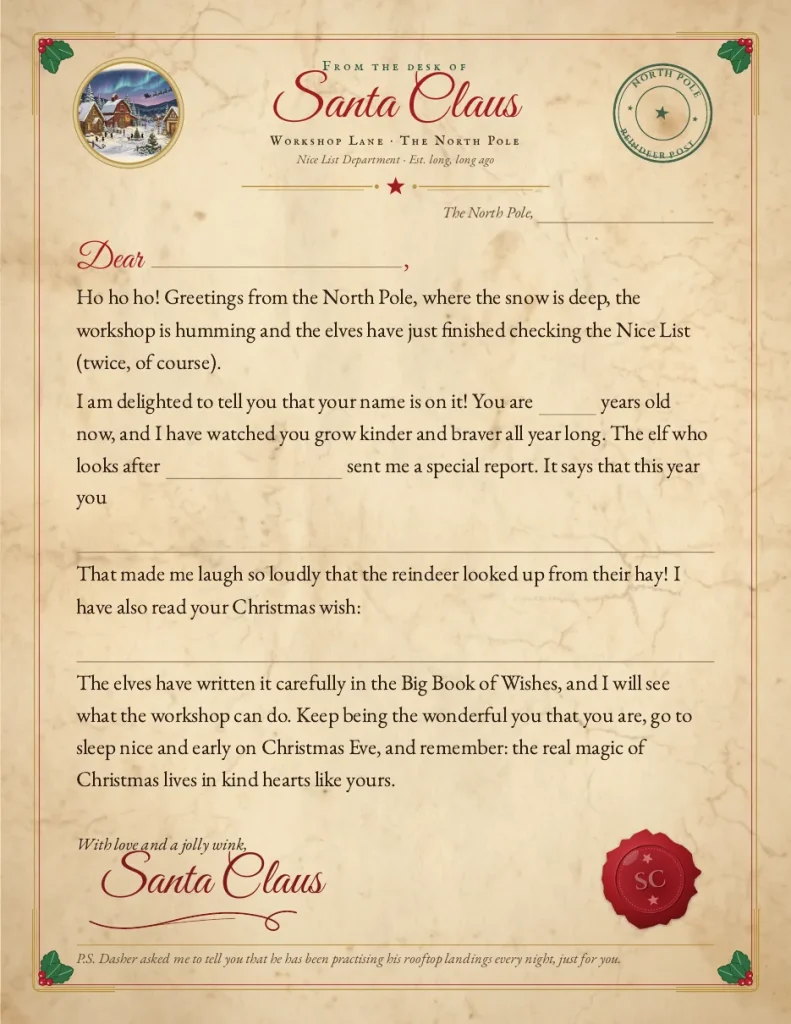
If you’d rather start from a printable letter from Santa with the certificate and envelope already designed, our Letter from Santa & Nice List Kit has all three as a fillable PDF in US Letter and A4. It includes six editable letters (among them Baby’s First Christmas, a new big brother or sister, a moved house and a bumpy year), a blank letterhead, a gentle “under review” notice for the naughty-to-nice months and a few Christmas Eve notes. Type into the fields and print, or write by hand on the printed pages.
Mistakes that make kids suspicious
Two siblings get the same letter. Change at least the middle paragraph and the P.S. for each child, and use a different elf in each.
Spelling that doesn’t match school. If a word, or the child’s own name, looks different from the way your child learned it, fix it before printing.
The wrong year. Write the date the way a letter would (“North Pole, December 2026”) and check it.
Santa’s handwriting changes from one year to the next. Children keep these letters and compare them later, so note the font you used or ask the same helper again next December.
What to do this week
Pick the template that fits each child and copy it into a document. Then write down three things from their year that someone outside the house could have seen. Buy a small pack of cream paper. If you want the Anchorage postmark, have the child write to Santa before November 23, put November 23 on the calendar and pick up a free Priority Mail Flat Rate envelope at the post office (you pay only the postage). The letter itself takes about twenty minutes once those things are ready.