Christmas Gift Exchange Games: Rules, Timing and Fixes
Four gift swaps sorted by how much stealing your group can take, with a rules script for the steal game, our own dice chart and a fix for every common snag.
,
11 minute read
Choose a Christmas gift exchange game by how much stealing your group can handle. A white elephant swap with steals suits 6 to 20 adults who enjoy a bit of drama (past 20, split the room). A dice swap suits families, mixed ages and anyone who would rather blame the die than a coworker. A left-right story moves 30 gifts in five minutes, and pass-the-gift prompts work best for classrooms and for parties where only one prize is on the table.
If your group draws names weeks ahead and buys for one person, that’s Secret Santa, a different event, and our Secret Santa questionnaire covers the draw and the gift hints.
Compare the games before you write the invitation
The times below are planning estimates. They assume people are seated in a circle, gifts are already in a pile, and the rules have been read once. Add five minutes for the first round of “wait, can I steal that?” Headcount and, for white elephant, the steal limit move these numbers more than anything else.
Game
Players
Time
Ages
Chaos level
Best for
White elephant (steal swap)
6-20 (split above 20)
about 2 min per player
10+
High
Adult friends, office parties with a sense of humor
Dice swap
4-30
20-40 min, set by a timer
6+
Medium to high
Families, mixed ages, big rooms
Left-right story
6-30+
3-8 min per story
All
Low
Big groups, kids, a quick finale
Pass the gift with prompts
4-40
10-15 min
All
Low
Classrooms, icebreakers, one-prize parties
Secret Santa
Any
Weeks of setup, 20 min to open
All
None
Groups who want a gift chosen for them
The steal game is the only one whose length grows with every guest, while the others run on a clock or a story. If you have kids under eight, use left-right or pass the gift, or play the dice swap with gifts wrapped until the end and treat a 6 as “take from the pile.”
White elephant rules, ready to read out loud
The white elephant gift exchange is also called Yankee swap or Dirty Santa. Wikipedia’s entry notes that classic white elephant gifts lean funny and impractical, while Yankee swap gifts are more often things people actually want.
Read this to the room before the first number is drawn. It fits on an index card.
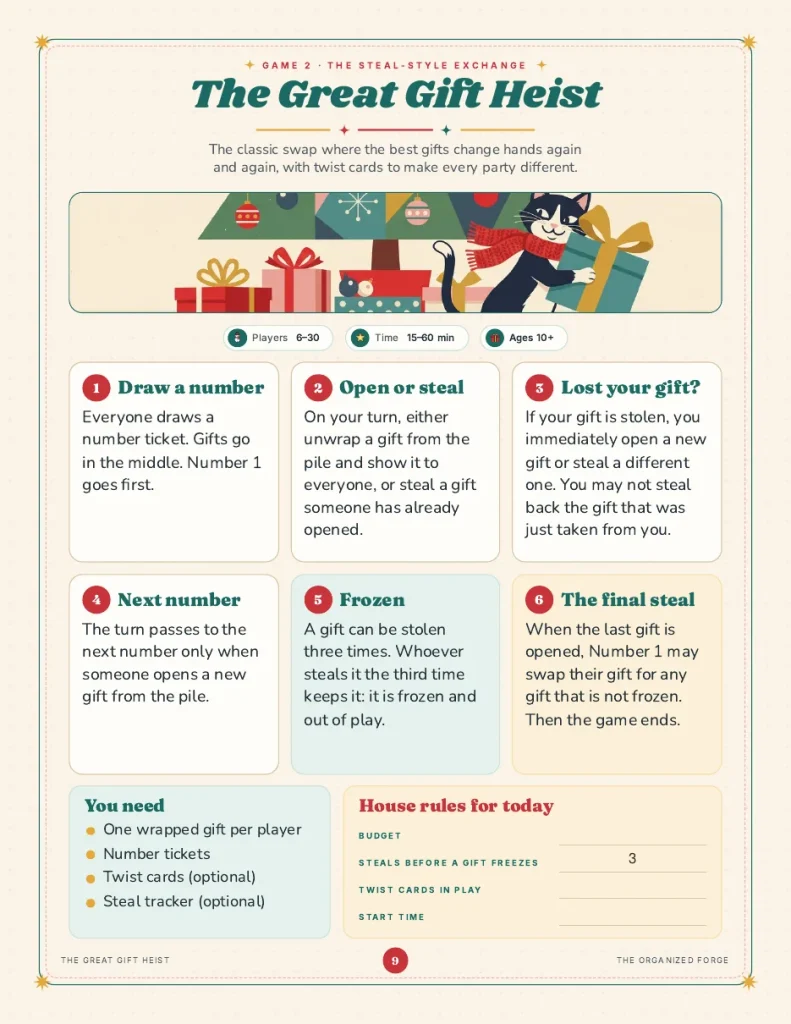
Everyone has drawn a number. Number 1 goes first and opens any gift from the pile. From then on, on your turn you either open a new gift or steal one that’s already been opened. If your gift gets stolen, you don’t wait: you open a new one or steal a different one right away. You can’t steal back the gift that was just taken from you. A gift can be stolen twice. Whoever takes it the second time keeps it, and it’s out of play. No more than three steals in one turn: after the third, whoever was just robbed opens a new gift. Your turn ends only when someone opens a new gift. When the last gift is opened, Number 1 gets one final swap with any gift that isn’t frozen. Then we’re done.
Arguments come from five things nobody decided in advance. Settle these out loud:
Decide how many steals freeze a gift. Two is a common limit, and the one Wikipedia gives. Three makes the game longer and the best gift more contested. With 15 to 20 people, stay with two.
Ban immediate steal-backs, or two people can trade the same bottle of olive oil until midnight.
Set a ceiling on steals per turn (the script uses three). One steal can trigger another, and another. Once the ceiling is reached, whoever was just robbed opens a fresh gift.
Agree on what Number 1’s final swap can reach. Number 1 opened blind, so the end swap is the compensation. We’d keep frozen gifts out of it.
Show every gift to the whole room when it’s opened, so a steal is never a surprise.
For numbers, tear paper into slips, write 1 to your headcount, fold them into a bowl and pass the bowl once everyone is seated. Anyone who arrives after the draw takes the next number after your headcount and goes last.
If you’d rather put a poster on the wall than an index card, The Great Gift Heist in our Christmas Gift Exchange Game Pack is a white elephant with number tickets, a steal tracker and 14 twist cards plus two blanks. The poster freezes a gift on its third steal, but its house rules box has a line for steals before a gift freezes, so you can write in two.
How to play the dice gift exchange game
The dice game removes the social cost of stealing: nobody chooses to take your gift, the die told them to. That’s why it suits families and coworkers who barely know each other.
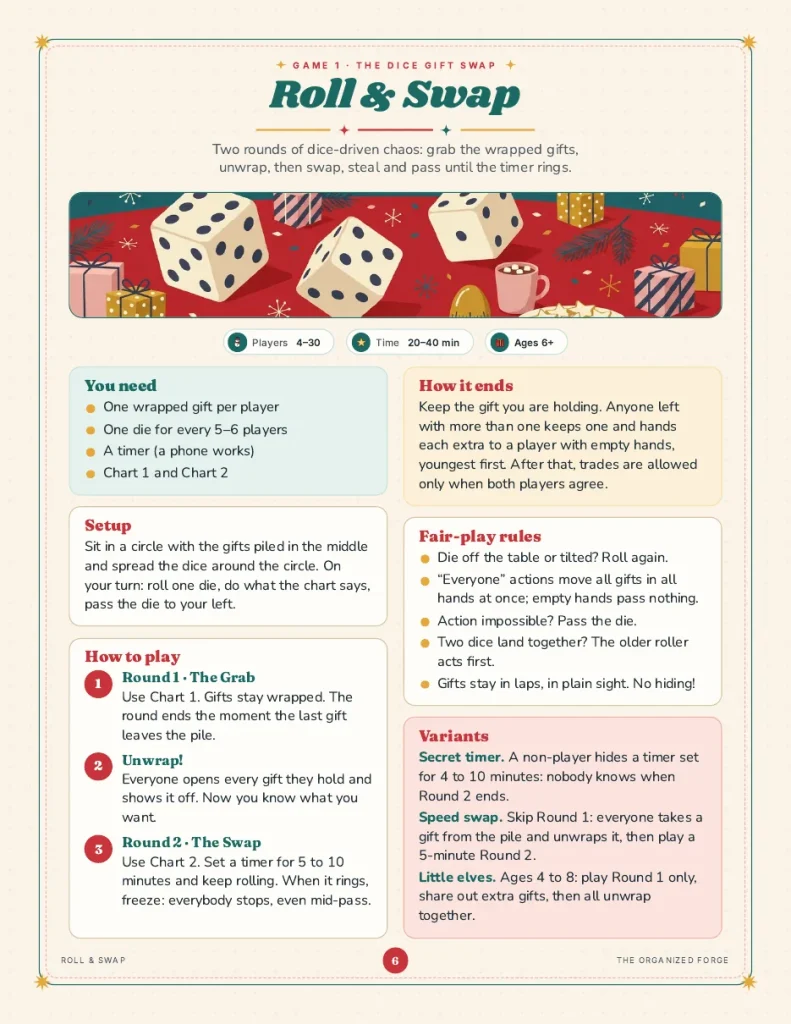
Seat everyone in a circle with the wrapped gifts piled in the middle and spread several dice around (one per half dozen people is plenty). On your turn, roll, do what the chart says, and pass the die to your left. The chart is ours:
Roll
Action
1
Take a gift from the pile.
2
Take a gift from the pile.
3
Pass one of your gifts two seats to the right.
4
Trade one gift with the person sitting across from you.
5
Everyone holding a gift passes it one seat to the left.
6
Steal one gift from anyone, then roll again.
Once the pile is empty, set a phone timer for 5 to 10 minutes and keep rolling. If you can’t do what the die says (a 1 with an empty pile, a 3 with empty hands), pass the die. When the timer goes off, stop on the spot. Anyone holding two gifts offers both to a neighbor with empty hands, who picks one. Then everyone unwraps whatever is still wrapped.
Keep gifts wrapped until the timer goes off for pure luck, which is kind to small children, or unwrap as soon as the pile empties and then start the timer, so people know what they’re chasing and the steals get loud. Either way, name one referee whose call on a disputed roll is final.
The left-right Christmas game
This is the fastest way to give 30 people a gift each. Everyone sits in a circle holding one wrapped gift while a reader reads a story slowly. On every LEFT, everyone passes their gift to the left; on every RIGHT, to the right. When the story ends, you keep what’s in your hands.
A sample we wrote, to show how the cues are spaced. It’s an excerpt, not a whole story:
Grandpa Lou pulled out of the driveway and turned LEFT, which was the wrong way, so Grandma told him to take a RIGHT at the gas station. He took a LEFT. “I said RIGHT,” she said. He sighed, turned RIGHT, then RIGHT again, and found himself back at the house, where the dog was barking at the LEFT front window and the turkey was still in the oven.
That’s seven cues (three LEFTs, four RIGHTs) in about 25 seconds. A full story spreads them out more, roughly one cue every seven or eight seconds. Notice the story says “wrong way” instead of “not right.” A stray lowercase “right” (“you’re right”) sends half the circle the wrong way. If you write your own:
Read it aloud once with a stopwatch running. Under two minutes, add a paragraph. Over five, cut one.
Print the script with every cue in capitals and highlighted, so the reader never hesitates.
Count your cues. Each gift ends up as many seats away as the gap between the LEFT and RIGHT totals. If the totals are equal, or the gap equals the number of players, every gift goes back to whoever started with it. The excerpt above has one more RIGHT than LEFT, so every gift moves one seat to the right.
A 3-minute story with 20 to 25 cues is right for kids. Adults can take a longer, sillier one. If you don’t want to write your own, our pack has five stories, from a kids’ one to an eight-minute chaos story with an extra MIDDLE cue.
Pass the gift with prompts
Use pass the gift when only one gift is in play. The host reads a prompt and whoever is holding the gift passes it to someone who fits. “Pass it to someone who…” followed by:
has a phone under 20 percent battery right now
has ever opened a gift early and wrapped it back up
brought a dish they didn’t cook themselves
has re-gifted something (no confession required)
still has a voicemail they’ve never listened to
has a gift still hidden in the trunk of their car
has wrapped a present in newspaper or a grocery bag
has stayed up past midnight putting a toy together
got here without opening a map app
has a song stuck in their head right now
After 15 to 25 prompts, the gift stops and whoever holds it opens it. To turn it into an exchange, everyone starts with a wrapped gift and passes it one seat whenever a prompt fits them, switching direction every few prompts. After 20 prompts, open what you’re holding. Nobody steals anything, and the whole round takes about 15 minutes.
More swaps to try
If none of the four above fits, these come from party sites like The Tabletop Family and Play Party Plan:
Plastic-wrap ball: small prizes wound into one big ball of plastic wrap. You unwrap while the player on your left rolls two dice. On doubles the ball moves on, and you keep whatever fell out (The Tabletop Family suggests saving the best prizes for the center).
Rock paper scissors steal: a normal white elephant, except you have to beat the holder at rock paper scissors to take their gift (Play Party Plan).
Heads or tails: flip a coin on your turn. Heads, you open a new gift. Tails, you steal (also from Play Party Plan).
Auction: everyone gets the same stack of board-game money and bids on wrapped gifts, then spends what’s left in a second auction for the opened ones (The Tabletop Family).
Card bingo: deal everyone a few cards from one deck and flip a second deck one card at a time. When all your cards are called, take a wrapped gift. In a second round, a full set lets you swap (The Tabletop Family).
Mug toss: everyone brings a cheap, silly Christmas mug, the mugs are packed together, and each player tosses a table tennis ball at them. The mug it lands in is theirs (The Tabletop Family).
Gift exchange games for large groups
The trouble with a big group is the steal game. At about two minutes per player, a 30-person white elephant runs an hour or more.
Players
White elephant (2-steal limit)
Dice swap
Left-right
10
20-25 min
20 min
5 min
20
40-45 min
25-30 min
5 min
30
60+ min, so split it
30-40 min
5-8 min
50
Split the room
Two circles
One big circle
How to shrink it:
Above 20 players, split into two circles, each with its own pile and number slips.
Give each turn a 30-second decision clock, called by one guest with a phone.
Run a hybrid. Play a dice swap until the pile is empty, unwrap, then open a 10-minute steal window where anyone holding the die can steal once.
With 40 or more seated in rows, use left-right and treat the rows as one long line: the end seat of each row passes to the nearest end of the next row, and a helper carries gifts between the back row and the front.
For the rest of a big work party, our list of office Christmas party games has station rotations and a sample run of show for 30 people.
Gift exchange games for small groups
With four or five people, a plain white elephant is over in ten minutes and there’s barely anything worth stealing. WhiteElephantRules.com puts the comfortable minimum at six players. Ways to stretch it:
Ask everyone to bring two smaller gifts and play two rounds, one with each batch.
Play the dice game with a 10 to 12 minute timer and let a 6 steal from anyone, even someone who already has two gifts.
Skip left-right with only three or four players. WhiteElephantRules.com points out that in a circle that small, people are likely to end up with their own presents. Pass the gift with one prize still works, because the holder picks who gets it.
Draw names in advance and do a Secret Santa with a guessing game at the end.
Christmas gift exchange games for adults, families and coworkers
For adults, the comedy comes from the gifts, so give the white elephant a theme (cozy, handmade, under $10 and as ridiculous as possible). One rule we like: before every steal, the thief tells the room what they plan to do with the gift. If the swap is part of a longer evening, our Christmas murder mystery party plan leaves a slot for it near the end of the night.
Young children change the setup the most. Under eight, stick to the no-steal options above. With older kids in a white elephant, set the steal limit to one, let the youngest guests take their turns early, and keep a separate pool of kids’ gifts with tags in a different color, so no kid goes home with a bottle of wine. Our guide to Christmas games for every group has more for mixed ages.
For the office, put the budget in the invitation, rule out gag gifts that could embarrass someone, and make playing optional. Anyone who doesn’t want to steal can be the reader or the timekeeper. Remote coworkers can play too. Mail the gifts a week ahead, numbered and marked “do not open.” On the call, players pick by number and everyone opens together on camera.
When a gift exchange goes wrong
Problem
Fix
One gift gets stolen again and again and the game stalls
Freeze it on the second steal. Announce the limit before you start, not when it’s already a problem.
Someone hates having their gift taken
Let people trade after the game if both agree. Use the dice game next year.
Budgets don’t match: a $5 candle next to a $50 speaker
Give a floor and a ceiling in the invitation.
A guest forgets their gift or brings a plus-one
Buy one or two neutral extras (good chocolate, a deck of cards) and leave them in the car until needed.
A gift is unsuitable (allergens, adult humor at a kids’ table)
Ask in the invitation for food gifts to list allergens on the tag, and keep a kids’ circle food-free.
Make your own or print a ready-made pack
Everything on this page is free to use: the rules script, the dice chart, ten pass-the-gift prompts and a sample stretch of a left-right story. You’d still need to write a full story (20 to 25 cues for three minutes) and 5 to 15 more prompts. Allow an evening for that.
If you’d rather print and cut, the printable Christmas Gift Exchange Game Pack has all four games, number tickets 1 to 40, gift tags and a host guide with three ready-made plans (30, 60 and 90 minutes) and a fillable planner. For a Secret Santa, the Secret Santa Kit handles the name draw, questionnaires and a guessing game for the reveal.
A host’s timeline that works for any of these games:
Two to three weeks out: choose the game and put it in the invitation next to the budget range.
The week before: write the number slips, copy the rules onto a card and buy your spare gifts.
On the day: name a reader and a timekeeper, and announce the steal limit before anyone is holding a gift they want to keep.