Murder Mystery Hosting
Murder Mystery Birthday Party: Roles, Cake, and Timing
Plan an adult birthday mystery around the guest of honor. Choose their role, send clear invitations, and leave room for cake without interrupting the case.
Choose roles without putting guests on the spot, screen the story, and plan a teen mystery party that reaches the reveal before pickup.
For a murder mystery party for teens, choose the game around the guests who will actually be in your living room: their ages, willingness to act, and comfort with the story. Check the required roles before sending invitations, have an adult review the complete kit, and leave enough time for everyone to make an accusation before pickup.
For a first party with ages 13–17, our recommendation is a structured game with clear rounds and a host who keeps track of the materials. Let guests read from their sheets. Costumes can be optional. Agree on the content and house rules before anyone gets a secret to protect.
“Teen-friendly” needs a few follow-up questions. A game can avoid graphic violence and still ask someone to act out a romance they would rather skip. Red Herring Games’ guide to games for teenagers specifically flags roleplay involving attraction, pregnancy, and drug use as content hosts should consider when choosing a game.
Make a short screening list before you buy a murder mystery party kit for teens:
An age label helps you narrow the search; it doesn’t replace reading the material. If the preview doesn’t answer a question, ask the seller before you commit.
For example, Unfollowed: Murder at Camp Spotlight is written for ages 13–17, with 6–12 guests and roles that work for any gender. Its stated content boundaries include no gore, alcohol, or romance. That is a useful starting point for a parent review, not a promise that every teenager will enjoy a story about a fictional death.
If death itself is the objection, choose a theft or missing-object mystery instead. Renaming a murder halfway through the instructions may leave you explaining evidence that no longer fits.
A room of 13-year-olds who love drama may want more performance than a room of 17-year-olds who came for pizza. Use age to check the content rating. Ask the guests how they want to participate.
Send these questions privately with the RSVP, ideally 7–10 days ahead. This is a suggested planning window, so shorten it if you’re organizing next weekend.
Would you rather play a big personality or keep the acting low-key? Are you comfortable reading a short introduction aloud? Is there anything you’d like us to avoid in the story? You can reply privately, and you don’t need a costume to join in.
For a mixed-age group, screen the story for the youngest guest and any stricter boundaries people have shared. Then adjust the support: allow reading time, keep the instructions visible, and make it possible to ask the host a question privately. Don’t announce who asked for which accommodation.
| What the group tells you | What to look for in a kit | What to arrange at home |
|---|---|---|
| “We’ll act, but we’ve never done this” | Clear rounds and written character instructions | A short practice introduction before the opening script |
| “Please don’t make me perform” | A format that permits reading rather than memorized speeches | Seated conversations and permission to use notes |
| “Some of us don’t know each other” | A defined role for each guest | Host introductions using character names, then an opening question |
| “We mostly want to solve the case” | Evidence available to every player | A central clue table with enough room to read |
| “We only have two hours” | A game whose full stated duration fits | Food before play, or a different game if it won’t fit |
If most guests dislike playing a character, an investigation game may suit them better than a suspect-based party. Don’t assign a central acting role to a guest who has said they don’t want one.
Have an adult complete the content review before assigning any roles. Before matching personalities to characters, separate required roles from optional ones. Follow the kit’s casting order. A funny optional character cannot necessarily replace a missing required suspect.
Give the birthday teen an early choice among suitable roles, then use the private RSVP answers for the rest. Match people to the amount of performance they want, not to a real-life reputation. Avoid “You’re the gossip because you gossip” or “You should be the villain.” The character should give a guest something new to play, rather than turn their school life into entertainment.
Don’t promise that someone won’t be the culprit unless you’ve read the casting instructions and can honor that promise. If a guest has a firm boundary about playing that part, handle it privately before distributing materials.
Keep a simple host-only roster with four columns: guest, assigned character, required or optional, confirmed attendance. Check it again the day before. Ask families to tell you promptly about cancellations.
If someone cancels:
Don’t invent extra suspects for a thirteenth guest in a twelve-player game. Ask the publisher about a supported expansion, or choose a game for the larger group.
Offer a low-pressure first exchange: “Introduce your character to the person beside you, then ask what they do at camp.” Keep this separate from the actual investigation so nobody mistakes a practice answer for evidence.
Once play begins, let guests read their permitted information from the page. Ask, “Would you like to read that, or would you like help?” rather than appointing someone else to speak for them. Don’t pair two guests onto one suspect unless the kit supports shared roles; they may need separate private information.
When someone dominates, use a neutral limit: “Let’s hear one question from each person before we come back around.” A guest can pass. Don’t turn inclusion into another compulsory speech.
For a first home party, put one adult in charge of the game. If another adult is available, ask them to handle food and arriving families. That is a hosting choice, not a universal requirement of murder mystery games for teens.
The game host needs to know when to release materials, what information must be shared, and how to reach the ending. They should also know which areas of the house are in play. Keep bedrooms and private cupboards out of bounds unless you have deliberately included them. A printed clue on the table is not an invitation to search the kitchen drawers.
A host who has read the solution should facilitate rather than compete to solve it. Unfollowed allows the host to play, but its instructions explain that a host who reads the answer already knows the ending. Decide whether you want to run the game or discover the answer before opening the host-only pages.
Keep those pages in a closed folder away from the shared materials. If a teen is hosting with adult support, agree who will hold the answer and prepare each round. Taking a quick photo of the whole packet for the group chat can spoil more than the host intended.
Read the stated game duration before choosing your invitation time. Distinguish the start of play from arrival, and the reveal from the end of the party.
For a game listed at 2–2½ hours, we would book a three-hour visit. This sample schedule gives you a 2-hour-20-minute game window, including a 10-minute snack break, with cake afterward. It is our planning template, not a replacement for a kit’s run sheet.
| Time | Plan |
|---|---|
| 5:30–5:45 | Arrival, bathroom directions, name tags, quick snacks |
| 5:45–5:55 | House rules, opening, private reading time |
| 5:55–6:25 | First round |
| 6:25–6:55 | Second round |
| 6:55–7:05 | Food and phone break |
| 7:05–7:35 | Final round |
| 7:35–8:05 | Written accusations and the reveal |
| 8:05–8:30 | Cake, photos with permission, pickup |
The final half-hour of play gives a larger cast room to make accusations without rushing the explanation. Follow your game’s timing if it differs. If the kit needs the full 2½ hours, begin earlier or reduce the separate arrival and cake windows.
Tell parents that pickup follows the reveal. For a sleepover, finish the mystery before the open-ended evening begins; otherwise the last round can end up competing with sleeping bags and a movie.
If you fall behind, shorten a decorative photo session or an extra snack break. Don’t skip evidence or tell players to guess before the final materials arrive.
Print one character packet and one name tag per player, plus an accusation sheet per player if the kit uses them. Prepare the shared evidence and host materials exactly as instructed. Page counts in a listing don’t necessarily equal the number of sheets you need for your selected cast.
Unfollowed includes US Letter and A4 files, color and Ink Saver versions, character materials, and a host guide. Its estimated prep time is about 45 minutes; leave yourself extra time for the content review and a printer test. For its round-based materials, follow the cutting and folding instructions so guests don’t read later sections early.
Put each player’s materials in a separate folder or envelope. Keep later rounds under host control when the instructions call for that. Set out pencils and a few spare sheets for notes. Choose a well-lit central surface for shared evidence, with drinks on another table.
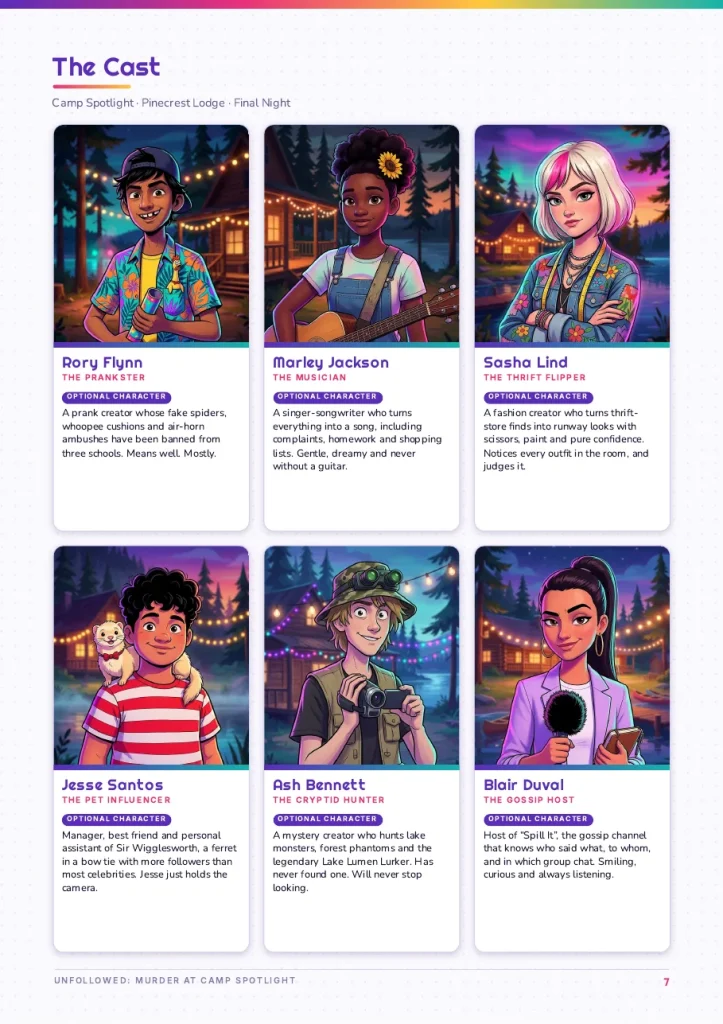
This public cast page shows character introductions, not the private booklets. Keep secrets and later-round instructions out of invitations.
Choose a theme guests can dress for with clothes they already own: a summer camp, a school club, or a music awards night. Check the story’s content separately; the setting alone doesn’t establish suitability. Let each teen decide how far to take the theme, and don’t make costume spending a condition of participation. Skip props that could be mistaken for real weapons.
Use this short briefing before reading the game’s own introduction:
“Accuse characters, not the people playing them. Keep jokes inside the story, and don’t bring in school rumors or personal comments. You can read from your sheet. If you need a break or want help, come to me privately. Only open the materials for the current round. We’ll pause for snacks, and everyone can contact home whenever they need to.”
Then explain the game’s rules about bluffing and required disclosures. Those rules vary; “you can lie about anything” can break a case if players must reveal certain facts.
Agree on phone use in advance. Our preference is a voluntary parking spot during rounds, with access for family contact and accessibility needs. Ask guests separately whether you may take photos and whether you may share them.
If a joke lands badly, pause it directly: “That comment is about a real person. Leave it out of the game.” Check privately with the affected guest. If someone wants to stop, give them a quiet place to sit and handle any missing-role problem yourself, according to the kit’s instructions.
For the wider logistics of invitations and dinner, use our general murder mystery hosting guide. For this teen party, finish with these checks:
Before guests arrive, count the packets against the roster once more. A missing envelope is much easier to fix before twelve people are asking who they get to be.
Murder Mystery Hosting
Plan an adult birthday mystery around the guest of honor. Choose their role, send clear invitations, and leave room for cake without interrupting the case.

Murder Mystery Hosting
Two schedules from doors to midnight that end before the countdown, a table for timing the reveal, masquerade versus 1920s, and a plan for guests who arrive late.
Murder Mystery Hosting
How the three types of murder mystery advent calendar differ, how to pick one, and a print-and-seal plan so everything is ready by November 30.