
Murder Mystery Hosting
Christmas Murder Mystery Party for Adults: How to Plan It
Format by headcount, five settings for grown-ups, a December timeline with a ready save-the-date, and a dinner schedule built around the rounds.
How the three types of murder mystery advent calendar differ, how to pick one, and a print-and-seal plan so everything is ready by November 30.

A murder mystery advent calendar swaps the chocolate behind each door for evidence. You read the case on December 1, then open one sealed document a day: a witness statement, a letter, a floor plan, a newspaper cutting. Each one moves a suspect up or down your list. In a typical story calendar you name a suspect on the 23rd or 24th, and the last door (Christmas Eve or Christmas Day, depending on the calendar) tells you whether you were right. They take 5 to 20 minutes a day, which is short enough to survive a December of school concerts and work parties.
Boxed versions and books exist, but with a printable advent calendar mystery you build the calendar yourself, and the only hard deadline is that everything is printed, cut and sealed by the evening of November 30.
Three designs are sold under similar names, and they play very differently.
You get a single crime and a cast of suspects up front. Each day adds one piece of evidence that means little on its own. The fun is in the cross-referencing, when a time in Tuesday’s statement contradicts the following Monday’s letter. It’s the format the name usually describes, and the one that needs house rules, because one person peeking spoils it for everyone.
Each door is a complete mini-mystery you solve in one sitting, often as a logic grid (suspects against weapons against rooms). Nothing carries over, so missing a day costs nothing and the whole family can race on the same puzzle.
A mystery escape room advent calendar turns each door into an escape-room puzzle, such as a cipher or a hidden pattern, that you solve with a code. Most have a light story running through the doors, but there are no suspects to weigh and no accusation at the end, so it suits players who want the puzzle more than the whodunit. Our guide to printable escape rooms at home explains how those puzzles work and how to run one.
You’ll also see “mystery advent calendars” that are just boxes of surprise items, from fishing lures to beauty samples, with no crime in them.

| Question | If your answer is… | Look for |
|---|---|---|
| How long can you give it each day? | 5-10 minutes over breakfast | One case with short daily documents, or easy logic grids |
| 20+ minutes after dinner | Harder grids, or a case with longer statements | |
| Who is playing? | 1-2 adults | Anything; difficulty matters more than player count |
| A family with kids 12 and up | A story case with no gore and a stated age | |
| Kids under 12 | A no-crime mystery, or a story case read aloud with an adult | |
| An office or a big friend group | A single case on a shared board, or a daily puzzle everyone can race (for an office, one sold with a workplace license) | |
| Story or pure puzzles? | You want codes, not suspects | An escape-room calendar with one code per door |
| Will anyone miss days? | Probably | Daily stand-alone cases, or a story case with short documents you can double up |
| Printable or boxed? | You want to start without waiting for shipping | Printable PDF, US Letter or A4 |
| It’s a gift to post | Boxed or a book, ordered with shipping time to spare | |
| Does it need a phone? | You want screens off | Fully paper-based; check for QR codes in the description |
Four details are worth checking on any listing. First, hints: a single case with no hint system can stall a group for a week, and once a group is stuck, the doors stop getting opened. Second, the age line. “For adults” can mean harder reading or darker content, and listings don’t always say which. When you shop for a murder mystery advent calendar for adults, decide which of the two you mean, then look for an explicit line about gore or violence. Third, a running check: some calendars tell you how many suspects should still be standing, so a misread on Day 6 doesn’t wreck Day 20. Fourth, the last door: if you want the 25th free, check whether the solution sits behind door 24.
Our own story case is The Nutcracker Affair. London, 1893: on the opening night of The Nutcracker, the theater’s owner is found dead in his office and the jeweled Nutcracker prop has vanished. It is written for 1 to 6 detectives aged 12 and up, takes 5 to 15 minutes a day, has a hint page for each week and contains no gore. You write your accusation on December 23 and open the Inspector’s final letter on the 24th.
If your house prefers a fresh puzzle each morning, 25 Christmas Murder Mystery Logic Puzzles runs from December 1 to Christmas Day with a complete case per day, starting with three-by-three grids and ending with five-way grids that add motives and timelines. The book suggests printing a fresh copy of each day’s case for every player and racing to name the murderer.
It helps to see what a good daily document looks like, because it tells you how to play. This one is invented for this post and doesn’t come from any product.
Day 6. Found in the victim’s overcoat pocket. A pink cloakroom ticket from the Marlowe Hotel, No. 41, stamped 7:52 p.m. A note from the inspector: “Odd, since the attendant keeps the ticket when a coat is collected. Her book shows tickets 38 to 44 were issued between 7:45 and 8:00. I have asked her for the names.”
It adds one fact (the victim was at the Marlowe before eight), one oddity (he had his coat back but still held the ticket) and one open thread (who held tickets 38 to 44). It doesn’t accuse anyone. Its value shows up only when you lay it next to an earlier day, say a Day 2 statement in which a guest swears she “arrived just after half past eight.” If a later document puts her ticket in that range, her statement no longer holds.
Build one habit from day one: every document goes on the timeline the day it is opened. A single line in the notebook is enough:
Day 6 | 7:52 p.m. | victim checks coat at Marlowe | tickets 38-44 = who? | see Day 2
Skip it and by the 21st you won’t remember which day mentioned the cloakroom.
A printable takes about an hour of hands-on work, spread over a few evenings so nobody ends up cutting seals at midnight on the 30th. With December 1, 2026 falling on a Tuesday, this is the order we’d use.
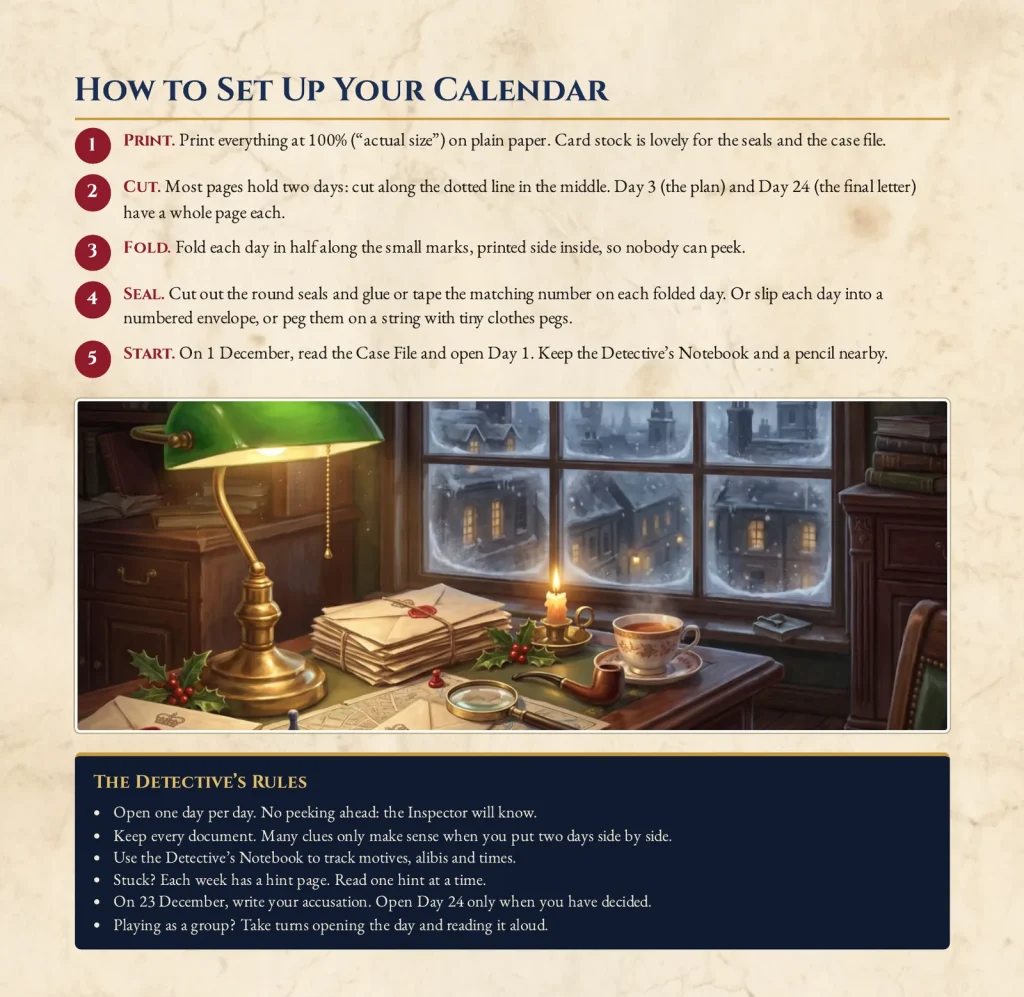
If you’d rather use envelopes than stickers, measure the folded day first. A half sheet of US Letter folded in half comes to 4¼ × 5½ inches, which is exactly what an A2 envelope (4⅜ × 5¾) is made for. With A4, half a sheet folded once is A6, which slides into a C6 envelope (114 × 162 mm). Days that fill a whole page need a second fold or a bigger envelope. Number the envelopes on the back flap so the front stays clean on the string.
A string with tiny clothes pegs along a mantel is pretty, but it sits at eye level for every houseguest. A shoebox on a high shelf is much harder to peek into. Either way, keep the solution door apart from the rest, in a drawer the host controls.
Write these on an index card and prop it next to the calendar. Agree on them on December 1, before anyone has a theory to protect.
Rule 7 is the easiest to skip. Without it, the group drifts toward whichever theory was said out loud first.
If you miss a day, open both the next day. With a single case, read them in order, because a later document can assume you’ve seen the earlier one. With daily stand-alone puzzles, skip it and do it on the weekend, or not at all.
If you only get organized on December 8, open Days 1 to 4 that evening and Days 5 to 9 on the 9th, and you’re back on schedule. Starting after the 15th, consider playing the whole thing over two or three long sessions after Christmas instead. The documents only need to be read in order; the dates don’t matter.
Then there’s the player who falls behind. In families it’s the teenager who sleeps through breakfast. In offices it’s the colleague on leave. Have the day’s opener write a one-line recap on a sticky note and stick it on the document: “Day 9: the cook says the victim skipped dinner.” The latecomer reads the recaps, not the whole stack, and can still argue at the accusation.
Give each child a job that isn’t “solver”: one keeps the timeline, another reads the day’s document aloud. A job keeps them engaged on days when the clue is a dull railway timetable. If your youngest are under 10, give them a lighter game alongside, like our Christmas scavenger hunt clues or a Christmas escape room for kids on a weekend. For a family evening with the whole table, our Christmas game night ideas has 24 games with rules.
Keep separate notebooks. It’s more fun when two people reach different conclusions from the same documents, and the sealed accusation becomes a small bet, with the loser wrapping the remaining presents.
Check the license first. All three of the products in this article are licensed for home and family use only (the logic puzzles also cover a classroom), so for an office you need a calendar sold with a workplace or group license. The schedule below works for any 24-door calendar.
Put the calendar on a kitchen wall with a corkboard for the opened documents, and open at a fixed time, like the 10 a.m. coffee. Many offices close before the 24th, so go by door number rather than date. Say your last day is Friday, December 18: open one door a day from Tuesday the 1st to Friday the 4th, then two a day from Monday the 7th, with nothing opened at weekends. That brings you to Day 22 on Thursday the 17th. On Friday you open Day 23 in the morning, collect the sealed accusations, and read the final door at the holiday party. Our office Christmas party games guide has timing for that slot. If the calendar has a stand-alone puzzle behind each door, work the day’s puzzle together at lunch.
Open at the same time every day on a five-minute video call: one person breaks the seal and reads the document aloud, then posts a photo in the family chat for anyone who missed it. On the last night, everyone sends their accusation by private message before the final door is read.
An advent case is a slow burn, so it pairs well with one loud evening. The Christmas Mystery Collection includes The Nutcracker Affair along with a 1920s murder party, a family mystery without a murder, and a cold case. If you’re planning the party, the Christmas murder mystery party guide for adults covers the timeline, and how to host a murder mystery party covers casting, food and the reveal.
For a parent or sibling who reads every whodunit, print, cut and seal the days yourself and stack them in a numbered box, with the case file on top and the final door in its own envelope marked with the day it opens. Hand it over by the last weekend of November so they can start on the 1st.
Murder Mystery Hosting
Format by headcount, five settings for grown-ups, a December timeline with a ready save-the-date, and a dinner schedule built around the rounds.

Murder Mystery Hosting
How many guests to invite, a planning timeline that starts four weeks out, three ways to fit dinner into the rounds, and how to run the reveal.

GM Craft
Six formulas for naming a tavern mid-session, d20 tables to roll on, names by mood and ancestry, and shop names that say what's for sale.