GM Craft
D&D Spell Cards: How to Print, Sort and Use Them at the Table
How many spell cards each class really needs, why 2014 cards go wrong at a 2024 table, how to print them at the right size, and a simple system for using them mid-fight.
Six formulas for naming a tavern mid-session, d20 tables to roll on, names by mood and ancestry, and shop names that say what's for sale.
Your players have just reached town, it’s raining, and somebody says “we head for the nearest tavern.” You have about five seconds to name it, and most tavern names that stick follow a pattern. The fastest is The [Adjective] [Animal]: The Bashful Ox, say, or The Soggy Magpie. Say it, describe the painted sign over the door, and carry on.
The other five patterns below are nearly as quick, and if you’d rather roll, the d20 tables give you 400 combinations.
Old pub names look random until you know they started as pictures. In 1393 Richard II ordered that anyone brewing ale for sale “must hang out a sign, otherwise he shall forfeit his ale,” so the borough ale tasters could find every alehouse and check what it served (Wikipedia: Pub). Many customers couldn’t read, so the sign was a painting, and the painting became the name. As the World History Encyclopedia puts it, for centuries the sign named the pub, not the other way around.
That’s why the most common British pub names are things a painter can draw. The same article, citing The Wordsworth Dictionary of Pub Names, gives the top three as the Red Lion, the Crown and the Royal Oak. The Red Lion usually traces back to the heraldic lion of John of Gaunt. The White Hart spread under Richard II, who used the white deer as his personal badge. Pairs tell a story too: the Plough & Shuttle stood for a farmer and his wife splitting the work, he in the fields and she at her spinning wheel.
Two habits from real history carry straight into your campaign:
Nobody in the setting finds the name strange. Only the players do, so they’ll ask.
Copy these onto an index card and keep it behind your screen. Each one gives you names for a tavern in under ten seconds.
When you’d rather let the dice decide, these four tables work as a paper tavern name generator: roll a d6 for the pattern and fill it from the d20 tables.
d6: Pattern
| d6 | Pattern |
|---|---|
| 1–2 | The [Adjective] [Noun] |
| 3 | The [Noun] & [Noun] (roll the noun column twice) |
| 4 | [Keeper]’s [Noun], e.g. Old Wenna’s Hare |
| 5 | The [Noun]’s Rest |
| 6 | The [Adjective] [Noun], but the regulars call it something else (roll on the nickname table) |
d20: Words
| d20 | Adjective | Noun |
|---|---|---|
| 1 | Tipsy | Badger |
| 2 | One-Eyed | Otter |
| 3 | Patient | Hare |
| 4 | Soggy | Ram |
| 5 | Bashful | Mule |
| 6 | Hungry | Magpie |
| 7 | Three-Legged | Toad |
| 8 | Velvet | Pike |
| 9 | Grumbling | Ox |
| 10 | Lucky | Cockerel |
| 11 | Painted | Bishop |
| 12 | Frostbitten | Widow |
| 13 | Honest | Ladle |
| 14 | Bald | Thimble |
| 15 | Barefoot | Boot |
| 16 | Brazen | Bell |
| 17 | Tin | Pickaxe |
| 18 | Second-Best | Griffin |
| 19 | Wicked | Wyvern |
| 20 | Whistling | Bucket |
d8: Keeper
| d8 | Keeper |
|---|---|
| 1 | Old Wenna |
| 2 | Bram Tollis |
| 3 | Mother Huckle |
| 4 | Widow Fask |
| 5 | Tamsin Rook |
| 6 | Big Ulla |
| 7 | Ferris Gant |
| 8 | Aldo Swale |
d6: What the regulars call it
| d6 | Nickname |
|---|---|
| 1 | The keeper’s name, never the sign |
| 2 | “The Last One,” because it’s the last door before the road out |
| 3 | “The Sticky Floor” |
| 4 | A rude version of whatever is on the sign |
| 5 | “The Hole,” because you step down three stairs to get in |
| 6 | Just “home” |
Here’s a sample roll: 6 on the pattern, 5 and 9 on the d20s, 5 on the nickname. The sign says The Bashful Ox, and every local calls it The Hole. Players will hear both names from different NPCs.
A name should tell the players who drinks there before they open the door. That’s what most lists of D&D and fantasy tavern names leave out: the names are fine, but nothing tells you which one fits your town. Start from what the town makes, trades or fears, then pick words from that world. A mining town names things after tools and the dark, a river town after fish and boats.
| Mood or folk | Words that fit | Names | A sign to describe |
|---|---|---|---|
| Cozy village | loaf, sock, porridge, slipper | The Warm Loaf, The Darned Sock, The Porridge Pot | A loaf steaming on a board |
| Rough and shady | tab, rope, ditch, rat | The Unpaid Tab, Rope & Ditch, The Rat That Got Away | A rat running off with a coin |
| Noble quarter | glove, ermine, quill, swan | The Kid Glove, The Ermine & Quill, The Lady’s Favor | A white glove on red velvet |
| Frontier | wagon, pelt, salt, axe | The Last Wagon, The Wolf Pelt, The Salt Lick | A wagon wheel with a spoke missing |
| Dockside | tar, gull, tide, hook | The Tarred Gull, The Low Tide, The Gull’s Debt | A gull with tar-black wings |
| Mountain pass | goat, chimney, sledge, snow | The Snowbound Goat, The Long Chimney, The Thawing Sledge | A goat up to its knees in snow |
| Dwarven | ore, oath, beard, vein | Deepvein Alehouse, The Unbroken Beard, Ore & Oath | A braided beard cut from iron |
| Elven | willow, dusk, dew, bough | The Willow Who Waits, Under the Third Bough, Dusk & Verse | A willow leaning over still water |
| Halfling | pantry, plum, burrow, pudding | The Full Pantry, Plum & Pudding, The Snug Burrow | A round door with a plum painted on it |
| Pilgrim road | candle, bowl, saint, mule | The Pilgrim’s Bowl, The Kneeling Mule, The Seven Candles | Seven candles in a row |
Inn names deserve a word of their own. An inn rents beds, a tavern or alehouse may not, so inn names lean toward roads and rest (The Ferry House, The Inn at Seven Stones) while taverns lean toward drink and gossip.
The joke has to be about the place, not about the players’ world. A pop-culture pun gets a laugh once and then breaks the mood every time someone says it. Ironic names last longer, because the joke turns into a detail you can play:
If your table hasn’t talked about tone yet, settle how silly the world can get before the first pun lands; our session zero questions cover it.
For a grounded campaign, copy the logic from the history section rather than the names. Take a lord’s badge and a color (The Black Ram), a trade and the word Arms (The Weaver’s Arms), farm tools (The Sheaf & Sickle), a count of everyday things (The Three Ladles), the building’s old job (The Tollhouse) or a churchy image with a twist (The Mitred Goat, The Praying Hare). None of these needs a fantasy word.
Shops follow the same sign logic, with one extra job: the name has to say what’s inside, or players will walk past it. The two reliable patterns are owner plus trade (Gant & Sons, Smiths) and a sign object that stands for the trade.
| Shop | Name | What hangs over the door |
|---|---|---|
| Blacksmith | Gant & Sons, Smiths | A horseshoe nailed open end up |
| Alchemist | Mortar & Mercy | A glass flask with a crack mended in wire |
| General store | Breckwood Sundries | A broom, a lamp and a coil of rope on hooks |
| Curio or magic shop | Second Sight Curios | One painted eye; a card in the window reads “No refunds on curses” |
| Tailor | Hem & Hood | Shears as tall as a child |
| Bookseller and scribe | The Dog-Eared Page | A wooden book, open and weathered |
| Pawnbroker or fence | Fask’s Loans, No Questions | No sign at all, just a green door |
| Healer | Saint Brisa’s Infirmary | A white hand painted on blue |
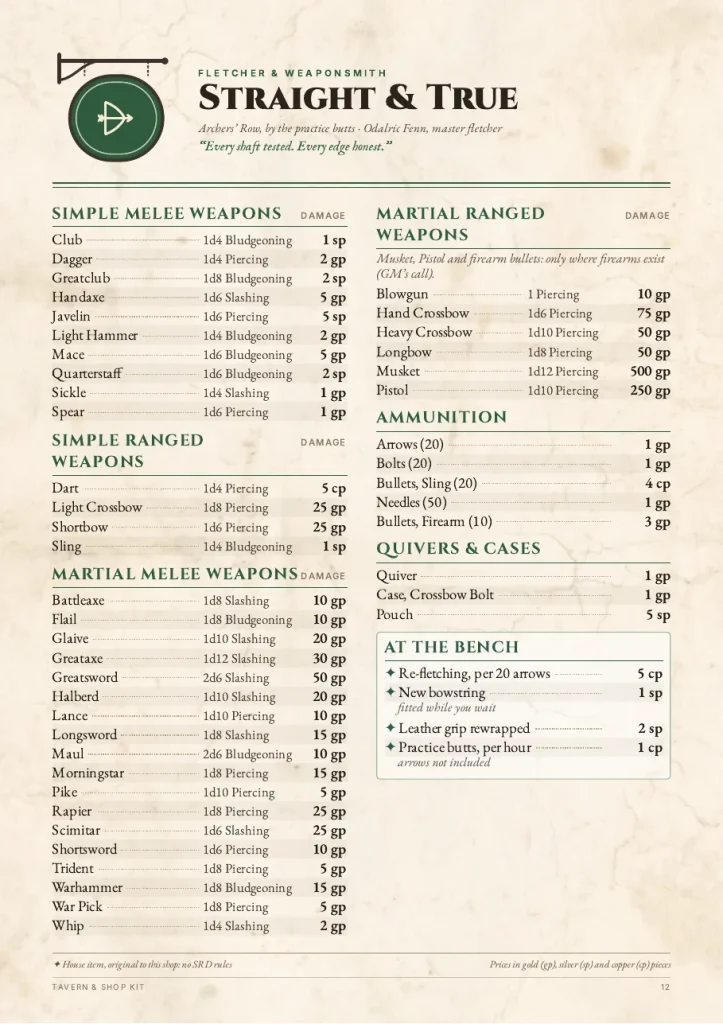
The fletcher’s price list in our Tavern & Shop Kit shows the idea: a bow on a round hanging sign, the trade printed above the name, and a motto underneath.
A name is worth the trouble only if it gives you something to describe. Pull four details out of it, each one taken straight from the words: what the sign shows, one house rule, one thing on the menu, and one oddity or rumor. Here’s The Bashful Ox from the sample roll:
Read-aloud version: “Above the door, a painted ox hides its face behind one hoof. Inside, a chalkboard says NO SHOUTING. THE OX STARTLES. The room smells of stew and wet wool, a pair of enormous horns hangs over the bar, and the keeper is already pouring something pale.”
A paragraph like that takes a couple of minutes to write and gives your players four things to poke at. Have the keeper’s answer about the horns ready.
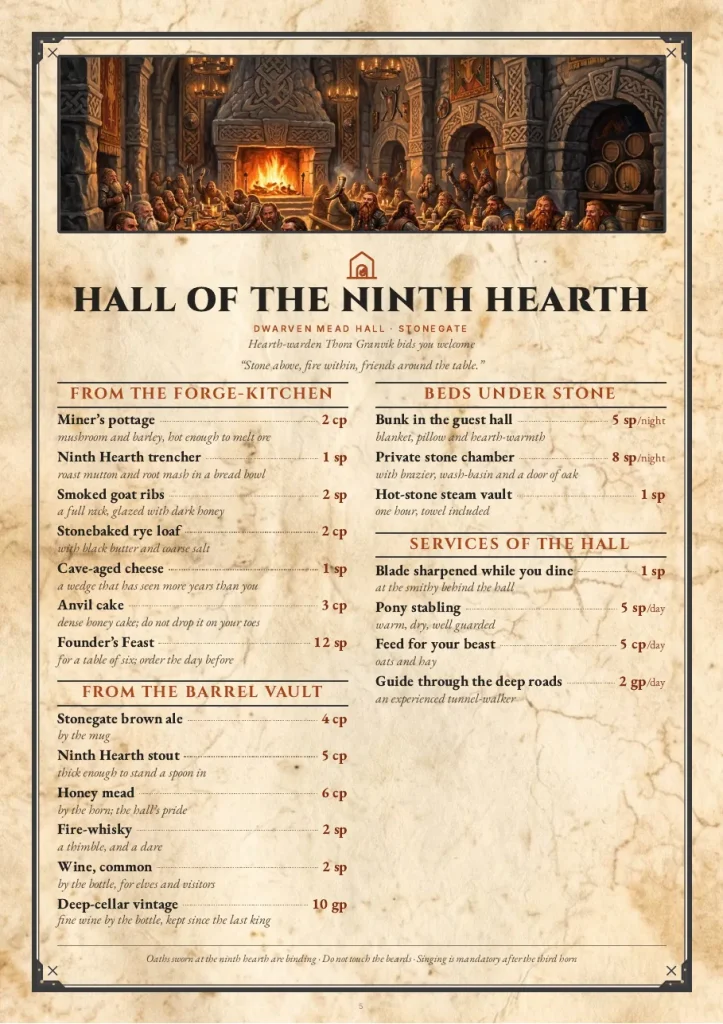
If you’d rather not build all of this at the table, the Tavern & Shop Kit has it done for six taverns and six shops. Each tavern menu names its keeper and ends with a line of house rules; The Salted Eel’s are “No knives on the bar · Fights go outside · The eel is not a pet,” and the dwarven Hall of the Ninth Hearth below bans touching the beards. There are 12 NPC cards, d20 tables for who’s in the taproom and what they’re gossiping about, a d12 of tavern events, and its own d100 Name That Tavern table, so you’d have two generators to roll on. The kit is 5E compatible, uses the SRD 5.2.1 prices, and isn’t affiliated with Wizards of the Coast.
Before your next session, write four names on an index card (a cozy tavern, a rough one, a roadside inn and a shop), each with a sign and a house rule. Clip the d20 tables above to the same card and roll the rest when the players surprise you. It’s the same idea as our 20-minute DM prep checklist: prepare a few small pieces you can improvise around, and leave the rest to the dice.
GM Craft
How many spell cards each class really needs, why 2014 cards go wrong at a 2024 table, how to print them at the right size, and a simple system for using them mid-fight.
GM Craft
How to find out what your GM already owns without spoiling the surprise, then gift ideas sorted by the way they run the game, by budget, and a list of what to skip.
GM Craft
How to run a horror one-shot for your D&D table in a single evening: a run sheet, a safety talk script, visible clocks, the rule of escalation and six premises you can prep this week.