GM Craft
D&D Horror One-Shot: How to Run It, Plus 6 Ready Ideas
How to run a horror one-shot for your D&D table in a single evening: a run sheet, a safety talk script, visible clocks, the rule of escalation and six premises you can prep this week.
A complete session zero checklist split into the week before, the meeting itself and the follow-up, with the questions to ask your players, a 90-minute agenda and a two-minute version for one-shots.

A session zero checklist is the list of things a game master and the players settle before the first real session of a campaign: the pitch and tone, content limits and safety tools, the schedule and house rules, and how the characters know each other. The full checklist is right below, split into what to do the week before, what to cover at the table and what to send afterward. After it you’ll find the questions worth asking, a 90-minute agenda and a two-minute version for one-shots.
Most campaigns that fall apart don’t end in an argument. They fade. One player wanted a heist story and got a dungeon crawl, half the group assumed weekly games while the other half assumed “roughly monthly,” and by session six the group chat has gone quiet. Nearly all of that can be caught in one evening of talking before anyone rolls initiative.
A session zero is a meeting before the campaign starts where the GM and players talk about the game instead of playing it. Mike Shea of Sly Flourish describes the goal plainly: it helps everyone manage their expectations about what the game is and what it is not, ties the characters to one another and to the world, and defines the boundaries of play.
It’s worth running for a brand-new group and for friends who have played together for years, because a new campaign is a new promise and people’s tastes shift. The checklist works the same for a D&D session zero before a 5E campaign as for any other system. Only the rules questions change.
Copy this into your notes, or print it and tick boxes as you go. Not every line fits every table, but skipping one should be a decision, not something you forgot.
If you’d rather not retype all of this, the Session Zero Kit has a GM pre-zero checklist split into before, during and after the meeting, plus a player expectations questionnaire, a safety tools agreement, a content matrix, backstory and party connection sheets and a group covenant to read aloud and sign. It’s a print PDF with a fillable browser version, and it works with 5E compatible games or any other system.
The checklist tells you what to cover. This running order tells you when. It’s built for about 90 minutes of talking, before character creation.
| Time | Segment | Goal |
|---|---|---|
| 0:00 | Welcome and pitch | Read the pitch, hand out the one-pager, answer questions |
| 0:10 | Expectations | What each player wants from the game |
| 0:25 | Content and safety | Content matrix, lines and veils, safety tools demonstrated |
| 0:45 | Logistics and house rules | Schedule, absences, rulings, table etiquette |
| 1:00 | Characters and connections | Concepts, ties to each other and to the world |
| 1:30 | Wrap-up | Recap what was agreed, set homework, tease session one |
If you’re short on time, cut it to about 30 minutes: pitch, expectations and the content conversation, with logistics handled in the group chat afterward. For a campaign meant to run for a year or more, stretch it to a full evening of around three hours, with party connections built together and a written covenant at the end.
These are the session zero questions worth sending ahead or asking around the table. You won’t need all of them. Short answers beat clever ones, and quieter players answer better on paper than on the spot.
That last one is the most useful question on the list. It surfaces the railroading GM, the spotlight hog, the campaign that collapsed into player-versus-player feuds. What your table is wary of often tells you more than what it wants.
A content matrix makes this faster and less awkward. List common topics and let each person mark them Green (want more), Neutral (fine in the background), Veil (off-screen only) or Line (never). People will tick a box they’d never say out loud, and you get a map instead of guesses.
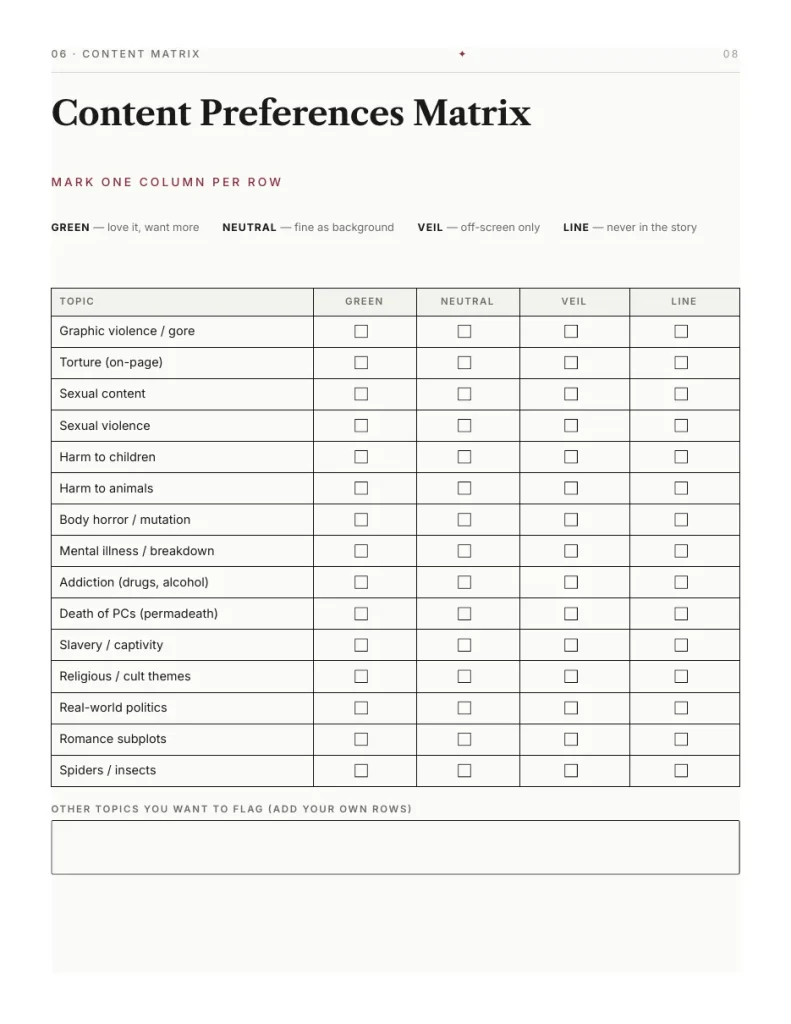
Never ask anyone to justify a line. “No harm to animals” is a complete sentence. If an edge needs clarifying, ask privately, later, and accept “I’d rather not” as an answer.
Go around the table for the connection questions so ties form in both directions. “My cleric pulled your fighter out of a river three years ago” hands two players a story at once. Shea suggests tying the whole group to a single patron, which is often an easy way to bind a party together. If a player loves long backstories, let them write one, but ask for the hooks separately: people, places and unresolved threads you can actually use.
A content list covers what you can predict. Safety tools cover the rest. These are the ones most tables pick from, with the people who designed them.
For a deeper library, the TTRPG Safety Toolkit, co-curated by Kienna Shaw and Lauren Bryant-Monk, is free and collects these tools with credits to their designers (it won the 2020 ENNIE Award for Best Free Game/Product, according to Wikipedia). Monte Cook Games’ free Consent in Gaming, by Sean K. Reynolds and Shanna Germain, includes a consent checklist you can hand out as is.
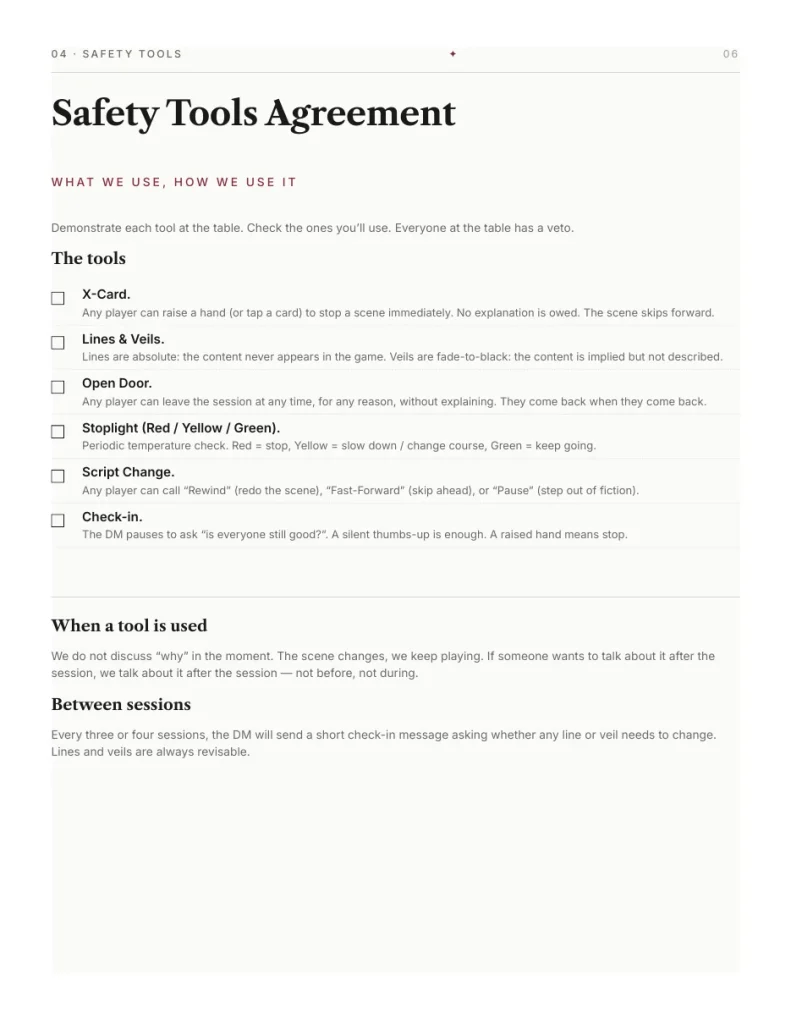
Two habits make these tools work in practice. First, demonstrate them, don’t just name them. Tap the card yourself during a made-up example: “Say the bandit starts describing what he did to the prisoner. I tap this. We skip it, the bandit stays menacing, we keep going.” It takes thirty seconds and everyone sees it’s real. Second, nobody discusses “why” in the moment. The scene changes and play goes on. If someone wants to talk about it, that happens after the session. Stavropoulos’s own framing is that the card’s presence tells the table the people playing are more important than the game.
A one-shot or a convention game still needs a session zero, just a much shorter one. Sly Flourish’s two-minute session zero runs like this, right before play:
With strangers or dark material, step five matters more, not less. If you’re running something like a horror one-shot, name the themes on the table before the lights go down and agree lines on the spot.
Send the written summary within a day or two. It’s the document you’ll point back to months later, when someone asks whether you ever agreed on permadeath. Start the per-session recap habit at the same time. The Campaign Chronicle has dispatch templates for this, from a five-minute Quick Chronicle (three bullets and a cliffhanger) to a full in-world newsletter.
Then session one has to deliver on what you promised. Use the answers right away: if a player said they love mysteries, the first scene has a clue in it, and if someone’s character owes a smuggler money, that smuggler is on the docks tonight. Skip the tavern meeting and start in motion. Shea treats the opening like a film’s cold open, and the prep for it is often a single sentence. Keep the rest of your prep light, with a few secrets, a few NPCs and a location or two. Our guide to DM prep walks through what to write down and what to leave to the table. End on time, on a hook.
If you have energy left after character creation, Shea likes a short “session 0.5”: a small adventure with a challenge, some roleplay and a hook for what’s coming.
For a first-time GM, the First Session Playbook covers this whole stretch, from a 15-minute mini session zero to prepping in 60 minutes and running a first combat.
If your table plays Daggerheart, the GM Companion & Campaign Builder, a Daggerheart compatible workbook, includes session zero and safety tool pages alongside campaign planning.
If your session zero is this week, do three things tonight: write the tone in two words, write the one-sentence pitch, and send the player questions. Everything else is on the checklist above.
GM Craft
How to run a horror one-shot for your D&D table in a single evening: a run sheet, a safety talk script, visible clocks, the rule of escalation and six premises you can prep this week.
GM Craft
A DM prep checklist you can finish before the doorbell rings: a 20-minute version, a copyable prep sheet with a worked example, and a ten-minute habit after each game.

Murder Mystery Hosting
Format by headcount, five settings for grown-ups, a December timeline with a ready save-the-date, and a dinner schedule built around the rounds.