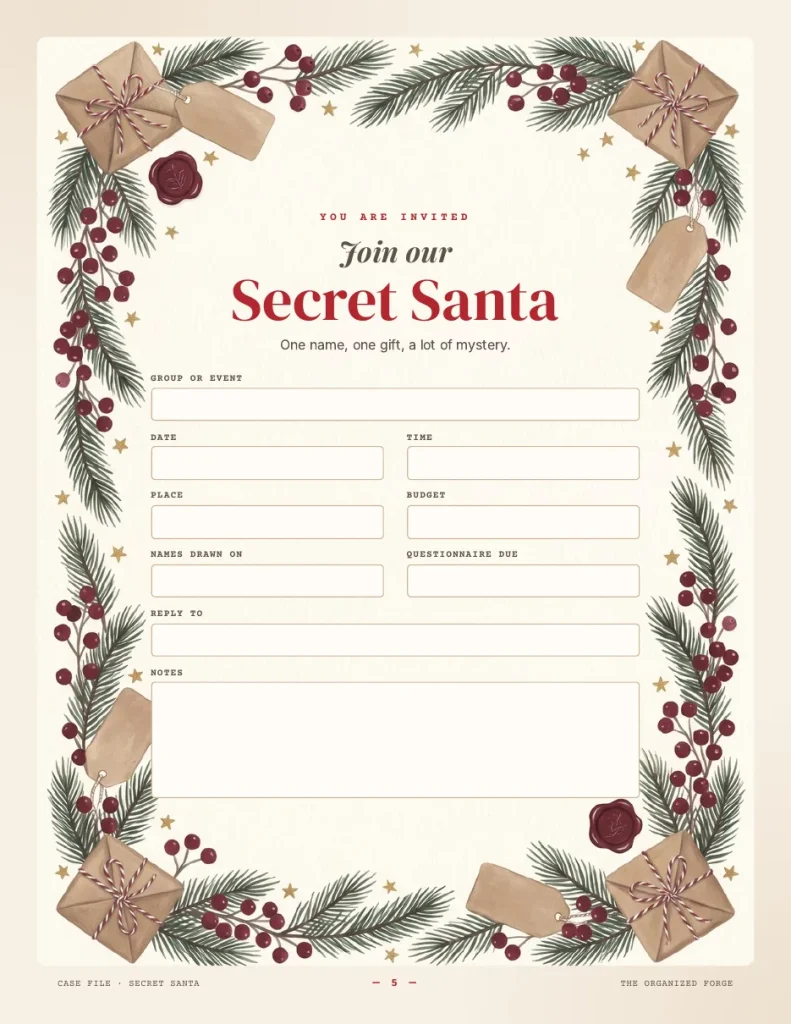
Secret Santa Questionnaire: 13 Questions That Get Better Gifts
A copy-ready Secret Santa questionnaire with answers a Santa can buy, versions for coworkers, friends, kids and family, and a foolproof name draw.
,
9 minute read
A good Secret Santa questionnaire has 10 to 13 questions, and every one of them should hand your Santa something they can actually buy within the budget. “Favorite color” on its own buys nothing. “Something you use up and buy again, and the brand” buys a gift. Send the questionnaire with the invitation, collect it before you draw names, and pass each Santa their person’s answers along with the name.
Below you’ll find a complete questionnaire to copy, versions for coworkers, adult friends, kids and family, the questions to leave off, and how to run the draw so nobody pulls their own name. (If your group wants to unwrap, swap and steal gifts at the party, that’s a white elephant, a different game with its own rules.)
The printable Secret Santa questionnaire (copy and paste)
This is the general template, for adults who know each other reasonably well. Replace [budget] with your actual number before you send it, because a budget printed on the form keeps the answers realistic.
Secret Santa questionnaire
Your name (and the name you’d like on your gift tag, if different).
Something you use up and buy again. Tell us the brand or flavor you like (coffee beans, hand cream, a pen, hot sauce).
Something under [budget] you’d love but never buy for yourself.
A hobby you spend real time on, and one piece of gear for it you don’t own yet.
Something you lost, broke or wore out this year and haven’t replaced.
An everyday object you’d happily upgrade to a nicer version (a mug, a water bottle, a notebook, a scarf).
Pets: species and name, if you have any.
Treats you love. Any allergies or diet rules (gluten-free, vegan, no alcohol, no caffeine)?
Scents: ones you like, ones you can’t stand, or “no scented things, please.”
Things you already own plenty of: mugs / candles / socks / novelty gifts / other ______.
Are these OK for you? Gift card (yes / only as a last resort / no). Second-hand or vintage (yes / no). Handmade (yes / no). Holiday-themed items (yes / no).
One good thing or a few small ones?
Your safety net: one exact item under [budget], with a store name or link, that your Santa can buy if everything else fails.
Thirteen looks long, but most answers take one line. If you add Secret Santa questions of your own, cut others to match: long forms collect thin answers on the last page.
To print it, keep the whole form on one Letter or A4 page and leave two lines of space under each question; a single line gets you one-word answers. Print one copy per participant plus a couple of spares for the people who lose theirs.
Why each question earns its place
Questions
What they give your Santa
2, 6
A gift the person will use, in a brand they already like
3, 13
A concrete target at the right price, so the Santa isn’t guessing at 11 p.m. the night before the exchange
4, 5
Something specific and a little personal, which is what makes a gift feel chosen
7
A pet toy or treat is a cheap, warm fallback. In an r/secretsanta thread about what profiles should ask, the person who started it says they wished they had mentioned their pets
8, 9, 10, 11
The no-go list: it rules out the most common bad gifts
12
Tells the Santa whether to spend the whole budget on one item or make a small bundle
The most useful line on the whole form is number 13. Plenty of people write “anything is fine” everywhere else, and the safety net gives their Santa one safe purchase.
Versions for coworkers, friends, kids and family
Keep the core questions (2, 3, 8, 9, 11, 13) and swap the rest depending on who is playing.
Secret Santa questions for coworkers
At work, the questionnaire has two extra jobs: keep everything appropriate for an office, and keep it short enough that people fill it in between meetings. Cut the scent question down to yes or no, don’t add a clothing-size line (gloves, hats and scarves are fine), and add these:
Do you have your own desk, or do you hot-desk? (Hot-deskers have nowhere to keep a plant or a desk toy.)
How do you get to work: walk, bike, car, train, or from home?
Lunch: brought from home, bought nearby, or skipped?
What do you keep borrowing from coworkers (a phone charger, say)?
Is there anything you’d rather not get at work (food, joke gifts)?
The commute question is the sneaky good one. A train commuter can use a paperback or a small case for earbuds; a cyclist needs gloves or a light; someone who works from home might love a good mug and nothing that has to be carried. For a whole party built around the exchange, our guide to office Christmas party games has games sized by headcount and time slot.
Secret Santa questions for adult friends
Friends usually know each other well enough for more personal questions, and a bigger budget makes them worth asking:
Sizes, if you’re happy for someone to buy you clothes (top, bottom, shoes, gloves). Mark it optional.
Alcohol: yes, what kind, or no.
A subscription you’d enjoy for a month or two.
Something to do nearby that you’ve been meaning to try (a pottery class, say).
Secret Santa questions for kids
Kids fill it in with a parent, and the parent’s notes matter as much as the child’s. From the core, keep 3, 8, 13 and the gift-card line of 11; brands and second-hand shopping mean little to a seven-year-old. Then ask:
What are you into right now, this month? (Kids’ interests move fast, and answers from early November may be stale by the exchange.)
What did you play with last weekend?
Books: do you read on your own, or does someone read to you?
Something you asked for before and didn’t get.
Grown-up’s corner: allergies, no-go items (slime, glitter, noisy toys, small parts for younger siblings), screen-time rules.
Let younger kids draw their answer to “What are you into right now?”; a drawing can tell a Santa things a parent’s summary leaves out.
Secret Santa questions for family
In families the trouble is repeats: the same aunt gives the same scarf every year. Ask the questions that break the pattern and prevent duplicates:
What does the family always give you that you no longer need?
A household fix or upgrade you’ve been putting off.
Is a gift for the whole house fine, or would you rather have something just for you?
A gift from past years you still use, and why.
If you don’t want to typeset four forms, our Secret Santa Kit has four fillable questionnaires already designed (grown-ups, colleagues, kids and family) plus a wish list with sizes and prices, so each group gets the version that fits.
Questions to leave off
Most questionnaire mistakes come from asking too much, or asking something that sounds friendly and turns awkward once it’s printed.
Don’t ask
Why it backfires
Ask instead
Clothing size, at work
Plenty of people would rather coworkers not know it, and a size that’s wrong is worse than no gift
Leave clothing out of office exchanges, or ask about gloves, hats and scarves
“What do you want?”
People write “surprise me” and the Santa is back to square one
“Something under [budget] you’d never buy for yourself” plus the safety net
Favorite color, on its own
It narrows nothing
Pair it with an object: “If you had a new mug, what color?”
Home address on a group form
Everyone who sees the form sees the address
The organizer collects addresses privately, only for people who ship
Health, weight, religion, money
Too personal for a gift form, and nobody needs it to buy a present
Allergies and diet rules, plus “holiday-themed items: yes or no”
Joke questions (“your spirit animal?”)
Funny once, useless to the Santa
Keep the fun questions for the reveal at the party
When to send it, and how to collect it
Every form has to come back before you draw names, so the Santa receives the name and the answers together. Here’s a working schedule for an exchange on Friday, December 18, 2026, with Thanksgiving on November 26 in the middle:
Date
What happens
Mon, Nov 16
Send the invitation with the budget, the exchange date and the questionnaire
Mon, Nov 23
Questionnaires due
Tue, Nov 24
Draw names, send each Santa their person’s form (before people leave for the holiday)
Fri, Dec 11
Reminder: budget, date, how to label the gift
Fri, Dec 18
Exchange
That gives Santas a little over three weeks to shop. If anyone has to ship a gift, move every date one week earlier. The Secret Santa Kit’s organizer checklist runs the same kind of steps on a 3-4 week countdown, from invitation to reminder.
Paper and online forms both work, with different weak spots.
Paper is best when the group meets in person and the organizer hands out sheets in one room, say at a team meeting. The weak spot is the form that goes home in someone’s bag and never comes back. Collect them on the spot if you can.
An online form (any survey tool, or a fillable PDF sent by email) is better for remote teams and families spread across states. The weak spot is privacy: the organizer, and anyone with edit access to the form, sees every answer. Tell people that up front, and never forward the full spreadsheet; send each Santa only their own person’s answers, as a screenshot or a single page.
Late forms will happen. Draw on the date you announced anyway, and give the Santa of a missing form a nudge: they can ask the organizer to chase it, or ask a question or two through the organizer without giving themselves away.
Drawing names so nobody gets themselves
The hat draw has a math problem
In a plain hat draw, the chance that nobody pulls their own name is about 37% for any group of four or more; mathematicians call that outcome a derangement, and the share settles at 1/e. So roughly two draws in three leave someone holding their own name.
If you use a hat, make the rule clear before anyone draws: pull your own name (or your partner’s, if you’ve agreed couples skip each other), put it back and draw again. If the very last person is left with their own slip (or their partner’s), everyone puts theirs back and you start over. That’s annoying with 25 people, which is why bigger groups do better with the next method.
The chain method
Shuffle the names and write them down in that order. Each person buys for the next name on the list, and the last person buys for the first. Nobody can get themselves, and the whole group forms one loop, so the Santas can be revealed one by one, around the circle, at the party.
To keep partners apart, check the shuffled list before you finalize it. If two people who shouldn’t draw each other sit next to each other in the list, swap one of them with someone further down, then check the new neighbors too. Remember the last name buys for the first, so check that pair too.
Whoever writes the list knows every pair, so if the organizer wants to play, ask someone outside the group (a partner, a manager who isn’t playing) to shuffle and write it, or accept that the organizer’s own Santa won’t be much of a surprise to them.
The chain also fixes dropouts. If someone leaves after the draw, their Santa simply takes over the dropout’s person. With Ana giving to Ben and Ben giving to Cal, if Ben drops out, Ana buys for Cal instead, and nobody else needs to know anything changed. With a hat draw, only an organizer who recorded the pairs can do that repair.
At a distance
For remote groups, run the chain yourself (or have your outside helper run it), then send each Santa a private message with their person’s name and questionnaire, one message per Santa. Never put the assignments in a group chat or a shared document, even “just for a minute.”
Before you send the invitation
Paste the questionnaire above into a document or form, fill in the budget, and cut or swap questions for your group using the versions above. Then put four dates on the invitation: questionnaires due, names drawn, reminder, exchange. Choose hat or chain before you send it, so the rules are written down before anyone asks.