
Solo RPG
Solo Journaling RPGs: How to Start and Which Games to Try
A deck of cards, one die and a notebook: how solo journaling RPGs work, a first session played step by step, and six beginner games to try, some of them free.
Choose a winter journaling game by its emotional tone, risk of loss, writing load, and pace. Includes a comparison table and a one-prompt writing test.
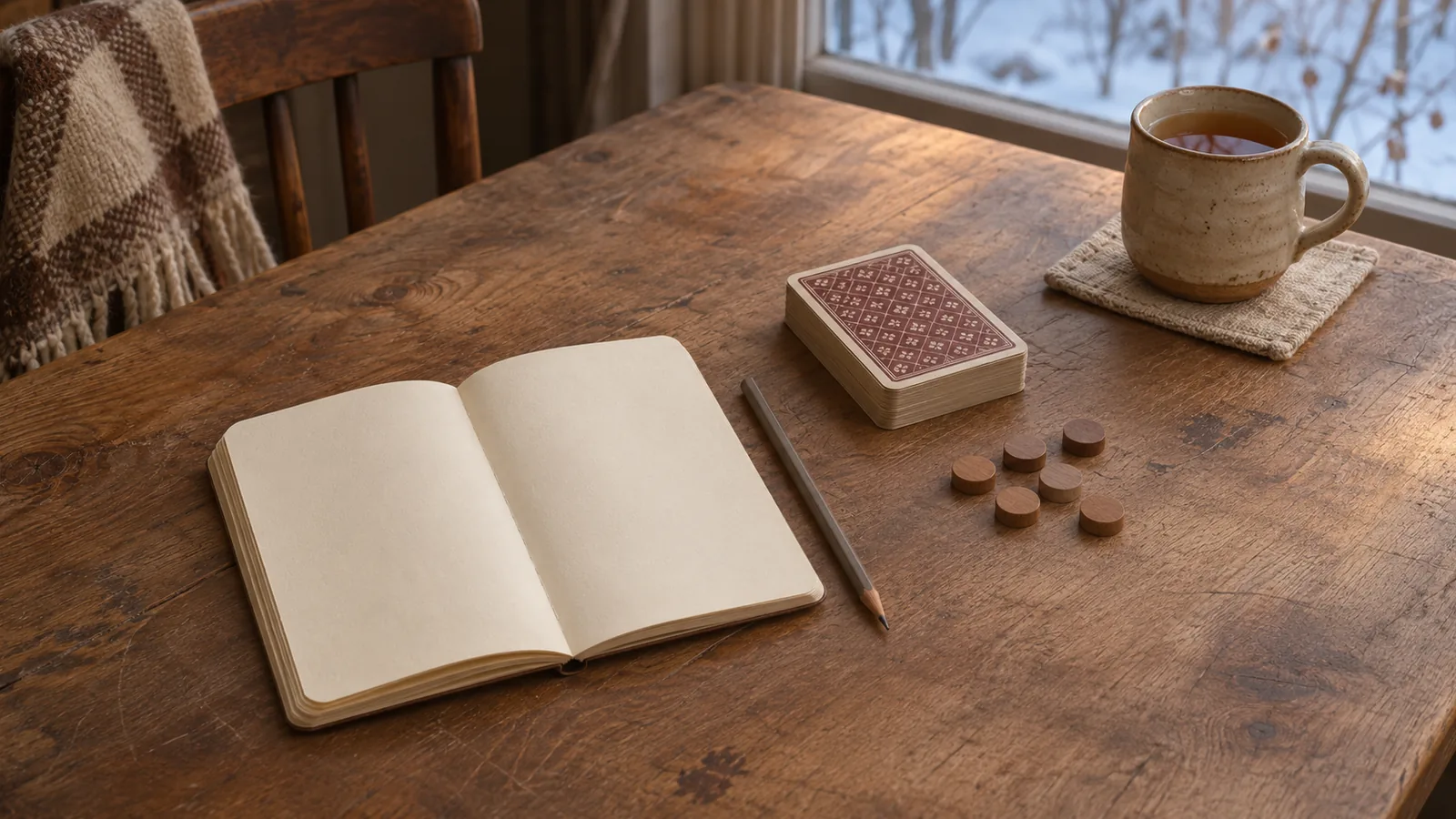
Choose a cozy solo journaling RPG by what happens on a difficult night in the fiction: can you lose your home, run out of a resource, or meet a prompt about grief? Then check how much writing one turn asks of you and whether the story wants daily visits or occasional longer sessions. A snowy cottage on the cover answers none of those questions.
For winter play, start with your actual evenings. If you want company after a tiring day, favor familiar characters and a mode that prevents resource loss from ending the game. If you want a little uncertainty, keep the risk but set limits on the themes. The comparison below helps you choose that combination without turning your notebook into December homework.
If you need the basics of cards, prompts, and playing without a GM, use our solo journaling RPG beginner’s guide. Here, the decision is which kind of cozy you want to spend the winter with.
Write one sentence about the experience you want. Make it specific enough to rule a game out:
“I want to visit the same place twice a week, write a few lines about its residents, and know that a bad roll won’t take it away.”
That preference points toward a recurring home base, brief entries, flexible scheduling, and protected stakes. Someone who wants to deliver letters through a dangerous winter may want almost the opposite, despite liking the same cover art.
These three games from our studio suit different evenings. The writing preferences below are editorial recommendations, not fixed word counts required by the rules.
| Game and focus | Risk and emotional tone | Writing and rhythm |
|---|---|---|
| The Winter Hearth: run a mountain inn and keep a Guest Book | Rolls against the cold; Cozy Mode keeps the hearth from going out. Includes illness, grief, and loneliness. | Card prompts; listed sessions of 20–60 minutes. Choose it if you want to record life at an inn. |
| The Midwinter Apothecary: gather ingredients and brew fictional remedies for a village | Cozy Mode keeps the stove from going out. Includes illness and encroaching cold. The remedies are fictional, not herbal or medical advice. | A Recipe Book and Villager Ledger suit players who like recording their work. |
| The Clockmaker’s Advent: repair a clock through 24 sequential Doors | Cozy Mode available. Content notes include loss, estrangement, old age, and Christmas loneliness. | Listed evenings of 15–40 minutes; December 1–24 or any 24 evenings. Choose it for a prescribed sequence. |
For any other game on your shortlist, check the same things in its description or preview. Look for explicit protection against terminal loss if you want a safe home base, specific questions if inventing everything tires you, and a visible task loop if you prefer decisions to paragraphs. Check missed-night rules for a daily ritual, or what you must record between sessions if your free time moves around.
Do not average away a dealbreaker. A game can suit your schedule and still be wrong for you if its central subject is something you don’t want to write about tonight.
For this comparison, treat tone and mechanical risk as two different settings.
Tone covers what you spend time imagining. Domestic tasks and small acts of kindness may be comfortable; illness, estrangement, or an empty chair at dinner may not be. Mechanical risk covers what the rules can take away. Even a story full of generous neighbors can have a dwindling resource and an ending you were trying to avoid.
A no-loss option changes the second setting. It does not necessarily remove grief from the prompts. Before buying, read content notes and search the preview for “safety,” “tone,” “failure,” and “ways to play.” If there is a Cozy Mode, check its actual rule rather than assuming it removes every kind of tension.

Before the first turn, make a small boundary note. For example: “Storms can delay visitors. Nobody dies from exposure. Family conflict stays off the page.” This is an example of a personal play boundary, not a rule quoted from a game. Follow the game’s safety guidance and change the prompt when it crosses your line.
If every setback makes you want to reverse the result, choose protected stakes at the outset. If removing loss makes the decisions feel empty, retain the resource pressure and soften the subject matter instead.
Page count is a poor way to judge how much you will write. A long rulebook can support short entries. A single question can occupy an entire evening if you decide to write the conversation in full.
Try this original sample before choosing a game:
Someone leaves a repaired mitten on your doorstep. The patch doesn’t match. Who recognized it as yours, and what will you do when you next see them?
Respond at the length you would genuinely enjoy after dinner. You can use one of these formats:
This is a format test, not a timed writing challenge. Notice where you stall. If the answer comes easily but expanding it feels like work, look for rules that let a short response carry the turn. If choosing a name stops you, favor a game with names and character tables. If you finish and immediately want a consequence, look for more mechanical decisions rather than a longer prompt list.
For a lighter session, set a personal ceiling of one short paragraph per prompt. That is an optional writing limit, not permission to skip required actions or ignore a game’s recordkeeping. Resolve every required step, but keep the optional prose brief.
Read the game’s play loop as verbs. “Draw, answer, repeat” feels different from “gather, choose, make, record,” even if both produce a journal. Decide which sounds restful to you. Resource tracking can be a pleasant little puzzle or an extra chore after a day spent with spreadsheets.
For an outside example, Apothecaria’s creator describes a village witch making potions for villagers, adventurers, and monsters. The page explicitly presents it as a long-term game and encourages taking time with discoveries. That makes it worth investigating if you want an ongoing practice built around helping people, rather than a story chosen mainly for a December finish date. Its listed supplies include a deck with jokers, a journal, and something to write with; don’t assume every card-based game uses the same deck setup.
A useful preview question is: “What will I actually write down after making a choice?” A recipe, a conversation, and a resource total ask for different kinds of attention.
Separate fictional time from real time. Village Witch’s official description gives your newly trained witch a year to find a village to call home. That is the character’s time frame, not a promise that the player needs a year to finish. The same distinction matters when a winter game describes days, nights, or seasons.
Choose whether to play one complete turn, several turns, or a fixed seasonal sequence.
A recurring short visit. Reserve one complete turn, then stop. This works when returning is the attraction and you don’t want to decide how far to play each night. Check that the stated session range fits your available time; a “card a day” label alone doesn’t establish that it fits ten minutes.
An occasional longer sitting. Play several complete turns on an evening when you have room. Leave a resume note so the next session begins with a decision rather than a search through old entries.
A finite seasonal sequence. Choose a defined number of visits if you enjoy approaching a known endpoint. Read the late-start and missed-night instructions before making a calendar for it. Do not turn fictional dates into an attendance requirement unless that is part of the fun for you.

This is an illustration from the game, not a page of Door slips; keep the slips unread until play.
Keep this note beside the game’s own tracker.
Example: “Stopped after evening meal. Resource totals are on the tracker. Mara wants the spare room for her sister. Next: draw the next night’s card.”
That is enough context to return without polishing yesterday’s prose. If a week passes, resume from the recorded state. Consult the game’s scheduling rules if it has them; don’t invent penalties for your real-life absence.
Keep the physical setup equally modest. Read the PDF on screen if that suits you, and print only the sheets you plan to mark, unless the game requires printed components. Check the paper size and printing instructions before sending a whole book to the printer. A notebook, a rules bookmark, and a place for the tracker are more useful than a table you must rebuild every session.
Make a shortlist of two games and give each the same five checks:
If you’re torn between domestic comfort and winter suspense, choose based on your tired evenings, not your most ambitious ones. Keep optional writing short for the first sitting, resolve a complete turn, and leave the resume note before closing the book. You can add longer scenes once you know you want them.
Solo RPG
A deck of cards, one die and a notebook: how solo journaling RPGs work, a first session played step by step, and six beginner games to try, some of them free.

Murder Mystery Hosting
Plan an adult birthday mystery around the guest of honor. Choose their role, send clear invitations, and leave room for cake without interrupting the case.
Murder Mystery Hosting
Choose roles without putting guests on the spot, screen the story, and plan a teen mystery party that reaches the reveal before pickup.