
Murder Mystery Hosting
Christmas Murder Mystery Party for Adults: How to Plan It
Format by headcount, five settings for grown-ups, a December timeline with a ready save-the-date, and a dinner schedule built around the rounds.
A deck of cards, one die and a notebook: how solo journaling RPGs work, a first session played step by step, and six beginner games to try, some of them free.

In a solo journaling RPG you are the only player, and you play by writing. A deck of cards or a die picks tonight’s prompt, you answer it in a notebook, and over a few evenings the answers add up to a story nobody else has read. You don’t need a group or a game master, because the rules do that job.
The kit is probably already in your house. A standard deck of cards, one six-sided die, a notebook and a pen will run most of these games. Below you’ll find how the pieces fit together, a first session played step by step, a short list of solo RPG journaling games worth trying first (some of them free), and what to do when the page stares back at you.
The game hands you a character, a setting and a set of prompts. A randomizer, usually playing cards, dice or both, tells you which prompt you face today. You answer it in your journal, the game state shifts a little (a resource drops or a threat gets closer) and the story grows one entry at a time. You are the player and the narrator. The rules decide what happens next and when the story ends.
Solo roleplaying comes in two broad families. Traditional solo RPGs use an oracle, a yes/no table you consult to stand in for a GM while your character goes through a fairly conventional adventure with stats and fights; Dicebreaker’s beginner guide maps that side well. Journaling games lean the other way, with fewer numbers and more introspection. The question is rarely “do I hit the goblin?” and much more often “what do you remember about the person who taught you this?” If you enjoy writing backstory more than rolling initiative, start here.
The form is young but already large. Tim Hutchings self-published Thousand Year Old Vampire in 2019, and in 2020 it took ENNIE gold for Best Rules and Best Production Values. Researchers Jessica Hammer and Paul Czege noted 1,092 journaling games on itch.io as of 2023, as cited on Wikipedia’s solo RPG page, and in 2026 the ENNIE Awards added a Best Solo Game category.
Almost every journaling game is built from the same four parts. Learn them once and any new rulebook becomes a quick read.
A prompt is a short situation plus a question: something happens, and you decide what it means. Good prompts are specific enough to spark an image and open enough that you can still surprise yourself.
A standard 52-card deck makes a very good story engine. Designers usually give each suit a theme (memory, supplies, craft, danger) and write a prompt for every card. The deck also does two quieter jobs. It is a clock, because it runs out, so the story has a natural maximum length. And certain cards work as triggers: many games treat the four Kings as escalating events, and when the fourth one turns up the ending arrives, ready or not.
One six-sided die usually measures progress (did today’s work succeed?) or attrition (did the danger cost you something?). It adds the small jolt of not knowing, which keeps the story from feeling written to order.
Six coins, beads or tally marks often stand for a resource that drains and refills, such as warmth or lamp oil. When it runs out, the story bends toward a hard ending. Games in the Wretched & Alone tradition swap the tokens for a wooden block tower, and the game ends when it falls.
The rules are the GM. Your only job is to answer honestly and see what happens.
A turn is the same small ritual every time: draw a card, write the entry, roll the die.
If you are buying a game, check that it has a one-page quick reference, so you aren’t flipping through rules mid-entry, and journal pages you can reprint. Both make the first night smoother.
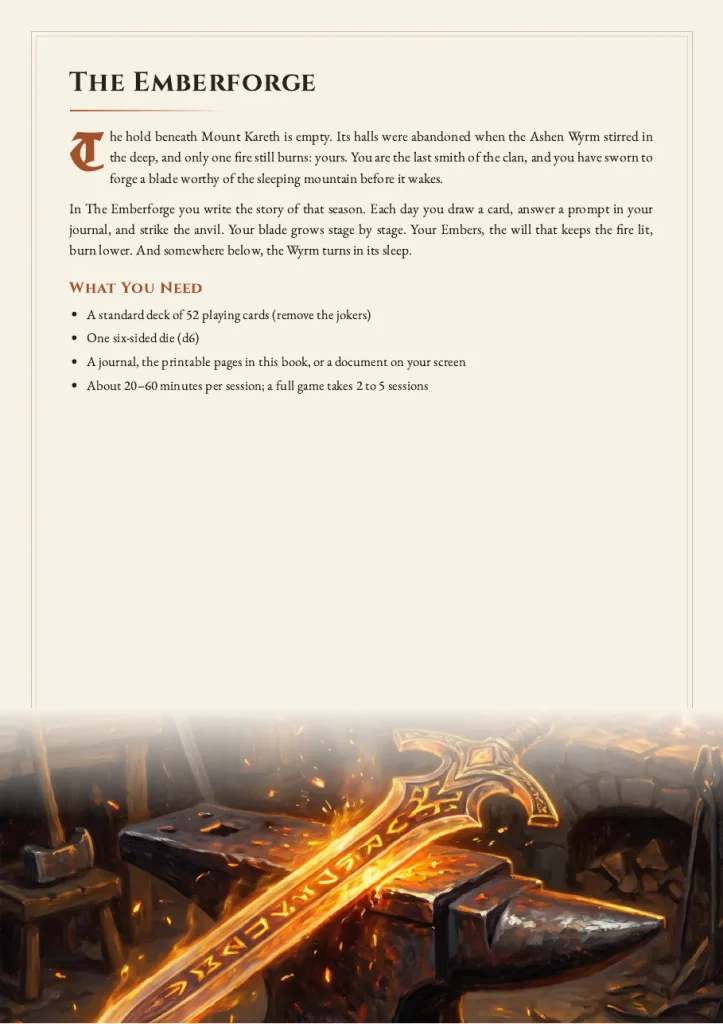
Here is a first evening with our own game, The Emberforge, picked because its rules are short enough to learn at the table. You play the last smith of an abandoned mountain hold, trying to forge a blade before the Ashen Wyrm sleeping below wakes up. You need a deck, a d6 and a journal; your six Embers, the will that keeps the fire lit, live on a tracker sheet.
You name your smith and write two lines about who they were before the hold emptied. Then you write what the blade is for: vengeance, protection, remembrance or something else. Mark your six Embers, shuffle the deck and set it face down.
Don’t overthink it. Two lines really means two lines. Your character becomes clear through play, not before it.
Say you draw the six of Hearts. Hearts in this game are about kin and memory, and the prompt reads:
“You set an extra place at the table without thinking. For whom?”
A first entry can be this short:
Third night alone. I set out two bowls again. Brannoc’s, with the chipped rim. He has been gone since the spring thaw, gone south with the others, and my hands still have not heard the news. I left the bowl where it was. It is easier than putting it away.
That is a complete entry. It has a person and an object in it, and the object will be useful later. Write a page if the prompt grabs you, but you never have to.
Roll the die to strike the anvil. On a 5 or 6 you gain one Progress on the current stage of the blade (a Club card makes it a 4 or better). Because you drew a Heart, you can also win back an Ember by writing one sentence of gratitude toward someone in your story: “Thank you, Brannoc, for teaching me to bank a fire so it lasts the night.” It is a small rule, and it shows how the whole genre works. The mechanics exist to make you write a particular kind of sentence.
You can stop after any card. Three to six cards, roughly twenty minutes, makes a good first session. End while you still want to know what happens next, because that curiosity is what gets you back to the table tomorrow.
These six are good first picks because each one teaches a different side of the form. Each name links to the designer’s or publisher’s own page.
| Game | Designer / publisher | What you need | Cost | Length | Pick it if you want |
|---|---|---|---|---|---|
| Alone Among the Stars | Takuma Okada (noroadhome) | 52-card deck, a d6, a journal | name your own price | a few minutes per session | a free first game you can finish tonight |
| The Wretched | Chris Bissette (Loot The Room) | a deck, a block tower, a way to record your voice | paid | 30 to 60 minutes | survival horror and real tension |
| Thousand Year Old Vampire | Tim Hutchings (Petit Guignol) | dice, a journal | paid | many evenings | the modern classic about memory and loss |
| Apothecaria | Anna Blackwell | a deck with jokers, a journal | paid | about half an hour per session | something cozy and funny |
| Koriko: A Magical Year | Jack Harrison (Mousehole Press) | tarot deck, dice, a journal | paid | six volumes, an hour or two each | a longer story told over many evenings |
| Ironsworn | Shawn Tomkin (Tomkin Press) | dice, the free character sheet | free digital edition | open-ended campaign | more mechanics, with quests and fights |
A few notes to help you choose.
Alone Among the Stars is pay what you want, so it costs nothing to try. You travel through space, and the cards and die tell you what you find on each planet. Its itch.io page lists an average session of a few minutes, so it is the gentlest possible start. If you run games for a group, one quick session can also hand you a strange planet or a lonely NPC for your next adventure, the kind of single detail our lazy prep method builds a session around.
The Wretched puts you aboard a crippled salvage ship as the last survivor, with an alien still outside the hull. It asks you to record your daily logs out loud, and a block tower is the ship’s structural integrity. Matt Sanders, with Bissette, later turned its structure into the Wretched & Alone system, which many other solo games now use.
Thousand Year Old Vampire has you write the centuries-long life of a vampire who can hold only five Memories at a time, so forgetting is part of play. It is heavier than the others, emotionally and in length, and repays the effort.
Apothecaria makes you a village witch brewing cures for villagers, adventurers and monsters with ailments like Fairy Fever and Candlesick. Koriko follows a teenage witch spending a year in an unfamiliar city and takes its inspiration from Kiki’s Delivery Service.
Ironsworn is not strictly a journaling game. It is an oracle-driven fantasy RPG that won the ENNIE for Best Free Game, and nothing stops you from keeping a journal alongside it. It is the natural next step if you finish a few journaling games and want more crunch.
For more free options, browse itch.io’s free journaling tag, or ask for recommendations in r/Solo_Roleplaying.
A deck of cards maps neatly onto days, and some games are built around that.
You can turn almost any card-driven journaling game into an advent calendar. Count out 24 cards, one for each day from December 1 to 24, keep any cards that trigger the ending in that stack, and shuffle the rest away. Draw one card each evening. If the game’s ending depends on a full deck, decide in advance that the 24th card closes the story, whatever it is.
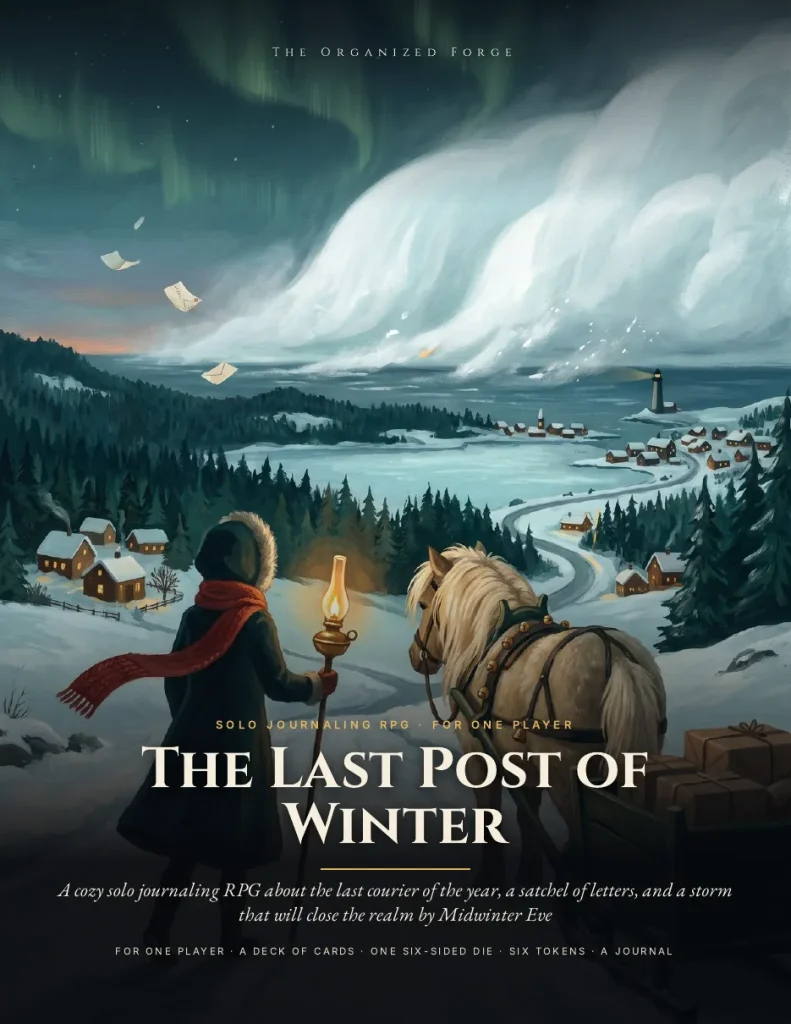
Some games build this in. In The Last Post of Winter you are a courier racing a storm across the snowy north, carrying a sealed letter addressed to you that you may only open on the last card. Its “A Letter a Day” mode keeps 24 cards for December 1 to 24, and if you miss a day you draw two the next evening.
October works the same way on a smaller scale: pick a game with candles and a little creep and play it one short chapter at a time. Our The Witch’s Library has a Quick Game that covers one wing of a tower per evening, which fits a week of rainy nights.
To make a December run feel like a ritual, count out the deck on November 30 and leave it next to your journal with a rubber band or ribbon around it. On busy nights, one line still counts.
Beginners often freeze because they assume every entry has to read like a novel. It doesn’t. All of these count:
Rule of thumb: if you can picture the moment, you have written enough.
The hard part is coming back on the third night.
Pick a fixed slot, like ten minutes after dinner or the last thing before bed. Attaching the game to a habit you already have works better than waiting for inspiration. If you like that idea, our guide to gamifying your goals uses the same trick for real-life habits.
Leave the next card ready. Draw tomorrow’s card at the end of a session and leave it face down on the journal. You’ll want to know what it is.
Open with a “previously on” line. Read only your last entry, then write one line about where things stand.
Let small details come back. The chipped bowl from night one can return on night six. Recurring objects and names give a solo story the texture of a novel without any planning.
Try a card a day. Many card-driven games can be played one card a day, which turns a game into a gentle daily practice instead of a project.
Group games use safety tools so everyone at the table can steer away from material they don’t want. The best known is Lines and Veils, first developed by Ron Edwards for the game Sorcerer, according to the Lines and Veils project. A line is something that never appears; a veil is something that can happen, but off the page. We cover how groups set these up in our session zero checklist.
Solo play deserves the same care, because journaling games often touch grief and loneliness on purpose. Before you start, note one or two lines of your own on the first page of the journal. And use the rule our games print in black and white: if a prompt lands too close to home, change it, soften it, or discard the card and draw another. That is never cheating. Some games, ours included, offer a Cozy Mode in which the worst ending can’t happen.
| The block | What to try |
|---|---|
| The blank page: you read the prompt and nothing comes | Answer with one concrete noun first (an object or a smell), then build a sentence around it. |
| The prompt doesn’t fit your story | Twist it. A prompt about a visitor can become a letter, a memory or a rumor about a visitor. Or draw again; many games allow it. |
| Perfectionism: every entry feels clumsy | Set a five-minute timer and write badly on purpose. You can polish later. You almost never will. |
| Every entry sounds the same | Rotate formats (letter, list, dialogue, sketch), or use one sense per entry: today, only sounds. |
| The story got too dark | Use your lines, switch to a gentler mode if the game has one, or write a small kindness into the next entry. A small kindness can turn a story without breaking it. |
| You missed a week | Don’t restart. Write one line in the character’s voice about the gap, and draw the next card. |
| The dice keep punishing you | Let it happen. A failing forge or a draining lamp is drama, and the best entries often come right before an ending. |
| You lost interest | Write the last entry now, as if the deck ran out. Then start a different game with a different mood. |
Murder Mystery Hosting
Format by headcount, five settings for grown-ups, a December timeline with a ready save-the-date, and a dinner schedule built around the rounds.
Holidays & Parties
24 Christmas games with the rules in a few lines each, sorted by who is playing: the whole family with no supplies, little kids, grandparents and grandkids, teens, and adults.

Planning & Productivity
A paper quest system for real life: a character sheet, quests, XP tiers, a weekly boss and a Sunday recap, with the research on what works and the rules that stop burnout.