Holidays & Parties
Christmas Scavenger Hunt Ideas for Teens, Adults and Groups
Five ways to run a Christmas scavenger hunt for teens and adults, with eight original riddles, a lights checklist for the neighborhood and real prep times.
Printable dreidel rules with the house-rule questions settled, a night-by-night game plan for Hanukkah 2026 that works around the two Friday nights, and eight original trivia questions.
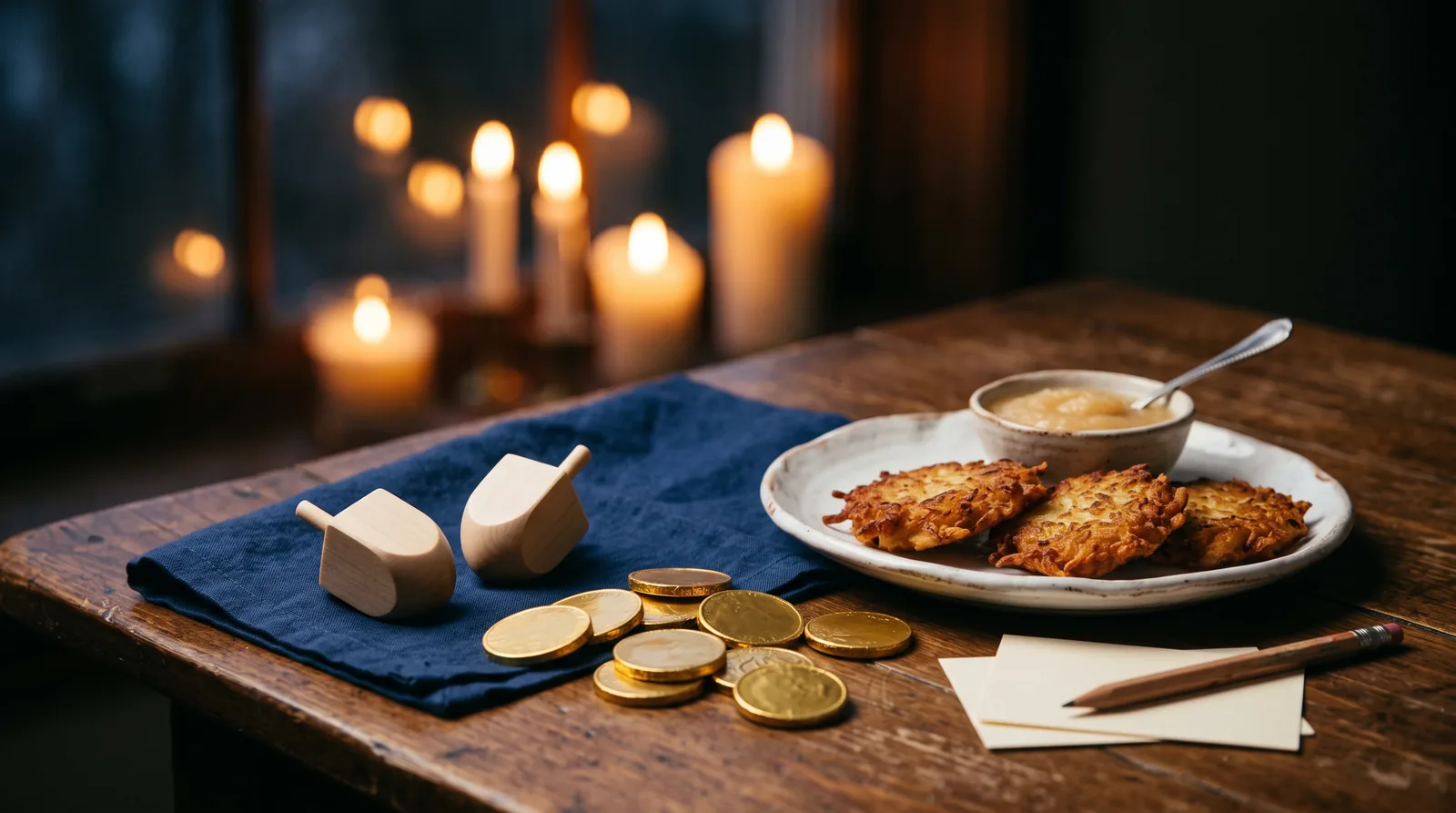
The best Hanukkah games are the ones that fit after the candles are lit: short, played around the table, and easy to stop when dinner is ready. That means dreidel first, then a handful of games you can rotate across the eight nights, like trivia, picture bingo, a latke tasting, would-you-rather questions and a longest-spin contest. Below you’ll find dreidel rules you can print, a night-by-night plan for Hanukkah 2026, a table of games sorted by age and time, and eight trivia questions written for this article.
One date note before you plan anything. In 2026, Hanukkah (Chanukah in many spellings) begins at sundown on Friday, December 4 and ends at nightfall on Saturday, December 12, according to Hebcal. The first and the eighth candles both fall on a Friday evening, so two of your eight nights are also Shabbat. The plan further down works around that.
| Game | Best for | Players | Time | What you need |
|---|---|---|---|---|
| Dreidel | Ages 5+ (simplified version for 3-4) | 2-8 per dreidel | 15-30 min | A dreidel, 10-15 pieces each (gelt, raisins, pennies) |
| Longest spin contest | Ages 5 to adult | Any | 10 min | Dreidels, a stopwatch or counting out loud |
| Picture bingo | Ages 3+ with pictures, any age | 2-30 | 20 min | Bingo cards, markers |
| Hanukkah trivia | Ages 9+, teams | 4-30 | 20-40 min | A printed question list |
| Would you rather | Ages 5+ | 2+ | 10-15 min | A printed list of questions |
| Latke tasting | Teens and adults | 4-20 | 30 min | Two or three batches of latkes, score cards |
| Gelt toss | Ages 3-10 | 2-12 | 10 min | Gelt, masking tape for a target on the floor |
| Fold-up paper dreidels | Ages 6+ (cutting), 3+ with an adult | Any | 25 min | Printed templates on card stock, scissors, glue |
A dreidel is a four-sided spinning top. Each side carries a Hebrew letter: nun, gimel, hei (also written hey or heh) and shin. Together they stand for Nes Gadol Haya Sham, “a great miracle happened there.” Dreidels made in Israel swap the shin for a pe, for Nes Gadol Haya Po, “a great miracle happened here.” The Hebrew name for the toy is sevivon, from the root “to turn around” (My Jewish Learning).
The miracle in question goes back to the Temple in Jerusalem. Judah the Maccabee and his followers recaptured it in 164 BCE, cleansed it and rededicated it, which is what the word Hanukkah, “dedication,” refers to. Later rabbinic tradition explains the eight days with a small amount of oil that burned for eight days (My Jewish Learning).
The letters also double as instructions, from Yiddish words: nun for nisht (nothing), gimel for gantz (everything), hei for halb (half) and shin for shtel arayn (put in) (Wikipedia: Dreidel). Kids who don’t read Hebrew yet pick up the shapes within a round or two if you say the action out loud every time the top falls.
Dreidel: the rules 1. Everyone starts with the same number of pieces: 10 to 15 each. 2. Everyone puts 1 piece in the middle (the pot). 3. Take turns spinning once each. 4. Nun: nothing happens. Gimel: take the whole pot. Hei: take half the pot. Shin (or Pe): put 1 piece in. 5. If the pot is odd on a hei, take half plus one. Decide this before the first spin. 6. When the pot is empty or down to 1 piece, everyone puts 1 piece in again. 7. Run out of pieces and you are out, or you may borrow from another player. 8. The game ends when one player has everything, or when the timer rings: most pieces wins.
Rules 1 to 7 follow the basic game as My Jewish Learning prints it, which also notes that rules vary from home to home. That variation is where most arguments at the table come from, so settle three things before the first spin.
The first is rounding on hei. The version above rounds up, so with 7 in the pot you take 4. Some families round down and leave the odd piece in. Neither is wrong; changing it mid-game is.
The second is the re-ante. Some players add to the pot only after a gimel empties it. Re-anteing whenever the pot drops to one piece keeps the game moving, because a spin on an empty pot is a wasted turn.
The third is borrowing. Loans keep small children in the game, which is kind, but they can stretch a game to an hour. With kids under seven, allow one loan per player. With older players, out means out.
With four to six players and 10 pieces each, plan on 15 to 30 minutes. Elimination games with 15 pieces and generous loans can run much longer, because the last two players trade the pot back and forth. To shorten it:
Gelt is the Yiddish word for money, and giving children small sums at Hanukkah is an older European custom (My Jewish Learning); the chocolate coins sold as gelt today take their name from it. If you play with chocolate, give each player a cup for their pile and one rule: nobody eats their stake until the game is over. Raisins and pennies avoid the problem entirely.
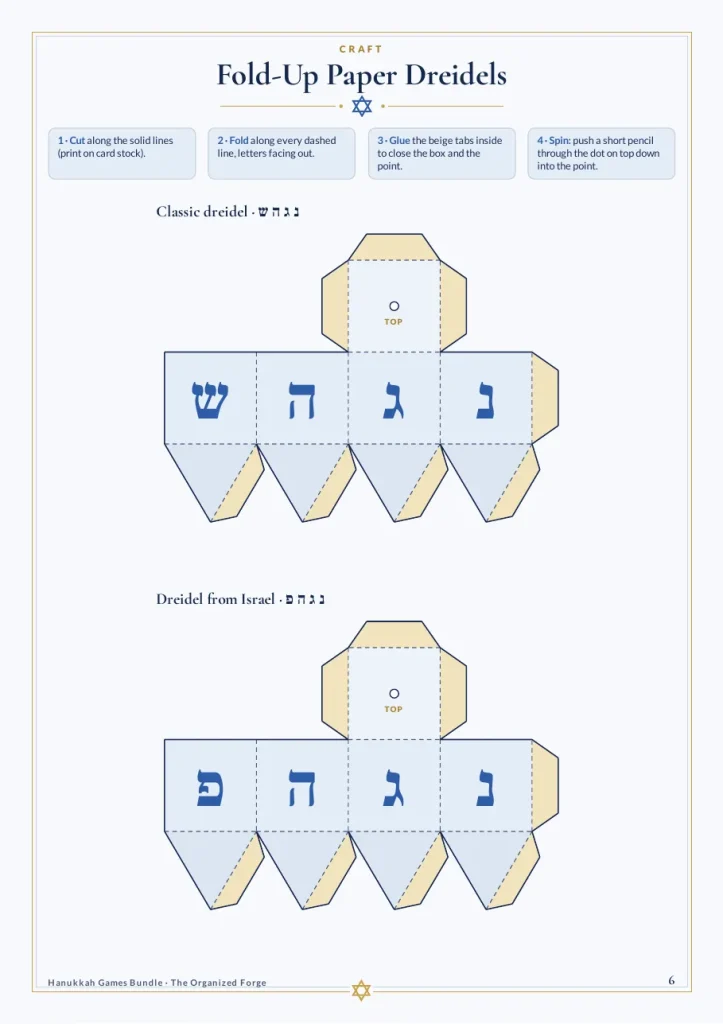
If you’re short on dreidels, paper ones work if you print them on card stock and push a short pencil through the top as a spindle. The template above, with a classic and an Israeli version, comes from our Hanukkah Games Bundle, which also includes a dreidel score sheet and 40 printable gelt tokens for families who would rather not play with chocolate.
This plan follows the 2026 calendar. Each night assumes 20 to 40 minutes of play after the candles, not a full evening. Swap nights freely; the only fixed points are the two Fridays.
In 2026 the first night is also the start of Shabbat. Lighting a fire is forbidden on Shabbat, so the hanukkiah is lit first, before the Shabbat candles, while it is still light out and before your local Shabbat candle-lighting time, which Hebcal lists by city (My Jewish Learning). Use longer candles or more oil than usual, since they need to keep burning for half an hour after nightfall (Chabad-Lubavitch).
Observant households avoid activities like writing and drawing on Shabbat (My Jewish Learning), and many also keep phones and money off the table. So pick spoken games: would you rather, a trivia round read from a list you printed earlier, or telling the Hanukkah story together, one person per part. Save the gelt and the dreidel for tomorrow.
Candles are lit after Shabbat ends; customs differ on whether the hanukkiah comes before or after havdalah. Then it’s dreidel night, and the natural moment for the tournament, since nobody has school in the morning.
The best night in 2026 for a Hanukkah party with friends: latke tasting, picture bingo for the kids, trivia teams for the adults.
School nights, so keep each one to a single game. Monday: ten minutes of would you rather at dinner, then a longest-spin contest. Tuesday: tzedakah dreidel, with the cause agreed before you start so the winner picks from a short list. Wednesday: picture bingo, eight rounds with eight different winning patterns (a row, four corners, a big X, the full card). Thursday: craft night, making the fold-up dreidels and testing them in a spin-off. Also on Thursday, print anything you want for Friday night.
All eight candles plus the shamash, lit again before the Shabbat candles and again with longer candles. Keep it to conversation: each person names a favorite moment from the week. Hanukkah ends at nightfall on Saturday, December 12.
If you’d rather not plan the week yourself, the bundle has eight activity cards, one per night, and the cards for Nights 1 and 8 are written to be Shabbat-friendly.
These eight were written for this article, and each answer is checked against the linked source. Read the question, give teams 30 seconds, then reveal. Questions 1 to 4 suit ages 9 and up; 5 to 8 are harder.
For a full trivia night you’ll want about 40 questions in rounds of ten. The bundle’s set has 40, grouped by topic from history to food and gelt, with an answer key and short fun facts to read between rounds. Two of them, to give you the flavor: “What does the Hebrew word Hanukkah mean?” and “Where is the hanukkiah traditionally placed?”
Three- to five-year-olds can’t follow a full dreidel economy, and they shouldn’t have to. Three games that suit them:
Keep coins, raisins and wrapped gelt at the table under an adult’s eye; small round pieces are a choking risk for toddlers.
This is the dreidel age. Use the full rules, add the tournament, and let the winner keep the “champion” dreidel until the next night. Kids this age also like:
Teenagers will play dreidel if something real is at stake, like choosing tomorrow’s dessert or skipping dish duty. For adults, the latke tasting does the work: three batches (classic potato, sweet potato, one experiment), applesauce and sour cream on the side, and blind score cards rating crunch, color and flavor. Latkes and sufganiyot (jelly doughnuts) are fried in oil in memory of the oil of the Temple (My Jewish Learning), so the tasting belongs to the holiday as much as the dreidel does.
Add the harder trivia questions above and a would-you-rather round between plates, and you have 40 minutes covered.
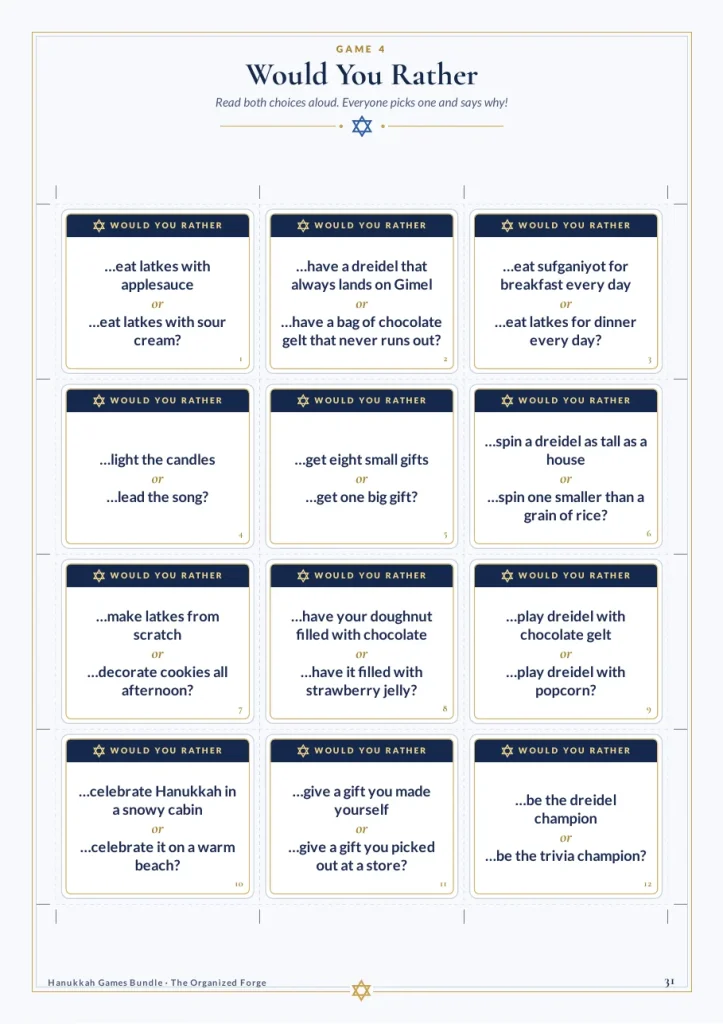
When guests range from toddlers to grandparents, and from lifelong dreidel players to a friend at their first Hanukkah, stations work better than one big game.
For 20 guests, print about 12 bingo cards (younger kids share with a parent), one rules card per dreidel table and score cards for every adult. At 12 pieces per dreidel player, 100 pieces of gelt covers eight players.
If your family also celebrates Christmas, the two holidays don’t touch in 2026: Hanukkah ends on December 12, nearly two weeks before Christmas Eve. For a separate Christmas evening later in the month, our Christmas game night ideas are sorted by group the same way.
If you’re planning ahead, the short list is: the dreidel rules box above (one per table), the eight trivia questions for Night 1, and a bingo set if you have kids under eight. A hanukkiah needs 44 candles for the eight nights, shamash included (My Jewish Learning); for the Fridays, set aside longer candles, 2 for Night 1 and 9 for Night 8. Add a bag of gelt for Night 2. If you’d rather print everything in one go, the Hanukkah Games Bundle has the rules, the paper dreidels, the trivia, the bingo and the eight-night cards in US Letter and A4.
Holidays & Parties
Five ways to run a Christmas scavenger hunt for teens and adults, with eight original riddles, a lights checklist for the neighborhood and real prep times.

Holidays & Parties
24 Christmas games with the rules in a few lines each, sorted by who is playing: the whole family with no supplies, little kids, grandparents and grandkids, teens, and adults.
Murder Mystery Hosting
Format by headcount, five settings for grown-ups, a December timeline with a ready save-the-date, and a dinner schedule built around the rounds.