Murder Mystery Hosting
Murder Mystery Advent Calendar: How to Choose, Prep and Play
How the three types of murder mystery advent calendar differ, how to pick one, and a print-and-seal plan so everything is ready by November 30.
Two schedules from doors to midnight that end before the countdown, a table for timing the reveal, masquerade versus 1920s, and a plan for guests who arrive late.
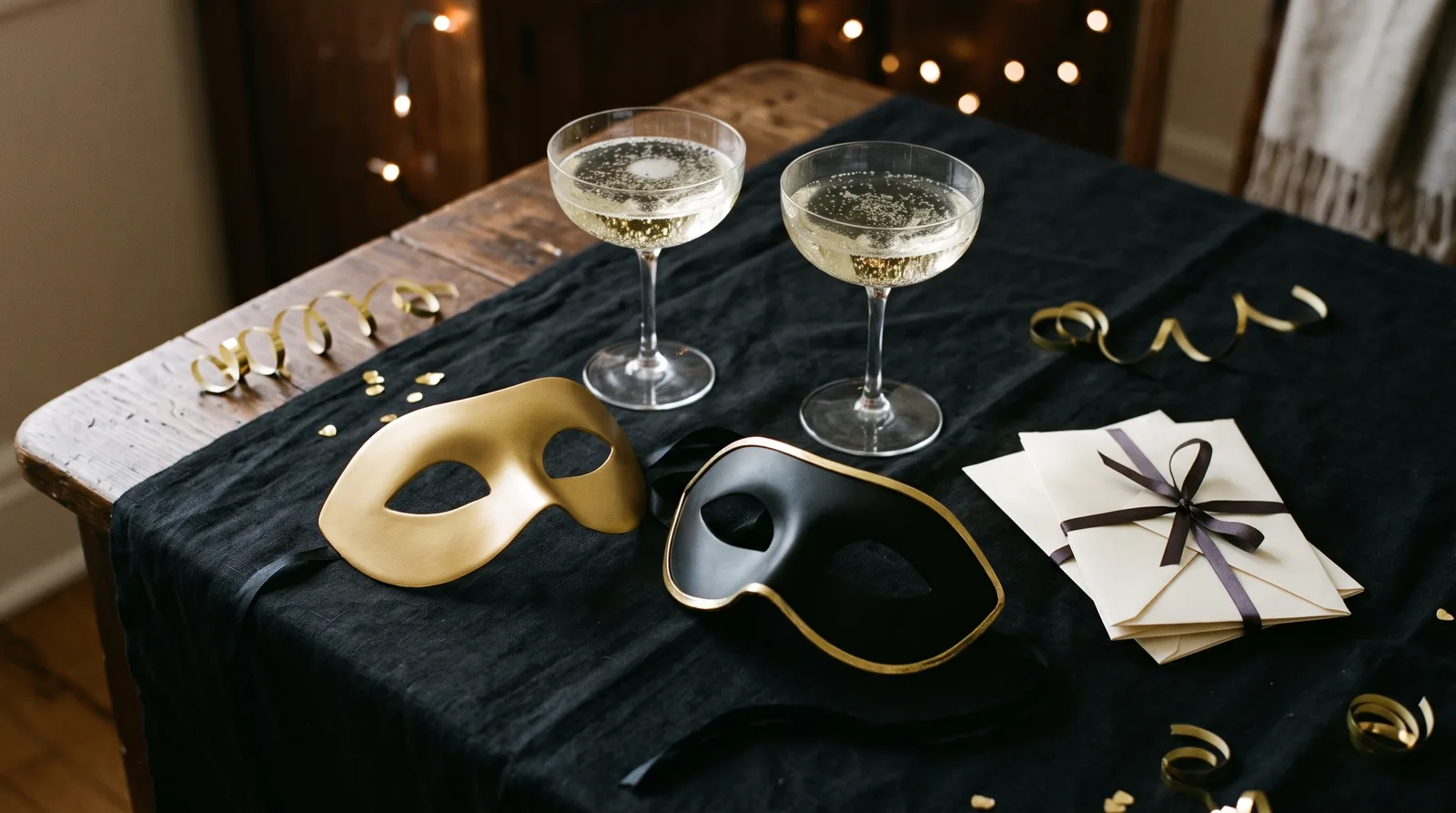
A New Year’s Eve murder mystery party works when you plan it backward from midnight. Decide first whether the killer is revealed before the countdown or after it, then fit three rounds of 30 to 40 minutes, the food and the late arrivals into the hours before. For most groups the safest plan is to collect accusations around 11:20 and read the solution by 11:45, so the last fifteen minutes belong to the clock and whoever you want to stand next to at twelve.
A New Year’s Eve murder mystery game that suits this night has four things going for it:
If you’re new to hosting, start with our complete host’s guide, which also compares printable kits with host-free dinner games; if kids are coming, see New Year’s Eve games for families. No spoilers below.
Midnight is a fixed appointment no one will skip, and at 11:58 nobody is listening to a solution. Pick one of these three endings first, because it decides when the evening starts.
| Solve before midnight | Unmask at midnight | Solve after midnight | |
|---|---|---|---|
| Accusations written | 11:20 | 11:40, sealed in envelopes | 11:45, sealed |
| Solution read | By 11:45 | 12:05 | 12:10 |
| Start | 7:30 (dinner) or 9:00 (cocktails) | 8:00 | 8:30 |
| Best for | Guests who leave at 12:30 for another party, groups where some will drink a lot | A masked theme and a group that loves a big moment | A late crowd that stays until 2 a.m. |
| What goes wrong | Rounds overrun and squeeze the solution | The solution competes with hugs and phone calls | Energy drops after the toast and people forget the clues |
Our default is the first column, and both plans below use it. The middle one is the most fun if your game already ends with a countdown: keep the accusations sealed, let the real countdown be the moment the masks come off, and read everything at five past.
If you follow the televised ball drop in Times Square, it starts its descent at 11:59:00 p.m. Eastern time. West of Eastern time the live drop comes an hour or more before your midnight, and delayed broadcasts drift, so count down from a phone clock. Treat 11:55 as your hard stop.
This is the plan we’d use for Murder at the Midnight Masquerade, a game of ours set at a Venetian ball on New Year’s Eve 1899, with 8 to 16 guests (10 to 14 fills one or two tables nicely).
| Time | In the game | On the table |
|---|---|---|
| 7:30 | Doors open. Name tags, booklets (page one only), masks on | Prosecco or a spritz, sparkling grape juice, cicchetti passed by hand |
| 8:00 | Opening script, then Round 1: everyone introduces themselves in character and mingles | Round 1 clue cards and the floor plan on a side table |
| 8:40 | Everyone sits, masks come off for eating | First course |
| 9:20 | Round 2: lights down a notch, change the music | Glasses topped up, plates cleared |
| 10:00 | Break from the case | Main course, a risotto if you’re going Venetian |
| 10:45 | Round 3, the last clues | Water on the table, dessert waits |
| 11:20 | Masks back on. Accusation cards filled in secret: who, how and why | |
| 11:30 | The unmasking: count down from ten, masks off together, accusations read aloud | |
| 11:40 | The host reads the solution; the murderer may confess | |
| 11:50 | Awards, then pour | Panettone and the bubbly |
| 11:59 | Countdown |
The rounds absorb any delay and the 11:20 accusations never move: if Round 3 starts at 10:55, cut it to 25 minutes. Cook food that holds, too. A risotto that needs stirring at 10:00 means the host misses the gossip, so make one that can wait or recruit a non-playing friend to the stove.
Standing parties suit smaller casts and later starts. This version uses Murder at the Gilded Orchid, a 1925 Chicago speakeasy for 6 to 12 adults. The story is set in June; for New Year’s, keep the 1920s dress code and music and ignore the date.
| Time | In the game | Food and drink |
|---|---|---|
| 9:00 | Doors. Guests knock and whisper the password from their invitation; name tags and booklets | First cocktail or mocktail, trays of finger food |
| 9:30 | Opening script, then Round 1 | Deviled eggs, cheese straws |
| 10:10 | The raid drill: ring a bell, dim the lights, 30 seconds to hide drinks and swap them for teacups. “All clear!” opens Round 2 | Iced tea in teacups |
| 10:40 | Ten-minute break, music up, trays refilled | Little sandwiches |
| 10:50 | Round 3 | |
| 11:20 | Accusation cards, each guest reads theirs aloud | |
| 11:35 | The host reads the solution, then hands out all the awards but one | Dessert out |
| 11:55 | Music down, glasses filled, one phone showing the exact time | Sparkling wine and a sparkling mocktail |
| 12:00 | Midnight | |
| 12:10 | Charleston contest; the last award goes to the best dancer |
A masked ball is the easier dress code. The 1920s give you more to do with the bar.
| Masquerade | 1920s speakeasy | |
|---|---|---|
| Costume effort | Low: evening dress and one mask | Medium: one period piece (beaded headband, pearls, suspenders, a fedora) |
| Format it suits | Seated dinner | Standing cocktails and finger food |
| Built-in big moment | Unmasking with a countdown (11:30, or at midnight) | Raid drill about an hour in, Charleston after midnight |
| Drinks | Prosecco, a Bellini, spritz | Bee’s Knees, Sidecar |
| Alcohol-free | Venetian hot chocolate, sparkling grape juice | Iced tea in teacups, a white grape and lime fizz |
| Music | Venetian baroque, Strauss waltzes | Hot jazz, ragtime piano |
| Typical cast | 8 to 16, seated | 6 to 12, standing |
Other themes work if they pass the same test: a dress code guests can pull from their own wardrobe, and one big moment you can set the clock by. With more than 16 guests, put two people on one optional character and let them play it as a pair. Under six, solve a cold-case file together at the table instead.
At a murder mystery masquerade party the mask is the costume, so tell guests on the invitation which kind to bring. A Colombina is a half-mask that covers only the eyes, nose and upper cheeks (Carnival of Venice, Wikipedia), which means people can talk and drink in it. Full-face masks look dramatic and turn dinner into a puzzle. The Venetians solved this with the bauta, a full mask with a projecting chin so the wearer could talk, eat and drink in it. A mask on a stick leaves you one hand for a glass, so give that guest a side table.
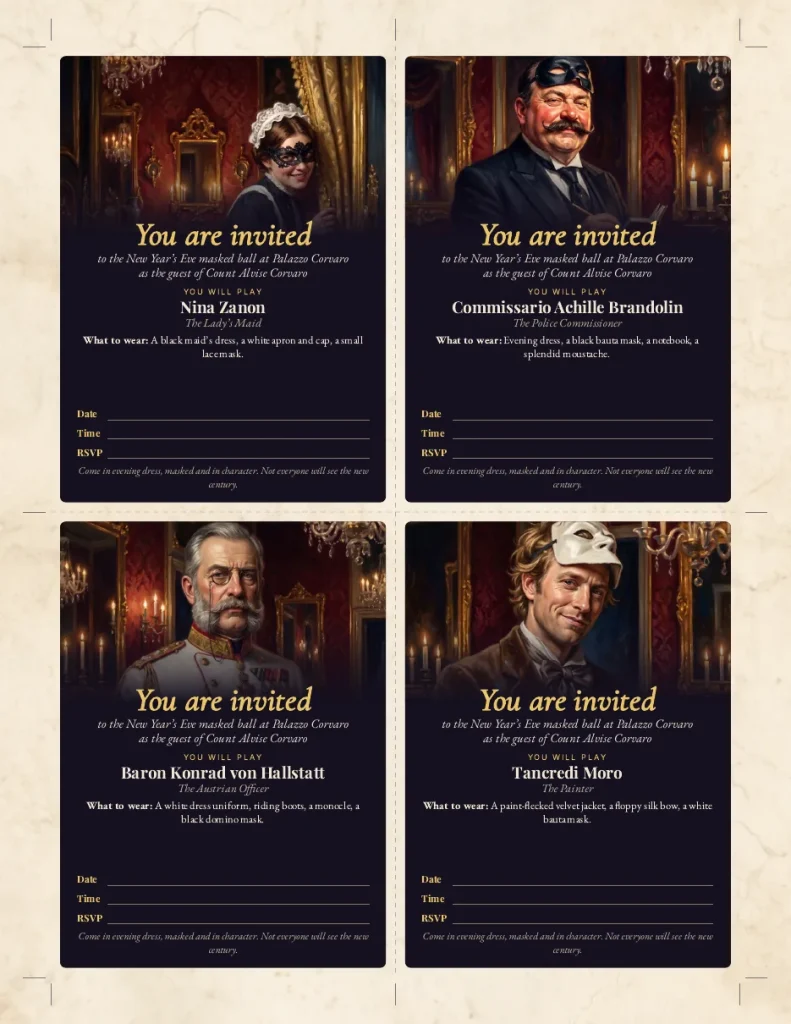
A simple rule: masks on for arrival and Round 1, off at the table, back on before the accusations. Murder at the Midnight Masquerade builds its finale on exactly that, with a countdown from ten and everyone unmasking together, and each character’s invitation includes a line on what to wear.
Start at the front door: put a password on the invitation and tape a plain sign to the door. Black, gold and emerald covers the decor: gold balloons, black tablecloths, white flowers in bottles, and a “cigarette tray” of candy and mints by the bar. For the playlist, look for hot jazz and ragtime piano and keep it low while the rounds run. After the solution, turn it up and clear a space for the Charleston.
New Year’s Eve plans get made early, and your cast depends on firm answers. For a party on Thursday, December 31, 2026, these are the dates:
If the same friends came to your Christmas murder mystery party, give the core roles to different people this time.
A save-the-date you can paste (both messages say doors at 7:30; change the time for the 9:00 cocktail version):
New Year’s Eve at ours, doors at 7:30. Someone at this party won’t make it to 2027, and everyone else is a suspect. It’s a murder mystery dinner: you’ll get your character and costume idea before Christmas. The case closes before midnight, so you won’t miss the countdown. Tell us by December 14 if you’re in.
Deciding on December 26 still works if you squeeze the steps into the five days before New Year’s Eve:
The short version of the message:
New Year’s Eve at ours, doors at 7:30. It’s a murder mystery dinner and the case closes before midnight. Yes or no by the 28th? Your character arrives the day after.
Good printable games split the cast into core characters, who carry the evidence and must be played, and optional ones added in a fixed order as the guest list grows. If nobody plays an optional character, the other guests ignore any mention of them.
That structure is your plan for late arrivals. Give the core roles only to guests you’re sure will be there when the opening script starts. Anyone coming from a family dinner or a work shift gets the next optional role in the cast order, and if they don’t turn up, you leave that role out.
When someone walks in at 10:15, don’t stop the game to explain it. Take them to the kitchen and read them something like this:
You’re [character]. It’s [Venice, New Year’s Eve 1899], a man has just been found dead, and nobody leaves until we know who did it. Read page one of this booklet, you have five minutes. You can lie about anything except what your booklet tells you to reveal. Then go and introduce yourself to two people.
Hand them the sections for the rounds already played.
If a core player cancels on the day, move one of your most reliable optional players into the core role before Round 1, since the case needs every core character in play from the start.
Some guests will tell you they don’t do acting. Give them a role anyway (they only have to answer questions honestly when the booklet says so), or a job such as timekeeper or bartender. Our host’s guide has more on drawing quiet players in.
On a night this long, keep the courses between rounds rather than during them: guests share their reveals out loud in rounds, and they’re hard to hear over cutlery. At a standing party, pass trays during the rounds and put the heavy food out in the break.
For a 1920s night, a Bee’s Knees (gin, lemon, honey syrup) covers the cocktail side. For the alcohol-free drink, serve a white grape and lime fizz in the same coupes as the cocktails, so nobody’s glass gives them away; keep iced tea in teacups for the raid drill.
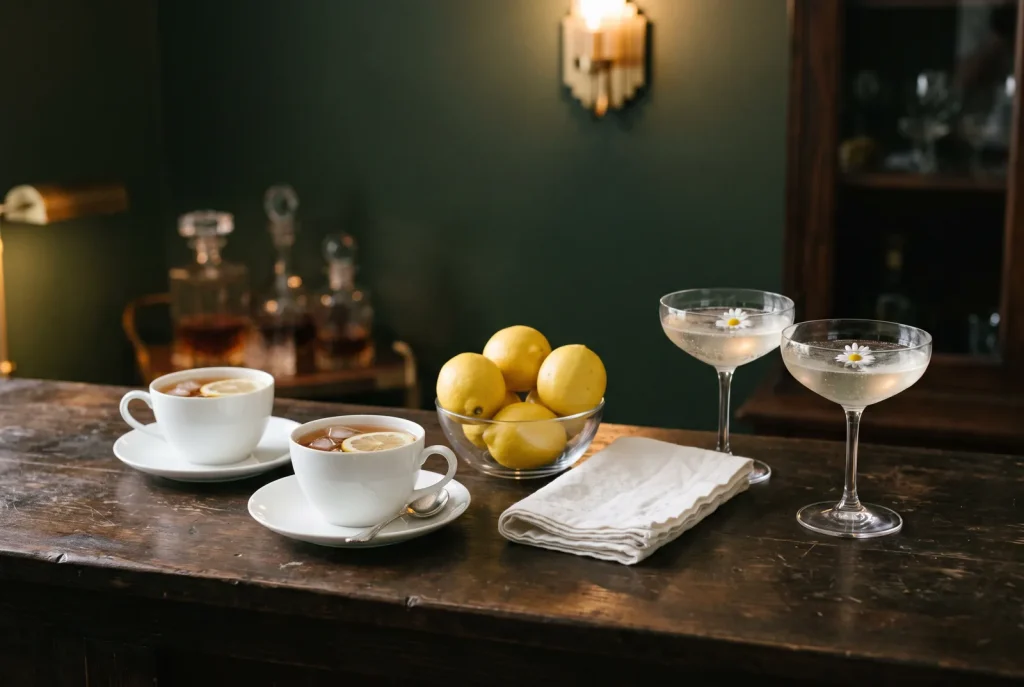
Slow the refills during Round 3 and save the sparkling wine for after the solution, since the last clues need the clearest heads. Some guests are driving, so label every jug and bottle.
Keep candles at least 12 inches from anything that can burn, as NFPA advises: over half of home candle fires start when a flammable piece of decor, paper or clothing is too close to the flame, and feathered masks, paper streamers and invitations all count. Use LED candles on the table and keep real ones on the mantel. If sparklers come out at midnight, they burn at about 2,000 degrees Fahrenheit, according to the Consumer Product Safety Commission, which also recommends a bucket of water or a hose nearby. Light them outside, after checking they’re legal where you live, and put someone sober in charge of them.
Pick your ending from the first table, then pick the theme. Send the save-the-date that day: the long version if the party is still three weeks off, the short one if it isn’t (change its RSVP date to three days from today). Choose your game, count its core roles against the people you’re sure of, and write down the name of one standby friend. Then put a note on the fridge with your accusation time (11:20 if you’re solving before midnight).
Murder Mystery Hosting
How the three types of murder mystery advent calendar differ, how to pick one, and a print-and-seal plan so everything is ready by November 30.

Murder Mystery Hosting
Format by headcount, five settings for grown-ups, a December timeline with a ready save-the-date, and a dinner schedule built around the rounds.

Murder Mystery Hosting
How many guests to invite, a planning timeline that starts four weeks out, three ways to fit dinner into the rounds, and how to run the reveal.