
Murder Mystery Hosting
Christmas Murder Mystery Party for Adults: How to Plan It
Format by headcount, five settings for grown-ups, a December timeline with a ready save-the-date, and a dinner schedule built around the rounds.
24 Christmas games with the rules in a few lines each, sorted by who is playing: the whole family with no supplies, little kids, grandparents and grandkids, teens, and adults.
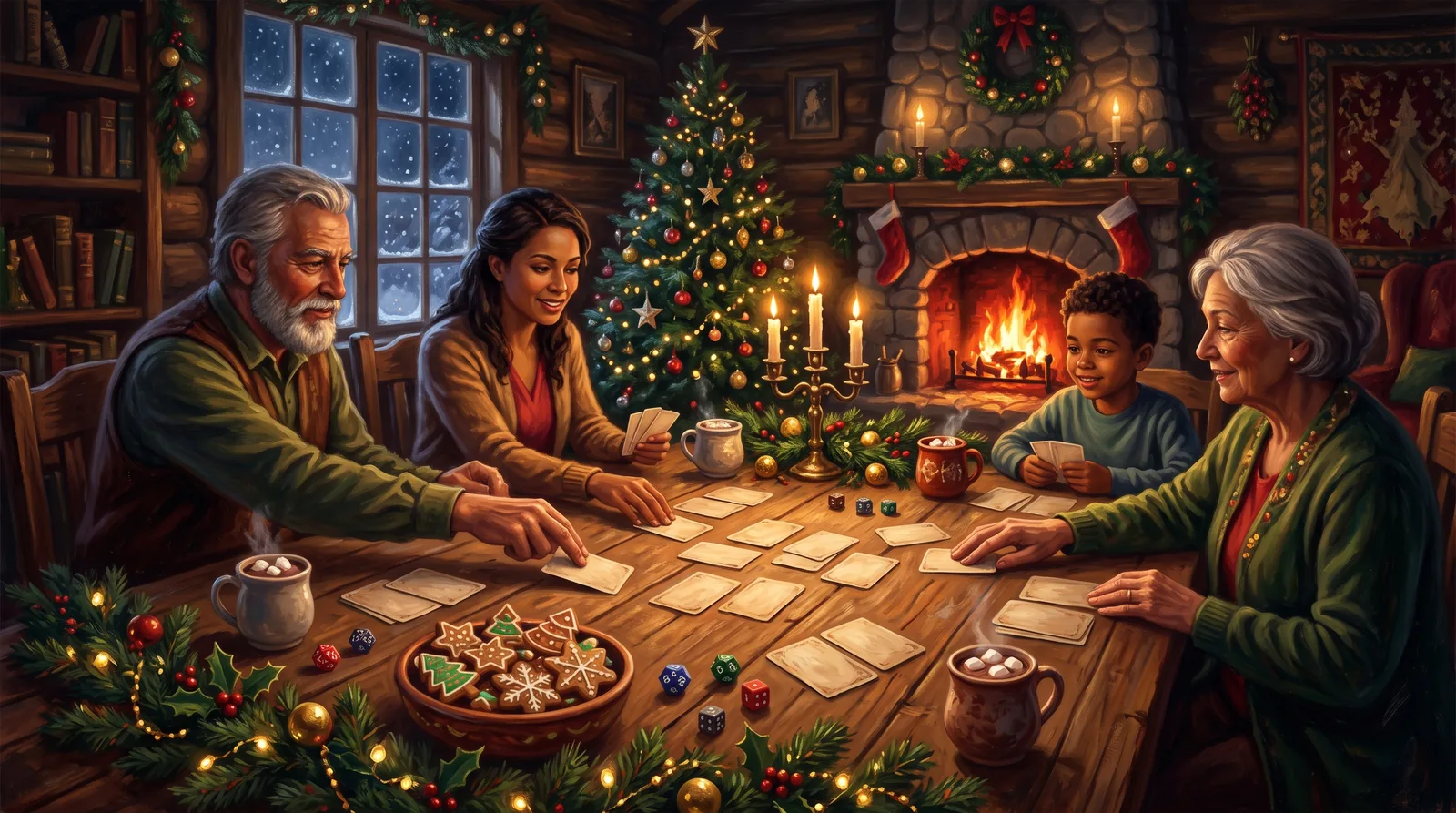
The best Christmas games for family gatherings are short, need almost nothing, and work for a six-year-old and a grandparent at the same table. Below are 24 of them with the rules in a few lines each, grouped by who is playing: the whole family with zero supplies, little kids, mixed generations, teens, and adults once the kids are in bed. The table below gives ages, group size and time for each one, so you can pick in two minutes.
Most need paper, a pen and a phone timer. Where a printable set saves you an evening of writing cards, we say so, and at the end there is a running order for the whole Christmas game night.
| Game | Ages | Players | Time | You need |
|---|---|---|---|---|
| Christmas charades | 5+ | 4-20 | 15-20 min | Paper slips, a bowl |
| Who am I? | 7+ | 3-12 | 15 min | Sticky notes |
| Santa says | 3-8 | 3-15 | 5-10 min | Nothing |
| Christmas categories | 8+ | 2-10 | 15 min | Paper, pens |
| Hum that carol | 6+ | 4-20 | 10 min | Nothing |
| Who’s most likely to | 6+ | 4-20 | 10 min | Nothing |
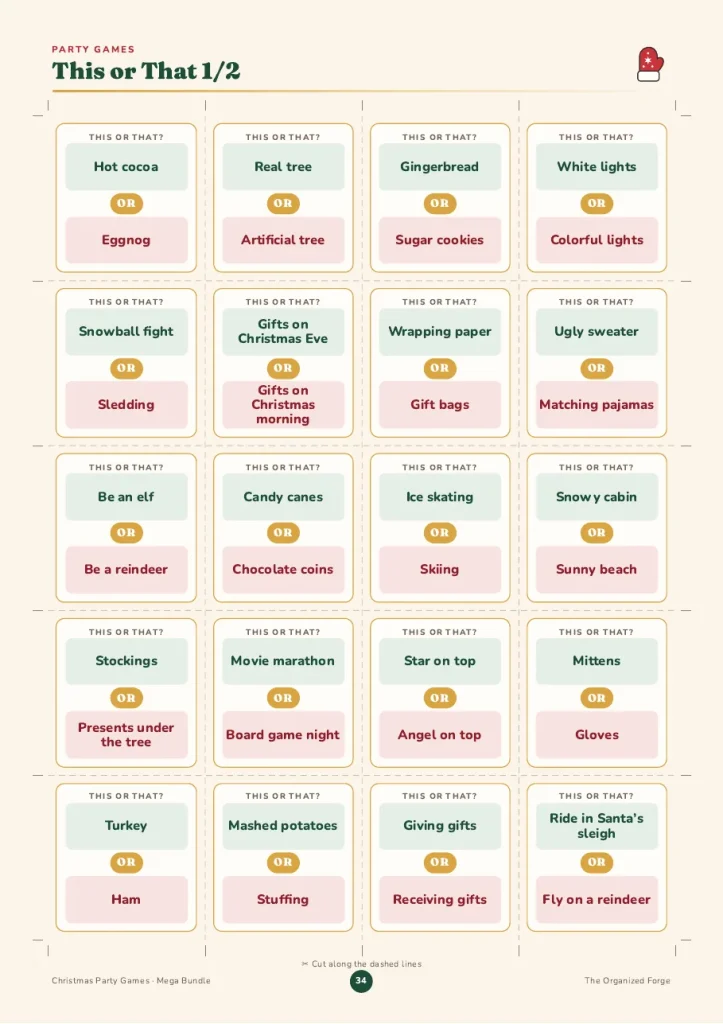
| This or that | 4+ | 4-30 | 5-10 min | A room with two sides |
| Story circle | 5+ | 3-10 | 10 min | Nothing |
| Cookie face | 5+ | 2-10 | 1 min a round | Gingerbread cookies |
| Candy cane hook | 6+ | 2-8 | 1 min a round | Candy canes |
| Snowman wrap | 4+ | teams of 3 | 2 min a round | Toilet paper |
| Picture bingo | 4+ | 3-30 | 20-40 min | Printed cards |
| Treasure trail | 4-8 | 2-8 | 15 min | 5 paper clues |
| Freeze dance | 3-8 | any | 10 min | Music |
| Christmas game show | 8+ | 4-20 | 30-60 min | Questions, a bell |
| Left-right gift exchange | 5+ | 6-20 | 10 min | A story, wrapped gifts |
| Family mystery | 8+ | 4-8 | 1.5-2 hrs | A mystery kit |
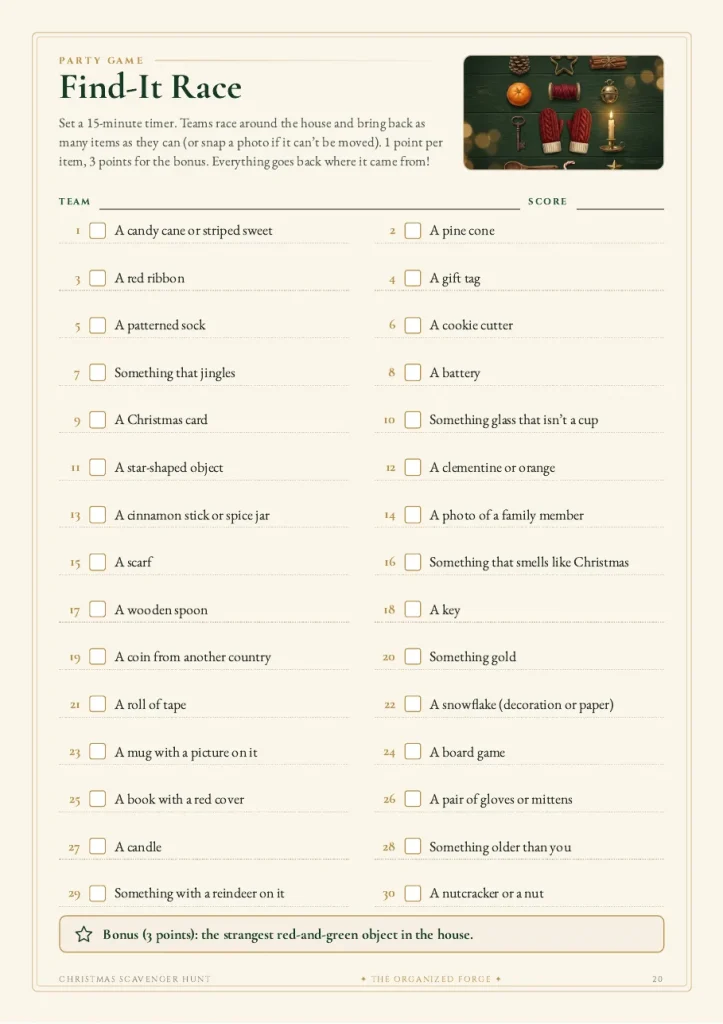
| Find-it race | 10+ | 2-6 teams | 15 min | A list, a timer |
| Photo challenge hunt | 12+ | 2-6 teams | 45-60 min | Phones, a list |
| Describe it, don’t say it | 8+ | 4-20 | 15 min | Word cards |
| Pub-style trivia | 12+ | 2+ teams | 30-45 min | Questions, answer sheets |
| White elephant | adults | 6-30 | 30-45 min | One gift per person |
| Blind tasting | adults | 4-20 | 20 min | Three of something |
| Two truths and a lie | 10+ | 4-15 | 15 min | Nothing |
These are the games to keep in your head for the moment after dinner when someone says “so, what now?” Nothing to buy, nothing to print.
Write 20 to 30 prompts on slips of paper and fold them into a bowl. Players take turns acting one out in 60 seconds while their team guesses. No talking, no pointing at objects in the room. Oddly specific prompts get the biggest laughs: “untangling the lights,” “a reindeer who is afraid of heights,” “wrapping a present with no tape,” “the dog stealing the turkey.” Let kids under seven draw from a separate bowl of single-word prompts like “elf” or “sled.”
Each player writes a Christmas character on a sticky note (Santa, Mrs. Claus, a nutcracker, a gingerbread man, an elf) and sticks it on the forehead of the person to their left without showing them. Going around the table, each player asks one yes-or-no question about their own note. First to guess wins, but keep playing until everyone has it.
The Christmas version of Simon Says. The caller gives commands (“Santa says pull your sleigh,” “Santa says freeze like an icicle”) and players only obey when the command starts with “Santa says.” Anyone who moves on a trick command sits out a round, not the whole game. Hand the caller role to a grandparent who would rather stay on the couch.
Give everyone a sheet with five categories: something you eat at Christmas, a Christmas song, something on a tree, a gift, a winter word. Pick a random letter. Players have two minutes to fill each category with a word starting with that letter. A point for every answer nobody else wrote. Pair readers with non-readers.
One player hums a carol (no words) while the others race to name it. The first correct guess earns a point and the next turn. Teenagers usually discover they can hum the bass line of a pop Christmas song well enough to stump the adults.
Someone reads a prompt and on the count of three everyone points at a person. “Who’s most likely to eat the last cookie and blame the dog?” or “Who’s most likely to wake everyone at 5 a.m. on Christmas morning?” Keep prompts affectionate: habits and holiday quirks, never looks, weight or grades.
Name two choices and point to opposite sides of the room. “Real tree or artificial tree?” “Gifts on Christmas Eve or Christmas morning?” Everyone walks to their side. Small kids love it because they get to move, and adults end up defending their position on eggnog with surprising heat.
One person starts a Christmas story with a single sentence. The next person adds a sentence, and so on around the table. Before the game, everyone writes one random word on a slip (pickle, hot tub, grandpa’s boots), and each player draws one and must use it in their sentence. Stop after two or three laps of the table.
Timed challenges take a minute, cost almost nothing and give everyone else something to watch. Play one challenge at a time, two or three players per round, with the rest cheering.
Each player tilts their head back and places a small gingerbread cookie on their forehead. On “go,” they work it down to their mouth using only face muscles. No hands. First to eat it wins. Buy the cheap bag: some cookies will hit the floor.
Put a pile of candy canes on a plate. Each player holds one candy cane in their mouth by the straight end and uses the hook to lift canes off the plate, one at a time, onto a second plate. Most canes moved in 60 seconds wins.
Teams of three: one person is the snowman, the other two wrap them in toilet paper from feet to head. Two minutes on the timer. A guest judge picks the best snowman, not the fastest.
If some of the family joins over video call, hum that carol, Christmas categories and two truths and a lie (game 24) work as they are: the host keeps score and everyone plays from their own couch.
Young children are great players with one firm limit: attention. CNLD Neuropsychology lists average attention spans of 8 to 12 minutes at age 4, 12 to 18 minutes at ages 5 to 6, and 16 to 24 minutes at ages 7 to 8. Plan several short games instead of one long one, and stop each game while the kids still want more.
Bingo cards with pictures instead of words, so nobody needs to read. The caller draws a picture card and names it, kids mark the square. Slip the cards into sheet protectors and use dry-erase markers, and you can play round after round. Prizes stay tiny: a candy cane, first pick from the cookie plate, or the right to choose the next game.
Write five simple clues that lead from room to room, ending at a box of clementines or chocolate coins. For pre-readers, draw the clues: a picture of the fridge, then the bathtub, then the shoe rack. One adult walks with the group to keep the youngest from being trampled.
Play Christmas music and stop it at random. Anyone still moving when the music stops does a forfeit (“waddle like a penguin to the door and back”) and rejoins. Nobody is out. Ten minutes burns off enough sugar to get through dessert.
If you would rather not draw bingo cards at 11 p.m., our Christmas Party Games Mega Bundle has picture bingo with 30 unique cards and 40 caller cards, plus charades in three difficulty levels, a this-or-that deck, a describe-it game, fill-in silly stories and a read-aloud left-right gift exchange. Eleven games in one set, with a suggested running order for the evening. The bundle is pitched at ages 6 and up, but the picture bingo works for pre-readers with a grown-up helping.
This is the hardest group to host: your youngest player might be six and your oldest might struggle to hear across a noisy room. Four rules make almost any game work here: mixed teams always (pair a grandparent with a grandchild), the child gets the final call on at least one answer per round, you teach with one sample round instead of reading rules aloud, and you turn the music down while you play.
Two teams, a host, and survey-style questions like “Name something that always gets tangled at Christmas.” Teams buzz in (a bell or a squeaky toy works), guess the most popular answers, and get three strikes before the other team can steal the round. You can write your own questions and answers the week before, or use Top Answers: Christmas Showdown, which has 40 rounds, a fast round and a TV answer board you can run from a laptop. For kids against grown-ups, give the kids’ team one extra strike.
Everyone sits in a circle holding a small wrapped gift. The host reads a short Christmas story full of the words “left” and “right.” Every time they hear “left,” everyone passes their gift to the left. On “right,” to the right. Whatever you hold when the story ends is yours. It takes ten minutes and the youngest kids can play. Write your own story or find one online, and set a gift budget so nobody feels awkward.
A family mystery gives everyone a character and plays out over three short rounds of questions, clues and fibbing, ending with everyone voting on who did it. It is the longest game on this list, so give it the slot right after dinner. Pick one with no murder for kids, and let younger players team up with an adult “detective partner” who helps them read.
Who Stole the Golden Star? is built for exactly this: on Christmas Eve, the family’s Golden Star vanishes from the mantelpiece before it can go on the tree. It plays with 4 to 8 people aged 8 and up, runs about an hour and a half to two hours, and has nothing scary in it.
Teenagers will play. What they avoid is anything designed for their seven-year-old cousin, or performing alone in front of adults they barely know. Team games with a clock and a bit of competition work best. Give a reluctant teen a job (scorekeeper, timekeeper, judge): teens who refuse to play charades will happily run it, and ten minutes later they are usually playing.
Hand each team the same list of about 30 things found in a house at Christmas, plus one bonus: a pine cone, a cookie cutter, something that jingles, a coin from another country, something older than you. Fifteen minutes on the timer. One point per item brought back (or photographed if it can’t be moved), and everything goes back where it came from.
Teams get a list of photo and video challenges with points: recreate an awkward family photo, build a human Christmas tree with a star on top, film a slow-motion snowball fight with paper snowballs. They have 45 minutes. At the end, everyone watches the results on the TV and a judge awards points. Late teams lose points per minute, which keeps the hunt from drifting into the next morning.
A player describes a Christmas word to their team without using the four forbidden words on the card. “Mistletoe” without kiss, plant, hang or door. One minute per turn, a point per word guessed. Teens love catching adults saying a banned word, so appoint one as the official buzzer.
Our Christmas Scavenger Hunt for Teens & Adults puts three of these in one printable: a 15-riddle trail through the house in two difficulty levels that ends at a gift, a 40-challenge photo and video hunt, and the 15-minute find-it race above.
With no kids in the room you can turn up the competition. These work for friends, couples’ parties and the after-bedtime shift at a family Christmas.
Five rounds of ten questions, teams of three to five, answers written on sheets and swapped for marking. Theme the rounds (Christmas movies, carols, food around the world, the year in review, a picture round of zoomed-in decorations). Make the last round double points so trailing teams stay interested. Write questions you can check online, and keep a phone handy for disputes.
Everyone brings one wrapped gift within a set budget. Players draw numbers. Number one opens a gift. Each next player either opens a new gift or steals one already opened, and the player who lost a gift picks again. Most groups add two house rules: a gift locks after its second steal, and number one gets a final swap at the end. Allow 30 to 45 minutes for 15 people.
Set out three versions of the same thing in numbered cups: three hot chocolates, three cheeses, three store-bought cookies, three mulled drinks. Guests taste and guess which is which (cheapest, most expensive, homemade). Hide the packaging in another room.
Each player tells three short stories about past Christmases. Two are true. The table votes on the lie. It works best with a mix of old friends and new partners, because nobody knows anybody’s childhood Christmases.
If you want a game that fills the whole evening, a murder mystery dinner is the adults’ version of the family mystery above. Our guide to a Christmas murder mystery party for adults covers the Christmas version, and how to host a murder mystery party covers invitations, casting and timing. For a group of four to six who would rather solve than act, a printable escape room at home fills an hour well.
At a work party, the same games apply with a few adjustments. Great Place To Work advises keeping the event focused on the team and its year rather than on one holiday. One of its advisors puts it plainly: “Your company doesn’t have to be the bearer of Christmas.” In practice that means winter themes over religious ones, team games instead of solo performances, and a role (judge, scorer) for anyone who would rather watch.
Pick four games, not eight (the quiet corner is optional). A running order that works for most families:
Common mistakes and the fix:
If you print anything, print a test page first to check paper size (US Letter or A4), use light card stock for cards people hold, cut everything the night before, and keep each game in its own labeled envelope with pencils and a spare copy of anything with a fixed count.
For tonight: pick one game from the no-supply list, one 60-second challenge and one finale, write the charades slips, and put a bag of gingerbread cookies where nobody will eat them first.
Murder Mystery Hosting
Format by headcount, five settings for grown-ups, a December timeline with a ready save-the-date, and a dinner schedule built around the rounds.

Planning & Productivity
A paper quest system for real life: a character sheet, quests, XP tiers, a weekly boss and a Sunday recap, with the research on what works and the rules that stop burnout.
GM Craft
How to run a horror one-shot for your D&D table in a single evening: a run sheet, a safety talk script, visible clocks, the rule of escalation and six premises you can prep this week.