
Murder Mystery Hosting
Christmas Murder Mystery Party for Adults: How to Plan It
Format by headcount, five settings for grown-ups, a December timeline with a ready save-the-date, and a dinner schedule built around the rounds.
A paper quest system for real life: a character sheet, quests, XP tiers, a weekly boss and a Sunday recap, with the research on what works and the rules that stop burnout.

To gamify your life, you borrow the parts of a tabletop campaign that keep players coming back and apply them to your real goals: a character sheet that shows where you stand, quests with milestones and a deadline, XP for showing up, one boss fight a week against the task you keep dodging, rewards you priced in advance and a short recap every Sunday. That’s the whole system. The rest of this guide shows how to set each piece up on paper in about 45 minutes, and which rules stop it from collapsing in week three.
We make games and GM tools, so expect fewer app lists and more house rules.
Most “gamify your life” advice stops at “add points.” Points alone are a scoreboard with nothing to play. Here is the full set of mechanics and what each one becomes off the table:
| Game mechanic | Real-life version | What it fixes |
|---|---|---|
| Character sheet | Six life areas rated 1 to 20, now and target | You stop guessing where to start |
| Quests | Goals with a why, milestones, a deadline and a reward | Vague resolutions that never begin |
| XP and levels | Points scaled to effort, fast early levels | Progress you can’t see |
| Boss battles | One avoided task a week, split into steps | Procrastination on the scary stuff |
| Loot shop | Real rewards bought with earned gold | Impulse “I deserve this” spending |
| Session recap | A 15-minute weekly review | Systems that quietly die by February |
You can run all six with a pencil and a few printed pages. You can also skip one or two, but keep the recap: without it, nobody notices when the other five stop working.
It helps, modestly, and the design matters more than the points.
The best-studied area is physical activity. A 2022 meta-analysis in the Journal of Medical Internet Research pooled 16 studies with 2,407 participants and found a small-to-medium effect of gamified interventions on activity (Hedges g = 0.42). Gamified programs beat waitlists and also beat comparable non-gamified programs, though by less (g = 0.23). About 14 weeks after the programs ended, the effect had shrunk to very small to small (g = 0.15).
So game mechanics push you hardest while you use them. The boost fades a lot once you stop, though it doesn’t vanish entirely. Use the game to carry you through the hard early months while behaviors turn into habits, and keep playing if it still helps.
The rest of the system leans on findings with more evidence behind them:
There’s also a real risk. A meta-analysis of 128 studies by Deci, Koestner and Ryan found that expected, tangible rewards tended to undermine intrinsic motivation, while positive feedback increased it. Pay yourself gold for reading and you might stop enjoying reading.
Points are feedback, not wages. The moment XP becomes the reason you do something you used to love, change the rules.
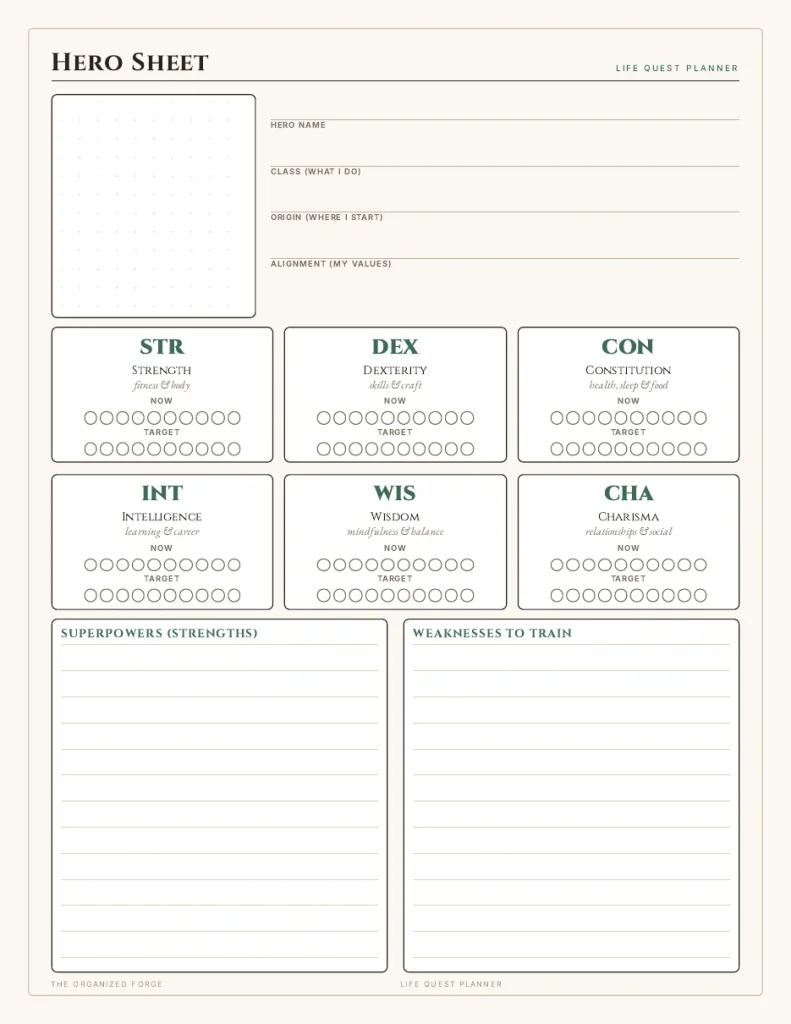
Most goal lists start with “what should I do?” instead of “where am I now?” Start with the character. Rate six real-life stats from 1 to 20 (on the Hero Sheet each circle is worth two points), as you are today and where you’d like to be in twelve months.
| Stat | Life area | Example now and target |
|---|---|---|
| STR | Fitness and body | 8 to 12: train three times a week |
| DEX | Skills and craft | 10 to 14: one painting a month |
| CON | Health, sleep, food | 6 to 12: in bed by 11:30 |
| INT | Learning and career | 12 to 16: one certification |
| WIS | Mindfulness and balance | 8 to 12: ten minutes of journaling |
| CHA | Relationships and social | 10 to 14: a monthly game night |
Then write your class (what you do), your strengths and your dump stat. The dump stat is usually where the most valuable quest hides: if CON is a 6, put a sleep quest on the list before anything else.
A goal is a wish. A quest has a reason, checkpoints and a payoff. Rewrite each goal with five lines:
Keep it to six Main Quests a year, with two or three active at once. Every GM knows what happens when the party chases five plot hooks at once: nothing gets resolved.
Then add one or two if-then triggers per active quest, since that’s where the research is strongest:
Scale points to effort and meaning. Four tiers cover almost everything:
| Tier | XP | Example |
|---|---|---|
| Daily Quest | 10 | A habit or small task done today |
| Side Quest | 25 | Book the dentist, fix the bike |
| Main Quest milestone | 100 | A checkpoint on one of your big quests |
| Boss Battle | 250 | Facing something you’ve been avoiding |
This is the economy in our Life Quest Planner, and the point of it is that the biggest XP goes to facing the thing you avoid, because that’s where most progress is stuck.
Make early levels fast and later levels slow, the way good games do. If Level 2 costs 300 XP, three daily habits get you there in under two weeks, before motivation fades.
Convert XP into gold (1 gold per 10 XP keeps the math easy) and price real rewards before you earn them: a new book, a dinner out, a set of dice, a Saturday with no plans.
Three house rules keep the economy honest. Don’t award XP for hobbies you already love; if you play guitar for fun, leave it outside the system. Missed days earn zero XP and cost nothing, because losing points teaches your brain that opening the planner hurts. And if your XP climbs while your Main Quests don’t move, cap daily XP: you’re grinding.
Streaks feel great at day 40 and terrible when they break at day 41. Keep the loop without the fragility.
Start with three or four daily habits. Give each one a minimum version: “run 5K” becomes “shoes on, outside for five minutes” on bad days, and the minimum still earns the full 10 XP. You’re rewarding the fact that you showed up.
Tie each habit to something you already do every day, like coffee or the commute. The 2024 review found that a stable context strengthened habits, and morning practice tended to produce stronger habits than evening practice.
In Lally’s study, summarized in this review by Gardner, Lally and Wardle, missing the occasional day did not seriously impair habit formation; automaticity gains resumed after one miss. Our house rule builds on that: one miss is noise, so don’t let it become two.
Expect two months or more. A habit that still feels effortful in week six is normal, and no reason to rewrite the quest.
Every week, name one thing you’ve been avoiding and make it the boss. Keep it specific: the phone call, the tax form, the awkward conversation, the CV update.
Split it into steps and give the boss one hit point per step. Then fill in a short battle plan: why you’ve been avoiding it (be honest, “I’m afraid the number will be bad” is useful information), the steps in order with a time and place for the first one, who or what can help, and a reward you’ll enjoy within a day of winning.

This is where most systems quietly die, and where the progress-monitoring research says the gains are. Fifteen minutes, same day and time every week. Sunday evening works for most people. If you already prep games, treat it like a lighter version of session prep, short and at a fixed time.
Ask five questions in this order:
Once a month, run a longer campaign review: what worked, what didn’t, next month’s boss.
If the quest log is still empty, borrow from this table. Each idea sits in the tier it usually fits. Swap the numbers for your own.
| Stat | Daily Quest (10 XP) | Side Quest (25 XP) | Boss Battle (250 XP) |
|---|---|---|---|
| STR | Ten-minute walk after lunch | Try one new class | Sign up for a 5K with a date |
| DEX | Twenty minutes of practice | Finish one small piece | Show your work to someone outside your circle |
| CON | Screens off at 11 p.m. | Plan the week’s meals | Book the checkup you’ve postponed for a year |
| INT | Read ten pages | Finish one course module | Send the application or pitch |
| WIS | Five minutes of journaling | A phone-free afternoon | Have the conversation you’ve been avoiding |
| CHA | Message one friend | Host a game night | Reconnect with someone you drifted from |
If the CHA column sounds like your weakest stat, a game night is a gentle first quest, and our guide to Christmas games gives you a ready-made excuse to invite people.
Gamers love to min-max, which is a strength at the table and a risk in real life. Watch for these:
The tool matters because it decides how often you’ll open it.
Apps handle the math for you, and each one gamifies a different slice of life:
Paper or a tablet PDF suits a weekly desk ritual, and the Harkin finding about physically recording progress is a decent argument for a pencil. If you live in Notion, The Adventurer’s Ledger calculates level, XP bar and gold purse automatically, with a Quest Board that runs from Bounty to Boss Fight and a Loot Shop for real rewards.
Researchers at Wharton described a fresh start effect: Google searches for “diet,” gym visits and goal commitments all rose after temporal landmarks such as a new week, month or year, a birthday or a holiday. New Year is the biggest landmark, so use it on purpose, but every Monday and every first of the month counts too, which is why the weekly recap matters more than the January kickoff.
If you want a dated New Year resolution planner built on this system, the 2027 Life Quest Planner starts Week 01 on Monday, December 28, 2026, so your campaign begins before New Year’s Eve. It opens with a Welcome to 2027 page (your word for the year, what you leave behind in 2026, what you take with you) and closes with a 2027 in Review page for victories, bosses defeated and next year’s main quest. The undated Life Quest Planner uses the same system and starts any day of the year.
Think of the setup as a session zero with yourself, where you agree on the rules before the first roll.
Print or open your pages, pour a coffee and go through this list once.
Leave the last five minutes to do the first daily quest right away, so your sheet has XP on it before you close the notebook.
Murder Mystery Hosting
Format by headcount, five settings for grown-ups, a December timeline with a ready save-the-date, and a dinner schedule built around the rounds.
Holidays & Parties
24 Christmas games with the rules in a few lines each, sorted by who is playing: the whole family with no supplies, little kids, grandparents and grandkids, teens, and adults.

GM Craft
How to run a horror one-shot for your D&D table in a single evening: a run sheet, a safety talk script, visible clocks, the rule of escalation and six premises you can prep this week.