GM Craft
DM Prep: A 20-Minute Checklist and Prep Sheet for Busy GMs
A DM prep checklist you can finish before the doorbell rings: a 20-minute version, a copyable prep sheet with a worked example, and a ten-minute habit after each game.
How to run a horror one-shot for your D&D table in a single evening: a run sheet, a safety talk script, visible clocks, the rule of escalation and six premises you can prep this week.
A D&D horror one-shot works when your players feel the danger before they see it. They have fought a hundred monsters, so a zombie lurching out of a closet gets a shrug and an initiative roll. What gets under their skin is quieter: the innkeeper who has been calling them by name all evening, when nobody told him their names, or the choice they made an hour ago that is only now starting to cost them.
This guide covers both halves of the job: how to run horror in a single three-to-four-hour session, and six premises you can prep this week if you don’t have a scenario yet. Everything works with 5E rules and adapts easily to other fantasy systems.
It is tempting to start planning a horror one-shot from the monster. Start with the feeling instead, because it decides your pacing and how much combat you need.
| Flavor | What does the scaring | Works best for | Watch out for |
|---|---|---|---|
| Folk horror | A friendly community with a terrible custom | Groups who love roleplay and talking to NPCs | Players attacking the villagers too early |
| Gothic | An old house, a family secret, the past coming back | Investigation fans, small groups of 3-4 | Too many rooms, too little pressure |
| Survival | Something hunts the party, resources run out | Tactical players who like hard choices | Turning into a plain dungeon crawl |
| Mystery horror | A death nobody can explain, a culprit who is not human | Tables that enjoy clues and theories | Players stuck on one clue for an hour |
Keep the characters at level 1 to 3: they feel fragile, and higher-level parties have a spell for most problems. Pregenerated characters save half an hour and let you write a hook into each backstory (a sister who vanished in this valley) without risking anyone’s campaign hero. Three to five players is ideal, because horror needs quiet moments and a table of six always has someone talking.
This is the shape we suggest for a single evening, built around three stages of dread (more on them below).
| Time | Stage | What happens |
|---|---|---|
| 0:00-0:10 | Before play | Safety talk, tone, content warning, the X-card goes on the table |
| 0:10-0:25 | Normal world | The hook, a welcome, something pleasant. The clock appears |
| 0:25-1:20 | Wrong | Open investigation in 3-4 locations. Small details that don’t fit |
| 1:20-2:10 | Worse | The details connect. Someone lies. The first real cost |
| 2:10-2:20 | Break | Stop on a cliffhanger, never during the climax |
| 2:20-3:10 | Unbearable | The descent, the threat seen in full, the clock nearly out |
| 3:10-3:30 | Ending | Consequences, a short epilogue, the check-out |
Write down what happens at each tick of the clock before the session, so you never have to invent pressure on the spot. If the table falls behind, cut a location from the Wrong stage, never from the ending. The lazy GM prep method works well here: prep the clock, the stages and the endings, and improvise the rest.
Some GMs skip this because it might ruin the mood. It does the opposite: players lean into dread when they know nobody will be blindsided by something genuinely painful. For an ongoing group this belongs in a session zero; for a one-shot, ten minutes at the start is enough.
A script you can read out as it is:
“This one is a horror game, so I am going to try to make you uneasy. That is the fun part. If anything stops being fun, tap the card, no questions asked, and we move on. Anything you want me to keep off the table completely?”
Good published adventures do part of this work for you. The Hollow King tells the GM up front that missing children are a heavy theme, asks you to check with the table first, and states that no child is harmed on screen.
Alfred Hitchcock explained suspense with a bomb under a table. If it goes off without warning, the audience gets fifteen seconds of surprise. If they saw it planted and know when it will go off, they get fifteen minutes of suspense. Hitchcock told François Truffaut, in an interview quoted by film scholar David Bordwell, that “whenever possible the public must be informed.”
At the table it works even better, because players who know something is wrong still have to choose where to walk. The simplest bomb is a visible deadline, which turns every decision into a trade: search the mill or question the miller, rest or press on while there is still light.
Ways to make the clock physical:
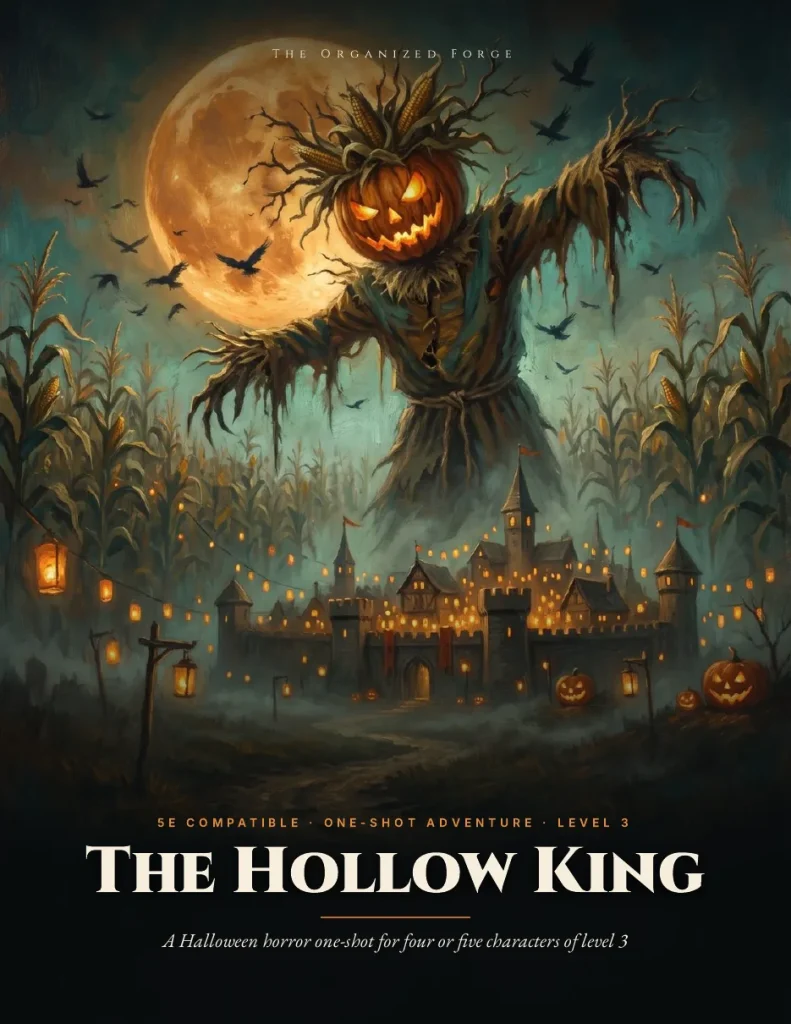
The Hollow King runs on this principle: its GM advice is to keep the Midnight Clock handout where players can see it and tick it in view. The Honey Wake uses a twelve-hour clock from noon to midnight with the same instruction. The ticking does the hurrying, so you never have to say it.
Dread climbs like a staircase, and each step should be clearly higher than the last.
| Stage | What players notice | Example |
|---|---|---|
| Wrong (first hour) | Small details that don’t fit, easy to explain away | The village dogs won’t go near the old well. The baker’s pies are perfect, and nobody eats them |
| Worse (middle hour) | Patterns. The details connect, and someone is hiding something | Every house has a fresh candle in the window except one. The villagers stop talking when the party enters the square |
| Unbearable (final hour) | The threat is real, close and personal, and the clock is almost out | The missing girl’s shoe is on the party’s own doorstep. The bell rings eleven |
Never go backwards: once the dog starts howling, it doesn’t stop. Follow every strong beat with a quiet scene, because relief is what makes the next scare land. And show the monster late and only in part, a shape in the corn or a hand print on the inside of a window. A full stat block belongs to the last act.
The frightened condition gives disadvantage on ability checks and attack rolls while the source of fear is in sight, and the creature can’t willingly move closer to it. Save it for the moment the monster finally appears. If every creak forces a saving throw, players start treating fear as a status effect to manage.
For low-level threats, the undead in the free 5E SRD suit horror well. A shadow (challenge 1/2) can hide as a bonus action in dim light, drains Strength with each hit, and a non-evil humanoid it kills rises as a new shadow a few hours later. A ghoul’s claws can paralyze, and a specter’s touch lowers maximum hit points until a long rest. Use one of them in the last act rather than three in the first, and remember that a lit lantern tells everything in the dark where the party is.
Players hear “a dark, spooky room” every week and stop seeing it. Reach for sound, smell and touch instead: a fiddle at the harvest fair playing slightly too fast, a doorknob warm on a cold night, the smell of wet earth in an upstairs bedroom.
One specific detail beats five adjectives. “A child’s shoe, still laced” is scarier than “a horrible, eerie scene.” Describe what is missing, too: no birdsong, no footprints in the snow even though the door stands open. And slow down for reveals. Pause before the last sentence and say it quietly.
The Honey Wake calls its approach “sweet dread,” and its advice works for any horror GM: play every villager as the warmest host the players have ever met, so the horror comes from the kindness, never from threats. One of its “sweet pressure” moments is a child offering a guest a spoonful of honey for luck and looking crushed when it is refused.
More you can use in any setting: a host refills a cup that is still full; everyone at the feast stops eating at once to watch the guests take the first bite; an NPC answers a question nobody asked out loud. None of these needs a monster; they work as long as you keep smiling.
Players who decide to open the cellar door own the fear that follows. Give information first, then the choice: the screaming came from the cellar, the bridge floods at midnight, what do you do?
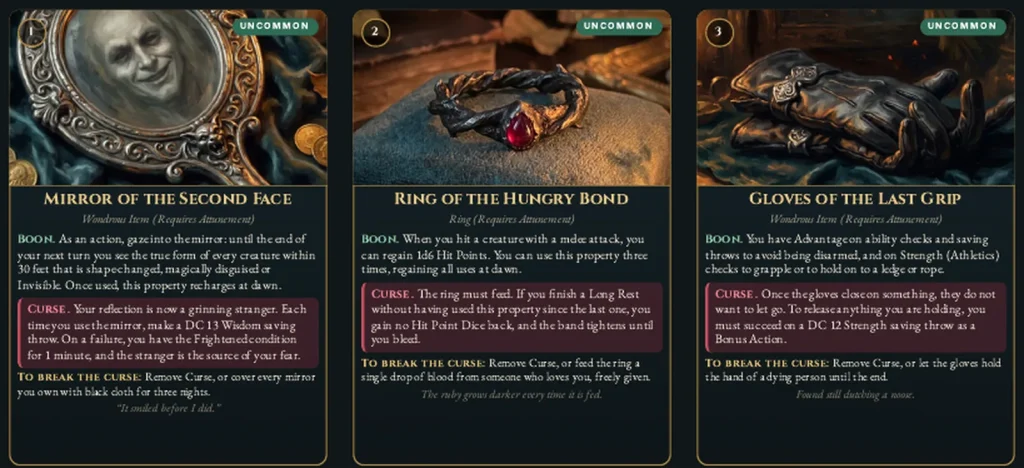
Offer temptations rather than traps. Horror runs on bargains, and cursed items put one straight into a player’s hands. The deck Cursed Relics is built on this idea: every relic has a real benefit and a curse that is just as real, and its GM tip is blunt about why it works: “Players rarely refuse a powerful item, and that is the point.” For a one-shot, the deck suggests dealing one relic face down to each player at the start and letting them attune whenever they like.
Don’t take control away for long: a possessed player with nothing to do for twenty minutes is bored, not scared, so give them a secret objective instead. And let failure move the story. The search finds the clue, but the lantern goes out. The lock opens, loudly.
Each premise below was written for this article and comes with its clock, its three stages and a few endings. Pick one, name the NPCs and draw a rough map of four locations: that is an evening’s prep.
A ferryman offers free passage across a black river at dusk, but the ferry always turns back before the far bank. Clock: six crossings before dawn, with one fewer passenger aboard each time it returns. Wrong: the ferryman’s lantern casts no shadow. Worse: a passenger who vanished on the second crossing waits on the near shore, soaking wet, unable to remember her name. Unbearable: the ferryman asks a character to take the pole “just for one crossing.” Endings: someone takes his place, the party burns the ferry and stays stranded, or they pay a toll that costs more than coin.
A storm drives the party into a lighthouse. The keeper counts them at the door and gets one more than there are. Clock: the lamp oil burns down one measure per hour, and the light must never go out. Wrong: there is one plate too many at dinner. Worse: the logbook records a ship wrecked on these rocks every year on this same night. Unbearable: the extra guest starts answering when the others are called by name. Endings: the extra guest takes a character’s place at dawn, the party lets the lamp die and the wreck happens anyway, or someone signs the logbook.
A snowed-in inn, a dozen travelers, and something outside that hunts by sound. Clock: the innkeeper snuffs one candle at the bar each hour to save them. Wrong: the horses stopped making noise an hour ago. Worse: a traveler is found with his ears stuffed with wax, smiling. Unbearable: the party must cross the courtyard to the stables without speaking. Endings: the party lures the thing into the snow, one character makes a noise on purpose so the others can run, or everyone lives and nobody at the inn speaks again.
A widowed noble invites the party to spend one night at her manor and be painted by her court artist. Clock: the painter finishes one portrait per hour, in an order the players can’t influence. Wrong: the house is full of portraits of guests, none of the family. Worse: the first finished portrait shows its character a few seconds in the future. Unbearable: a painted character starts making choices the player didn’t. Endings: the party burns the gallery and frees the guests trapped in it, someone leaves the manor who isn’t quite the original, or a character agrees to sit forever so the others can go.
In a mining village, the children sing down the old well every evening “so the miners can find their way home.” The mine collapsed ten years ago. Clock: the water rises one rung on the ladder each hour. Wrong: some of the voices that sing back are adults. Worse: a miner’s widow asks the party to bring her husband up, alive or not. Unbearable: the climb down. Endings range from bringing home someone who shouldn’t come home to sealing the well with the singing still going.
The party is hired to sit vigil until dawn over three bodies pulled from the lake. Clock: three tall candles, one per body, and custom says each must burn out on its own. Wrong: one body is warmer every time anyone checks. Worse: wet bare footprints lead from the lake to the chapel door, and stop. Unbearable: the candles are going out too fast. Endings: the party names the villager who drowned them and the dead go back to the lake, or the chapel is empty at dawn and so is one of the party’s beds. Plant two suspects in the village so the investigation has somewhere to go.
No group free this week? Some games in our solo journaling guide are horror you play alone. And if part of your group would rather solve a death than survive one, see how to host a murder mystery party.
A horror one-shot can end badly, because nobody has to play these characters next week. Escape with a cost suits most tables: they survive, but something stays behind, a memory or a hand that will always be cold. A tragic ending works only if the clock was always visible. Decide the possible endings before the session, not the specific one, and let the players’ choices pick. Afterwards, turn the lights up and ask everyone for their favorite scary moment, so you learn what to keep for next time.
Before the session:
At the table:
If the game is next week, do three things tonight: pick one premise from the list above, write its clock on an index card, and send the group chat a one-line content warning so the safety talk starts before anyone sits down.
GM Craft
A DM prep checklist you can finish before the doorbell rings: a 20-minute version, a copyable prep sheet with a worked example, and a ten-minute habit after each game.
GM Craft
A complete session zero checklist split into the week before, the meeting itself and the follow-up, with the questions to ask your players, a 90-minute agenda and a two-minute version for one-shots.

Murder Mystery Hosting
Format by headcount, five settings for grown-ups, a December timeline with a ready save-the-date, and a dinner schedule built around the rounds.