Holidays & Parties
Christmas Trivia: 18 Questions, Answers and Quiz Night Rules
Run a short Christmas quiz with 18 original questions, a separate answer key, and a final wager. Includes team rules and a 40-minute hosting schedule.
Five ways to run a Christmas scavenger hunt for teens and adults, with eight original riddles, a lights checklist for the neighborhood and real prep times.

The Christmas scavenger hunt ideas that work for teens and adults come in five shapes: a riddle trail through the house, a team photo and video hunt, a 15-minute find-it race, a Christmas lights hunt around the neighborhood, and a bigger team version for the office or a 30-person party. Pick the shape first, then the clues. A riddle trail needs a quiet house and one or two teams, while a lights hunt needs warm coats or a car and nothing else.
| Your group | Best hunt | Teams | Play time | Prep |
|---|---|---|---|---|
| Teens (13-17) at home | Photo and video hunt, or teens vs. adults riddle race | 2-4 teams of 3-4 | 45-60 min | 25 min (photo hunt) |
| Adult friends at a party | Photo hunt, or a hard riddle trail | Teams of 3-5 | 45-60 min | 25 min (photo hunt) to 1.5 hours (riddles) |
| Mixed family, ages 6 to 80 | Riddle trail with two difficulty levels, mixed teams | 2 teams | 30-45 min | About 2 hours (15-20 min with a printable) |
| A couple or two players | Short riddle trail ending at a small gift | 1 | 20-30 min | About 1 hour |
| Any age, out of the house | Christmas lights scavenger hunt, by car or on foot | 1 car or walking groups | 30-45 min | 25 min |
| Office or 20+ guests | Team photo hunt plus find-it stations | Teams of 4-6 | 30-45 min | 1.5-2.5 hours |
| After dinner, zero prep | Find-it race | 2-6 teams | 15 min | 5 min |
Teams of three or four keep everyone busy; at six, two people end up holding coats. The office is the exception: with 20+ players, go to four to six. Set a hard end time before you start: once a hunt runs past the hour, people drift off.
Each clue is a short riddle that names a place in the house. Players solve it, go there, find the next card, and the last card leads to a prize or a gathering point. For a Christmas scavenger hunt for adults or teens, aim for 10 to 15 stops: fewer feels thin, more and the last third becomes a slog.
How to build one without losing track:
For two teams on one trail, use a loop instead of a line. Hide two colored sets of cards in the same 12 spots: red runs from spot 1 to spot 12, green starts at spot 7, goes to 12, then carries on from 1 to 6. Both teams cover the whole house while staying roughly half a trail apart, and the last card of each color sends them back to you.
Writing 12 riddles takes about an hour, and hiding the cards and walking the trail another 20 to 30 minutes. Write them the week before and hide them half an hour before guests arrive.
When a team is stuck, the first hint is the first letter of the place.
We wrote these for this article. The first four are easy; the last four are harder, with less obvious places and a double meaning or two, for adults and teens who like a puzzle.
Easier:
Harder:
Answers, in order: the fridge door (slip the card under a magnet on the outside), the tree skirt, the oven mitt (on its hook, with the oven off), the dining table, the coat rack (tuck the card in among the coats), the TV remote (tape the card to its back), the junk drawer, the doormat.
To make any riddle harder, drop the rhyme that gives the answer away or add a double meaning (“I rule the room without a vote”). For a last twist, give each card one letter of a password that teams must assemble before they can claim the prize.
For a mixed group, write each stop twice: an easy version and a hard version leading to the same place. Give the teens and adults the hard set, the younger cousins the easy one, and race them. Our Christmas Scavenger Hunt for Teens & Adults is built on that idea: 15 rhyming riddles in a Classic and an Expert level that share the same hiding spots, plus blank editable cards for spots of your own. With the clues already written, prep drops to the 15 to 20 minutes it takes to print, cut and hide.
This is the one that gets loud. Teams get a list of challenges worth points, one phone per team, and 45 to 60 minutes. Everything is photographed or filmed, then the whole party watches the results on the TV while a judge awards points.
House rules that keep it fair:
Writing and balancing a list of 20 to 30 challenges takes about 20 minutes; print one copy per team. A starter list of eight:
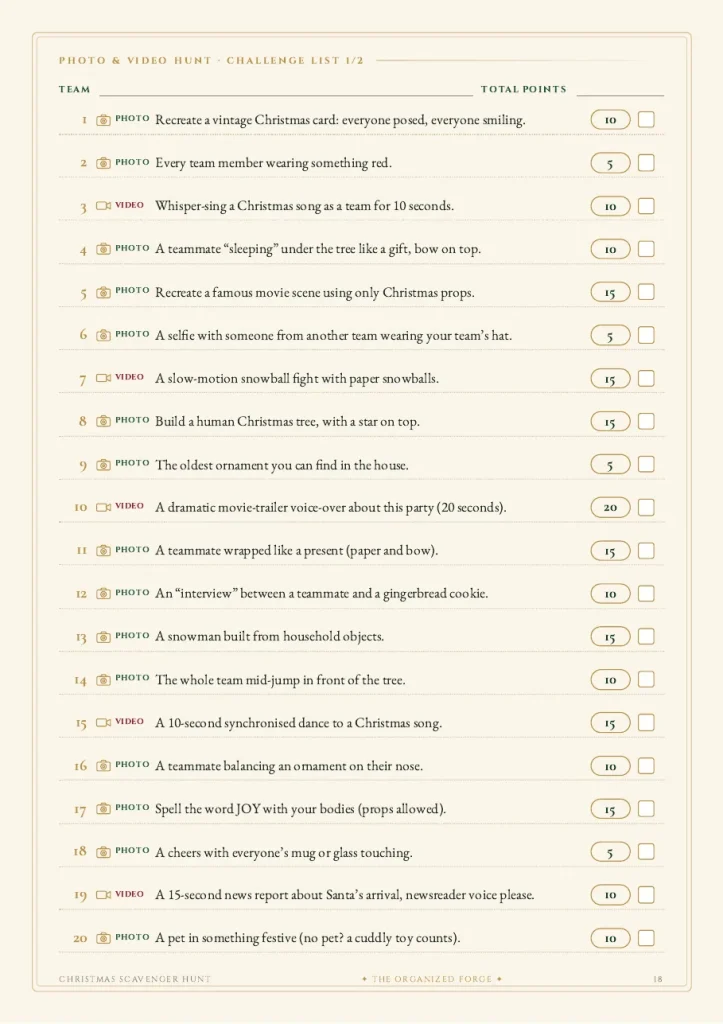
If you would rather not write your own, the printable has 40 challenges from 5 to 20 points (the first page is above) and a fillable score sheet.
The fastest format: each team gets the same list of 12 to 15 things that should be somewhere in the house, and 15 minutes. One point per item brought back or photographed if it can’t be moved. We covered the basic version in our Christmas game night ideas, so here is a tougher list built on descriptions instead of objects. Copying it onto a sheet per team takes five minutes.
Descriptions start arguments (“does a colander count as a hat?”), so name a judge before the timer starts and make their ruling final.
Families drive or walk past decorated houses after dark and tick off what they spot. It works for every age and needs no hiding.
Copy this onto a clipboard and score as you go.
Common (1 point each):
Harder to spot (2 points each):
Rare (3 points each):
By car, the driver never holds the list. One passenger is the navigator and scorekeeper, everyone else calls out what they see, and the first person to call an item gets the point. Plan a 30- to 45-minute loop in advance so nobody is reading a map at a crossroads. Copying the checklist takes ten minutes and planning the route about fifteen; drive the main streets the night before to check they are lit.
On foot, stay on the sidewalk and look from there: lawns and driveways are people’s homes. NHTSA’s pedestrian safety tips say to walk facing traffic where there is no sidewalk, and that children under 10 should not cross a street alone. Bring a flashlight per group. With teens walking without an adult, agree on a route, a group of at least three, and a fixed time to be back.
With 20 or more people, one trail through one house falls apart: teams queue at the same drawer. Switch to the team photo hunt (minus anything that needs a Christmas tree in the room) plus a few find-it “stations” on tables, where each team gets two minutes to find five things in a tray of clutter.
At work, mix teams of four to six across departments, keep the hunt in shared spaces (desks and drawers are off-limits), and drop anything involving alcohol or touching colleagues (so skip the sweater challenge). Anyone who would rather not run gets a real job, like judging or playing the photos on the big screen. Cap it at 45 minutes. Results go up on the screen while the food comes out.
Writing it all takes one to two hours, setting up the stations another 30 minutes. Book the room and announce the teams a week ahead.
For a remote team, run the find-it race on a video call: the host reads one item at a time from the section 3 list, and the first person to hold it up to the camera within 60 seconds scores.
Adults and teens search fast and know the usual spots. Hide where things belong, so the card looks like part of the house:
Where not to hide anything: inside appliances that someone might switch on (tape the card to the outside of the washer or microwave instead), near heaters, and anywhere near candles or tucked in among the tree lights. The NFPA reports that in December candles started 49% of home decoration fires, and a paper clue on the mantel is exactly the kind of thing that ends up next to one. Nothing that needs a chair to reach, either. Close any room that is off-limits with a sticky note on the door.
A Christmas scavenger hunt for teens works when it gives them something the adults would struggle with. Let them run the phone in the photo hunt or put them against the adults in a riddle race. Older teens can also design a short hunt for the grown-ups.
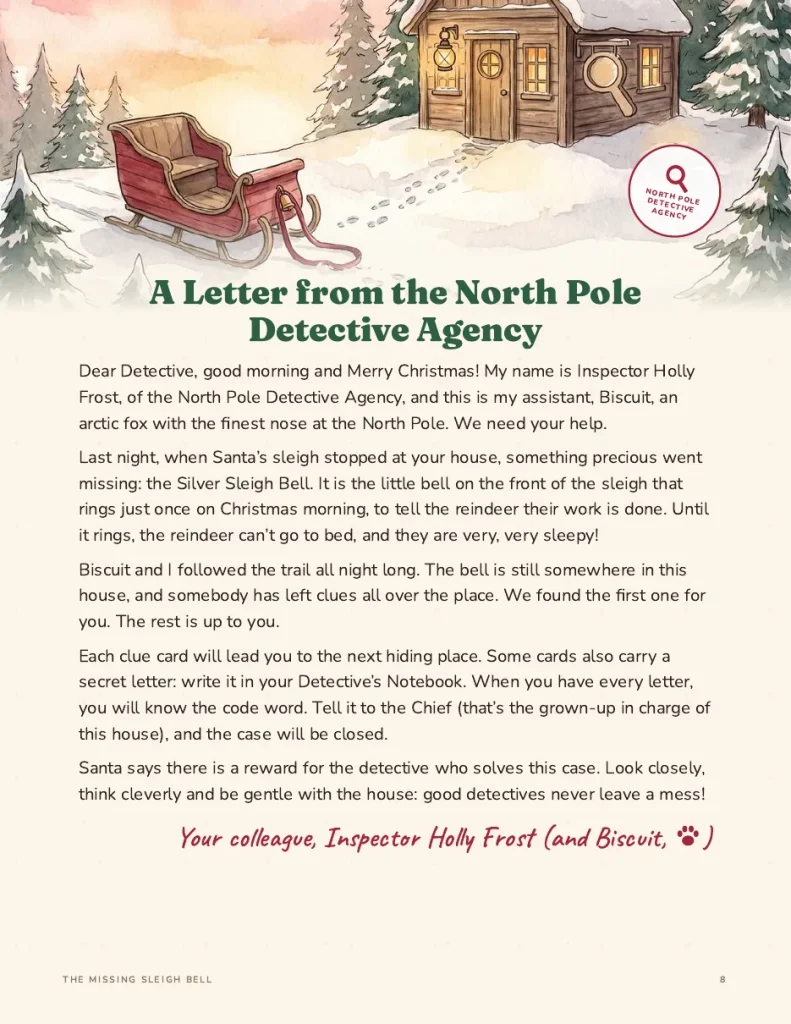
For a family with small children and teenagers, run two trails at once in different parts of the house, or give the little ones their own short hunt with picture clues while the older ones tackle riddles. For children from 4 up, The Case of the Missing Sleigh Bell does this in one download: a letter from Inspector Holly Frost sets up the case, and three levels (picture clues for ages 4 to 6, rhyming riddles for 7 to 10, a secret code on every card for 11 to grown-up) each have 12 cards and run from about 15 to 45 minutes.
For two players, keep it to eight stops with riddles about shared jokes. A Christmas morning hunt built around one present is a separate design problem.
Prizes should be small and a little bit ridiculous. Big prizes make adults competitive in a way that sours the evening.
Give the losing teams something too, even a candy cane each, or a printed certificate with the team name and finishing time.
A card disappears mid-trail. Someone tidied it away, and the team is stuck at spot 6. Keep the master list and a few blank cards in your pocket to rewrite the missing riddle in a minute.
One player solves everything. The fastest reader grabs every card and the others just follow. Rotate the card: a different player reads it aloud at each stop, and the reader can’t be the one who names the answer.
A team stalls on one riddle and goes quiet. For a cryptic riddle, the first letter isn’t always enough. After five more minutes, name the room. After ten, walk them there and let them do the searching.
If you are hosting this week, pick the format from the table at the top and copy the riddles or the lights checklist onto paper tonight. If the adults want a full evening of puzzles rather than a hunt, a printable escape room at home or a Christmas murder mystery party is the next step up.
Holidays & Parties
Run a short Christmas quiz with 18 original questions, a separate answer key, and a final wager. Includes team rules and a 40-minute hosting schedule.
Holidays & Parties
How to build a homemade advent calendar for two that lasts all 24 nights: five kinds of door, a full December 2026 grid, a prep plan to November 30, and long-distance and gift versions.

Holidays & Parties
Fifteen ways to welcome your Christmas elf, from five-minute setups to a full evening, plus arrival letters to copy, return ideas for year two and a plan for the night before.