Christmas Scavenger Hunt Clues and Answers for Every Age
Original Christmas scavenger hunt clues with answers, from photo clues for preschoolers to cryptic ones for teens and adults, and how to chain them to a present.
,
10 minute read
Good Christmas scavenger hunt clues point to one hiding spot only, and they match what the player can actually read. Every clue below is new and comes with its answer (the place where the next card goes), grouped by age: photo clues for kids who can’t read yet, two-line rhymes for ages 6 to 9, cryptic clues for teens, and clues for adults built on household habits and shared memories. Each set also works as a Christmas treasure hunt that walks someone from a first envelope to their present, on Christmas morning or Christmas Eve.
For party formats (a riddle trail, a photo hunt, a lights hunt), see our Christmas scavenger hunt ideas. This page is about the clues themselves, and the hunt that ends at a present.
How many clues, and which kind, at each age
Age
Clue style
Clues in the chain
Hunt time
Who reads
3 to 5
Photo of the spot
4 to 6
10 to 15 min
Nobody needs to; an adult can say one line aloud
6 to 9
Two-line rhyme
5 to 8
15 to 20 min
The child, with help on long words
10 to 12
Rhyme with a twist, plus one code
8 to 10
20 to 30 min
The child
Teens
Cryptic clue, anagram, close-up photo
8 to 12
25 to 40 min
The player
Adults
Cryptic or personal clue
6 to 10
20 to 40 min
The player
These counts are lower than for a party hunt on purpose: a present hunt happens in pajamas, with the family waiting.
Nemours KidsHealth places the start of reading familiar stories and sounding out new words at around ages 6 to 7, so the rhymes below stick to short, everyday words. Each answer is something the child walks past every day: the bread bag, not “the larder.”
Build your present clues backward from the gift
Decide where the gift will be before you write a single clue. Then work back from it.
Pick the gift’s spot, then choose the stops. Keep the route away from the gift’s room until the very end, or a sharp-eyed eight-year-old spots the bike box at clue 2.
List the stops in the order the player will visit them. Each card describes the next stop; the last card describes where the present is.
Pencil the player’s color and the card’s own hiding spot on the back of every card, never the next stop.
Photograph every card with your phone before you hide it.
For the youngest, keep all the stops in two or three rooms. For teens and adults, make the chain cross the house and go up and down at least once: the walking buys time for the rest of the family to get the cocoa on.
Where to hand over the first clue
Taped to the outside of your own bedroom door, so the hunt can’t start without you.
Inside their stocking, if your house opens stockings together and the stockings hang within a child’s reach, away from a lit fireplace.
In a small wrapped box under the tree with their name on it, which turns out to hold only a card. Save this one for older kids. A tired four-year-old may not see the joke.
What the last clue does
The last card should send the player somewhere you can stand and watch. If the present is too big to hide (a bike or a dollhouse), the last clue can lead to a small box containing a photo of the present and the words “go to the garage,” or to a closed door where you are waiting. Skip the ribbon trail across floors and stairs, because it trips people up.
Photo clues for kids who can’t read yet
Photograph each hiding spot from the child’s eye height, the view they’ll recognize. Print the photos, glue each onto a card in the child’s color, and read the line aloud if they need a nudge.
Hiding spot
What the photo shows
Line to say aloud
Their stocking (if it hangs low, away from a lit fireplace, and didn’t hold clue 1)
The stocking, with their name in the shot
“This one belongs to you. Look inside.”
Their favorite stuffed animal
The toy, in its usual spot
“Who keeps you company all night? Ask them.”
The fruit bowl
The bowl, from above
“Where do the apples and bananas wait? Look beside the bowl.”
The bath toy basket
The basket, with a duck on top
“Somebody in the bathroom is guarding a secret.”
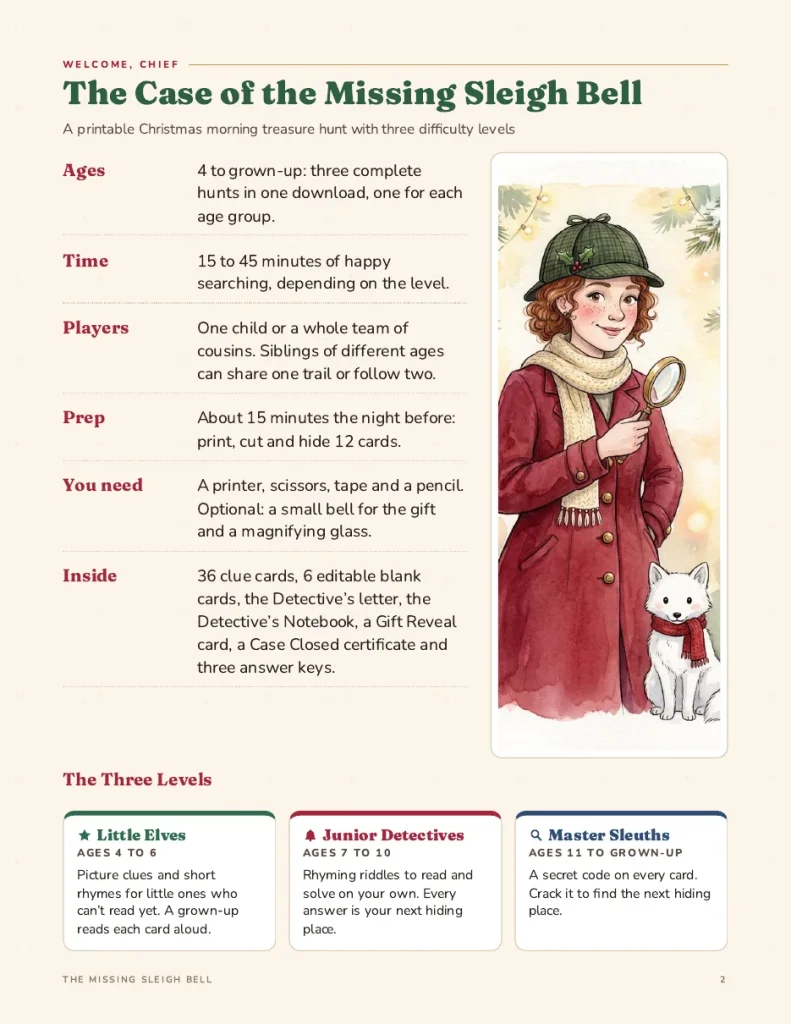
If you’d rather print than photograph, The Case of the Missing Sleigh Bell has a Little Elves level for ages 4 to 6: 12 picture cards, each with a short rhyme an adult reads aloud, in 15 to 25 minutes, so it fits a 5- or 6-year-old better than a 3-year-old. Its three levels (4 to 6, 7 to 10 and 11 to grown-up) let a 5-year-old and a 9-year-old follow separate trails the same morning, since every card carries its level badge, and a Gift Reveal card you fill in by hand tells the player where the present is.
Rhyming Christmas clues for ages 6 to 9, with answers
“Twenty-four doors, and you’ve opened each one. Look behind me: the hunt’s not done.” Answer: the Advent calendar (tuck the card behind the calendar itself).
“I’m soft inside and crusty out, and toast starts here without a doubt.” Answer: the bread bag or bread box (only if it isn’t next to the toaster).
“I hang up fluffy on the rack; I dry your front and dry your back.” Answer: the bath towel (fold the card into it).
“They came in envelopes this week, with snowy scenes. Go take a peek.” Answer: the Christmas cards on display (slip it between two of them).
“Two fuzzy friends sleep by your bed, and warm your toes instead of your head.” Answer: their slippers.
“I’ve got a snout but I never eat; I’m full of coins, so peek beneath my feet.” Answer: the piggy bank (the card goes underneath).
“Shirts with jam and socks with mud all land inside me with a thud.” Answer: the laundry hamper.
“Lights and ornaments, green and tall: I’m the one dressed up most of all.” Answer: the Christmas tree (tie the card to a low branch at the back, clear of the light strings; skip it if the presents wait under the tree).
And a last card you can fill in: “That’s the end, you followed every clue. Now look __, something’s waiting for you.” Write the gift’s spot in the blank: “behind the big chair,” “in Grandma’s room.”
Here is a short five-card chain for a 6-year-old, built from the list. Hand over card 1, the bread rhyme, at your bedroom door. Behind the bread bag, card 2 has the towel rhyme. Folded in the towel, card 3 has the Christmas cards rhyme. Between two Christmas cards, card 4 has the piggy bank rhyme. Under the piggy bank, card 5 is the fill-in card, pointing behind the big chair, where the present waits. For an older child, add stops from the list.
For ages 10 to 12, add a twist to any of these: scramble one word of the answer, or write the last line in mirror writing. The towel card, for example, becomes “I hang up fluffy on the rack; I’m the LOWTE that dries your back.” Use one twist per card. With two, most kids stall. Then make one card a book code (see the teen section). If they want harder puzzles than a trail can hold, try a Christmas escape room for kids later in the day.
Christmas scavenger hunt clues for teens
Teens tune out anything that looks like a school worksheet. Come at the spot from an odd angle, and let their phone be part of it.
“Look under the SMARTEST thing in your room. Rearrange it first.” Answer: the mattress (an anagram; tuck the card under one corner).
“Every night I feed the thing you love most, and it has never once said thank you.” Answer: their phone charger (card under the cable on the nightstand).
“Everything inside me has already lived one life. I’m waiting for the second.” Answer: the kitchen recycling bin (tape the card inside the lid of a clean bin).
“I came with your favorite sneakers. Now I hold everything except sneakers.” Answer: the shoebox in their closet or under the bed.
“Two sticks but no wood, two triggers that never fire, and I’m the reason for every ‘one more game’ after midnight.” Answer: the game controller (tape the card to its underside).
“I lose a page every month and nobody cries. Turn me to the end.” Answer: the wall calendar (card behind the December page).
“Twenty jars stand in a row, and the one you need is the brown one you shake onto cocoa and French toast.” Answer: the cinnamon in the spice rack (skip this one if your spice rack hangs by the stove).
“Everyone sits down on me ‘for five minutes,’ and somehow it’s always two hours.” Answer: the sofa (slide the card down the side, between the arm and the seat).
Two more clue types that work well with teens:
A close-up photo. Shoot a texture so tightly it takes a minute to place: the weave of the bath mat or the grain of the kitchen table. Print it and hide the next card at the spot in the picture.
A book code. Pick a book on a shelf they know and find a sentence that contains the word you need (kitchen, garage, window). The card says “Second shelf, third book from the left: page 41, line 6, word 2.”
When a teen is stuck, use sealed hint envelopes, one per clue, taped behind the card. Opening one costs a verse of a Christmas song, sung in the kitchen.
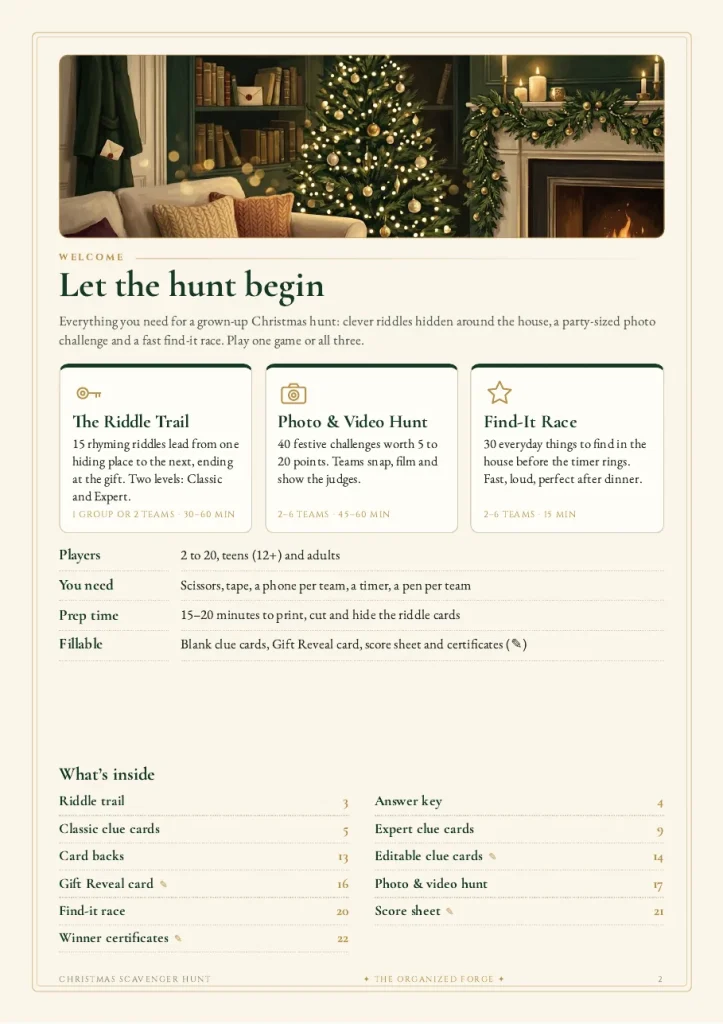
Our Christmas Scavenger Hunt for Teens & Adults is built for the present hunt. Its 15 rhyming riddles make a longer chain than the table above, for a teen who wants the hunt to last, and the trail ends at the gift, where a fillable Gift Reveal card waits with the present. It comes in a Classic and an Expert level. A few of its stops are kitchen and laundry appliances, so for a pajama morning you can swap those for your own spots using the editable blank cards.
Christmas scavenger hunt clues for adults around the house
For a partner, a parent or grown-up kids home for the holidays, the best clues lean on the habits everyone in the house knows and nobody admits to.
“I’m a bag stuffed with bags, and I only ever get fuller.” Answer: the bag of plastic bags under the sink.
“Hidden away so they stay sharp, and still missing every time the wrapping starts.” Answer: the good scissors (put the card under them, never in a drawer with the knives).
“The hammer sleeps here, and so does every ‘I’ll fix it this weekend.’” Answer: the toolbox (card taped to the outside of the lid).
“I hold the bottles we’re saving for a special night, all lying down.” Answer: the wine rack (slip the card between two bottles).
“I spend the whole year in a drawer and only matter the night the power goes out.” Answer: the flashlight (card under it).
“Bills and catalogs land on me first, and nobody ever writes back.” Answer: the mail tray or basket inside the front door.
“Our first Christmas is in here. Find the page where we look the most tired.” Answer: the photo album.
A few more personal templates to fill in with your own history:
“The shelf where you hide the chocolate from yourself.”
“The mug you’d save in a fire.” (card under their favorite mug)
“Where the __ stood in our first apartment.” (point to the object, which has moved house with you, not to the old place)
Use one or two personal clues per chain, since a memory the player doesn’t share is a dead end. For a Christmas treasure hunt for adults, the present at the end doesn’t have to be big: a handwritten note about the year or two tickets for something in January can carry a ten-clue hunt.
When the present lives in the garage
When the present is a bike or anything else too big for the house, end the trail in an attached garage. These two clues are for teens and adults. Turn the garage lights on before the hunt starts, save these cards for the last two stops, and tape them well away from the car, the workbench and the power tools.
“I wait on a hook for every ride, and I’m the first thing you grab before you go outside.” Answer: the bike helmet (card tucked inside it).
“I only come out when the sky turns white, and then everyone suddenly has a bad back.” Answer: the snow shovel (card taped to the handle).
For younger kids, use the photo-in-a-box ending above and walk to the garage together.
Running two or three trails on the same morning
Give each child a color (envelopes, card stock or a dot sticker on every card) and one rule, said out loud before anyone starts: open only your color, and leave anyone else’s where it is.
Give every child the same number of clues, even if one trail is photos and the other is rhymes. Kids count, and “she had more” is the first complaint of the morning. Two envelopes can share a spot (behind the same towel) if it comes at a different point on each trail, so nobody races for it.
Make the last clue on every trail lead to the same room, so the presents get opened side by side and nobody finishes alone. If one child is much faster, make them your assistant: they can give the youngest one hint, but only if the youngest asks.
Safety, and when the trail breaks
Hide cards for young children at the child’s shoulder height or lower, and never on top of a dresser, bookcase or TV stand that might tempt a climber. The CPSC’s Anchor It campaign exists because furniture and TV tip-overs cause injuries and deaths, and a clue up high is an invitation to climb. Keep every card clear of anything that gets hot (the stove, toaster, fireplace and space heaters). If a stop is an appliance, tape the card to the outside with the machine off, and put any fridge or freezer card in a sealed bag that a grown-up opens for the little ones.
As for the morning itself, a card that has gone missing overnight can be rewritten on the spot from the photo on your phone. If your kids wake at 5, use the bedroom-door start from the list above. And when someone finds a card early, let it count: they skip a step, and you don’t re-hide it.
Print or cut one blank card per stop for each player, plus two spares in each color, and keep the gift’s spot on your own list (or in a phone photo), never on the back of a card: only the last clue should give it away. Hide the cards on Christmas Eve after the last child is asleep. For a Christmas Eve hunt, hide them while everyone else is at dinner.