GM Craft
DnD One-Shot Ideas: 8 Adventures You Can Run Tonight
Eight original 5E one-shots on one ready-to-run card, plus a d6 generator, a blank template and a timing plan for 3 or 5 hours.
How to build a 24-door advent calendar for your 5E group, with eight sample doors and a December 2026 plan for tables that meet every other week.
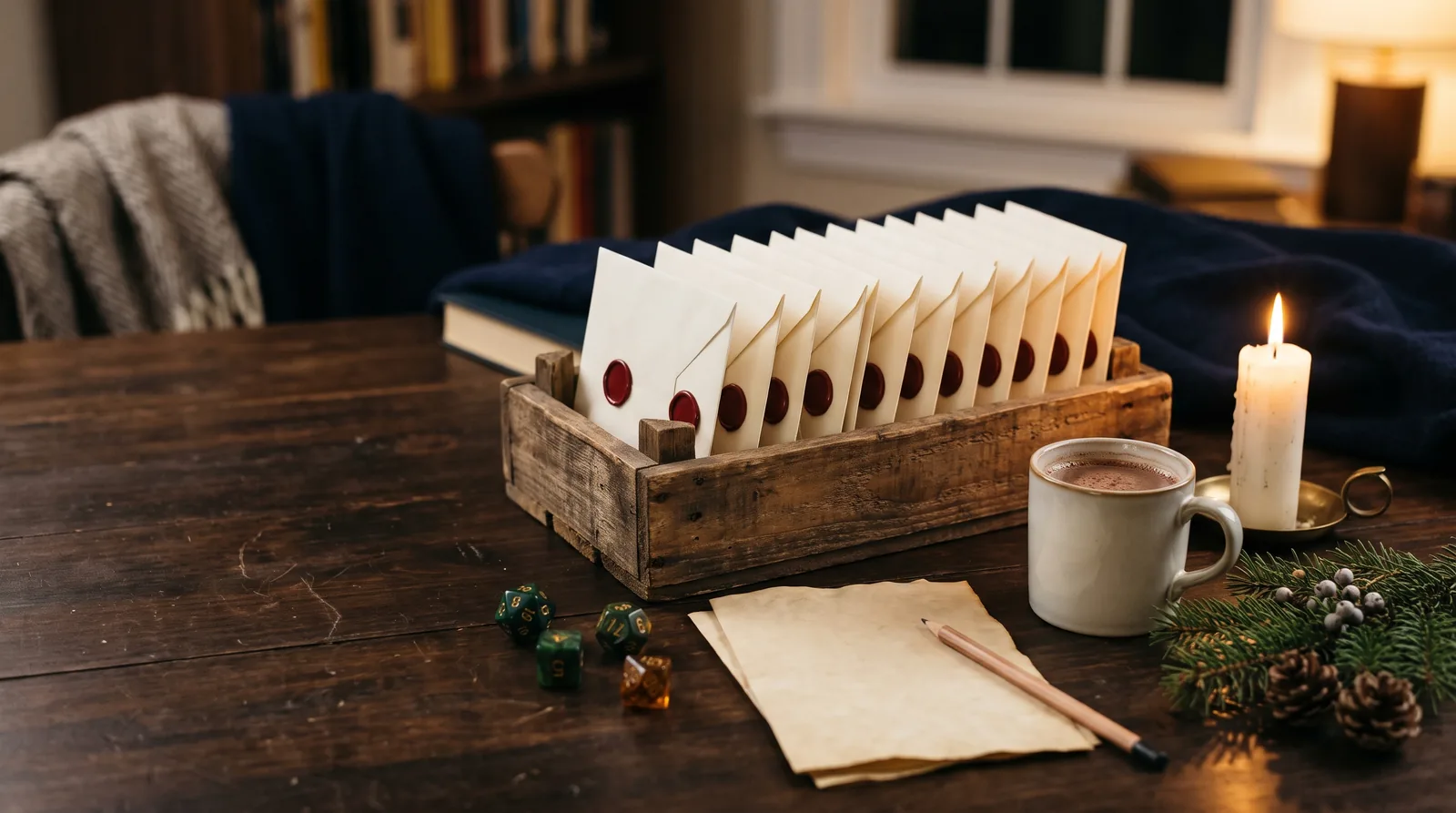
A DnD advent calendar comes in two shapes. The first is a DnD dice advent calendar: 12 to 25 little doors, a die or a mini set behind each one, opened by one person at home. The second is a calendar of game content for your whole table: a magic item, an NPC, a rumor or a five-minute scene every day of December, posted in the group chat and cashed in during a final session around Christmas. If you are shopping for a dice collector, buy the box. If you want your group to feel December inside the campaign, make or print the second kind.
This guide is mostly about the second kind, because that is where the questions are: what goes behind each door, how you stretch 24 doors over a group that meets every other week, what to prep before November 30, and what to do if you start on December 9.
The dice boxes are real products with a clear job. FanRoll’s Holiday Advent Dice Calendar 2026 runs for 25 days, with polar bear and Santa inclusion dice, red and green mini dice and holiday metal dice. The licensed dice boxes FanRoll lists are shorter: its comparison of dice advent calendars lists Frostmaiden’s Aurora at 12 days, with a dice tray, an inclusion set, a mini set, a mega d20 and a dice bag. Twelve days makes a fine gift, but it covers half of December. The same page notes that Dice Envy, Black Oak Workshop, Q-Workshop and Chessex make dice calendars too, and gives one question to ask of any box: how many complete sets will there be by the last door? The licensed boxes hold one inclusion set and one mini set plus accessories, so check the set count on any box before you buy, and order early enough that it arrives before December 1.
What a dice box can’t do is involve the other four people at the table. A Reddit user building a calendar for a girlfriend who runs one campaign and plays a bard in another put it plainly: the ones for sale “all felt like there were exclusively dice.”
| You want… | Get this | Why |
|---|---|---|
| A present for one player who collects dice | A dice advent calendar | Sealed and ready; you prep nothing |
| Something the whole group shares in December | A content calendar (homemade or printable) | Every door changes something in the game |
| A present for your GM | A content calendar they can run, with a die tucked in each envelope if you like | It saves them prep |
| A December ritual for yourself | A solo journaling advent | 15 to 40 minutes a night, no group to schedule |
You can also combine them. A content card in each envelope with one die from a bulk bag on top gives you both.
A good door is small enough to read in a minute and useful enough that someone asks whether they can use it tonight. Eight types cover almost everything. Mix them so no two days in a row feel the same.
| Door type | What’s on the card | Your prep | How it pays off at the table |
|---|---|---|---|
| Magic item | Name, two sentences of description, one effect | 10 min | Someone carries it into the next session |
| NPC | Name, look, what they want, one line to say | 10 min | A face the party already knows when they meet them |
| Five-minute scene | A short situation with one check and two outcomes | 15 min | Run it at the start of a session as a warm-up |
| Riddle | The riddle only, answer kept by you | 5 min | First right answer in the chat wins a small boon |
| Map fragment | A torn piece of a map, one landmark on it | 15 min | The pieces join up for the final session |
| Rumor | A d4 table of things people say, one of them false | 10 min | Players argue about it all week |
| Real-world treat | A recipe, a candy cane, a song to play | 5 min | Brought to the table on finale night |
| Boon | A one-use token with a rule | 5 min | Spent in the finale, then gone |
Write each door so it lands in any campaign. “A toll-keeper at a frozen bridge” works whether your group is in a city, a swamp or a dungeon, because you can move the bridge.
Change the names and these cover a third of your calendar.
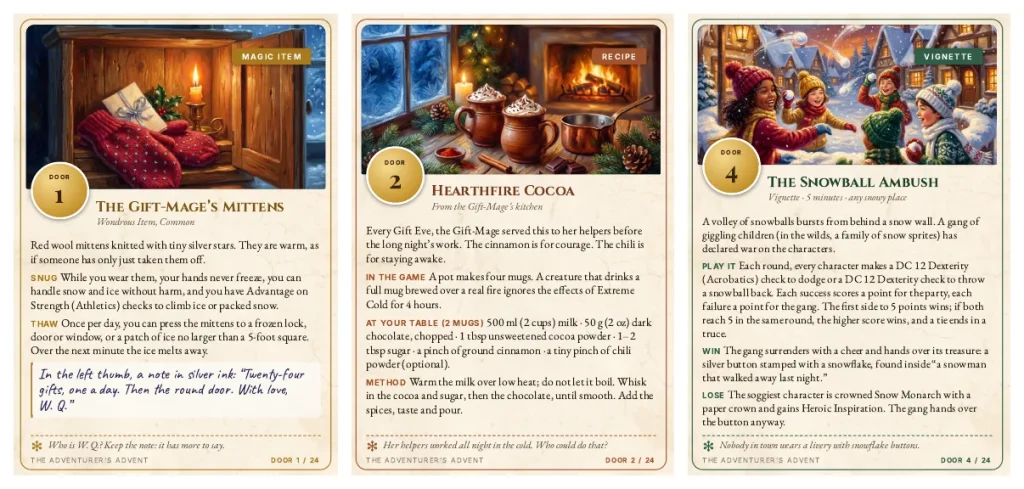
If writing 24 doors is the part you don’t have time for, our The Adventurer’s Advent is the printable version of everything above: 24 double-sided door cards (magic items, NPCs with secrets, vignettes, riddles, map fragments, a rumor table, recipes and boons), GM notes for every door with a ready-to-send message for the group chat, and a finale one-shot behind the twenty-fifth door where the gifts get used. It’s 5E compatible and written for the 2024 rules. A few of its items are uncommon, so decide before December whether they stay with the party after the finale.
This is the part that stalls homemade calendars. The doors are daily, but the game happens once a week at best, and less in December. The fix is to separate opening a door from using it.
Open a door every day in the group chat. Photograph the card, post it with a line in character, and let people react. The party holds the cards between sessions like loot. Items and boons get used at the next session; NPCs and rumors get met and argued about. Everything opened in December expires at the end of the final session, so your campaign doesn’t carry 24 new magic items into January.
Here is how December 2026 falls. December 1 is a Tuesday, Christmas Eve a Thursday and Christmas Day a Friday, so a Friday group plays its finale on Saturday the 26th or in January.
| Week | Dates | Doors | What to put there |
|---|---|---|---|
| 1 | Tue Dec 1 to Sun Dec 6 | 1-6 | The hook on day 1, then two NPCs, a rumor and something they can eat |
| 2 | Mon Dec 7 to Sun Dec 13 | 7-13 | First riddle, first map fragment, two items, a short scene |
| 3 | Mon Dec 14 to Sun Dec 20 | 14-20 | Second map fragment, a boon, the NPC who matters most in the finale |
| 4 | Mon Dec 21 to Thu Dec 24 | 21-24 | Last map fragment, the final boon, an invitation to the finale on door 24 |
| Finale | Dec 26-27, or your first January session | 25 | One session where the cards get spent |
A weekly Sunday group gets sessions on December 6, 13 and 20, and the finale on the 27th. Open each of those sessions with a five-minute advent check: who holds which card, and what they plan to do with it. A group that meets every other week runs two December sessions plus the finale and lets the chat carry the rest. A group that won’t meet until January moves the finale into the first session of the year, and door 24 says so, so nobody spends Christmas night waiting for a game that isn’t happening.
Two rules keep the whole thing from collapsing. No door can be required for the finale to work: if someone missed door 12, the finale still runs, just without that advantage. And nothing behind a door should be stronger than a common magic item (or an uncommon one that disappears after the finale) or a one-use boon. If you want a fuller winter session around the finale, the festival generator in our Frostfeast Winter GM Toolkit builds a town celebration in a few rolls, and its two common winter items and its d100 table of gifts and trinkets are a quick source for doors 20 to 24 if you run dry.
Starting late is fine too. Start on December 5 and open two doors a day: you’re caught up on December 8. Start on December 9 and the same pace catches you up on December 16. From mid-December, switch to a 12-door version and run it from December 13 to 24, one door a day; if you begin on the 15th, open two doors on the 15th and two on the 16th and you’re back on schedule. To cut 24 doors to 12, drop the extra riddles, NPCs and items first, and keep every map fragment and boon, because those are what the finale needs. You can also hand over the missed doors at the next session as a treasure chest and let the party sort through it like loot.
What doesn’t work is skipping the chat entirely and dumping 24 cards on the table in Christmas week: players need a few days with a card before they make plans for it.
Doors 1 to 8 are the hardest, because they set up the finale, so write them first. The rest fits into the remaining November weekends.
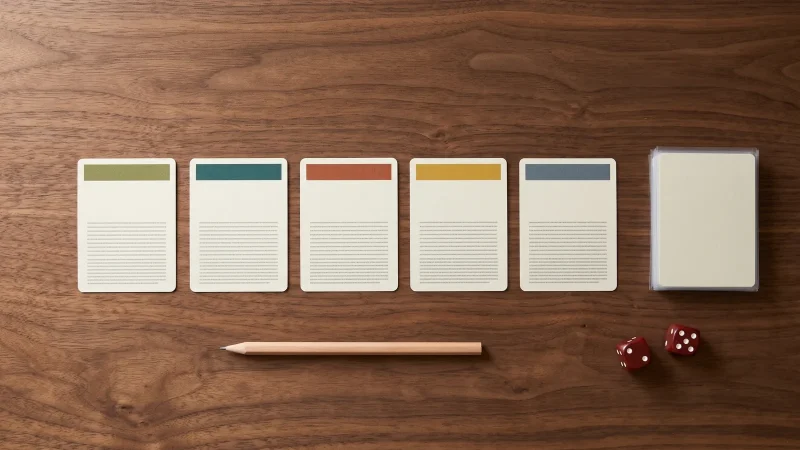
For homemade cards, a Letter sheet cut into quarters gives four 4.25 x 5.5 in cards, which is the size an A2 envelope (4 3/8 x 5 3/4 in) is made for. Twenty-four doors means six sheets, printed double-sided if the backs carry notes or art. Use card stock: plain paper curls by the second week of handling. Our spell card printing guide gives card stock weights and cutting tips. Twine and mini clothespins along a shelf turn the envelopes into a display, which is worth the ten minutes if the group meets at your place.
For the finale, keep prep light. The lazy GM prep method fits well: a strong start, a handful of secrets (most of them already on the door cards), two or three locations and an ending you don’t script. If the finale doubles as the group’s holiday party, our Christmas game night ideas have short games for the hour before or after the session.
When you give an advent calendar to your GM, give it before December 1 and give the doors to them, not to the players. The GM opens one each evening, decides where it lands in the campaign, and the table never has to know there’s a calendar at all. Our list of gifts for dungeon masters has more ideas, sorted by how they run their games.

For a player, a TTRPG advent calendar works best as a mix: a die in each envelope plus a card with something their character can use. Write a few doors for that character specifically, such as a letter from a sibling in their backstory or an item that suits their class, and clear them with the GM first so they don’t break the campaign; the GM also knows any lines the table agreed on at session zero.
In the same Reddit thread, people suggested enamel pins, candy dressed up as mini potions, bardic inspiration coins and a printed mini of the character for door 24.
If the gift is for a partner who doesn’t play, our couples advent calendar covers the version built for two. For a household that prefers a whodunit to a dungeon, there is a murder mystery advent calendar guide as well.
Some people want the December ritual without the scheduling. A solo RPG advent calendar gives you one door per evening: a prompt, a roll, a page in a notebook, done in 15 to 40 minutes. Our The Clockmaker’s Advent works this way with a deck of playing cards, one d6 and a journal. You are the clockmender of a snowbound town, repairing a clock that has been silent for forty winters, one door a night from December 1 to Christmas Eve. If you’ve never played a journaling game, our solo journaling RPG beginner’s guide explains how they run.
Message your group and pick the finale date. Then write door 1, the one that tells them something is coming: a note in a coat pocket, a letter left at the inn, a stranger who already knows their names. End it with a line that promises another door tomorrow, and write doors 2 to 8 this weekend.
GM Craft
Eight original 5E one-shots on one ready-to-run card, plus a d6 generator, a blank template and a timing plan for 3 or 5 hours.
GM Craft
Six formulas for naming a tavern mid-session, d20 tables to roll on, names by mood and ancestry, and shop names that say what's for sale.
GM Craft
How many spell cards each class really needs, why 2014 cards go wrong at a 2024 table, how to print them at the right size, and a simple system for using them mid-fight.