Office Christmas Party Games for Every Team Size and Time Slot
Office Christmas party games picked by headcount and time slot, from a 45-minute lunch to a three-hour evening, with a run of show, a print list and fixes for when the party sags.
,
10 minute read
Pick office Christmas party games that put nobody on stage alone and don’t depend on drinking, then size them to the length of the event. In a 45-minute lunch break, run one short team game and stop. In a three-hour evening, build the night around one anchor game (a murder mystery or a game show) with a warm-up before it and awards after.
Games for family night at home are in our Christmas game night ideas; the games below are for a work Christmas party, where the players share an office, not a family.
Pick by headcount and the time you really have
Work out the real slot before you pick anything. A “lunch party” is often 45 minutes, and the first 15 go to finding food and a seat. An evening event has the opposite problem: three hours is a long time for 60 people with nothing structured to do.
Your slot
Up to 15 people
15 to 40
40 to 100
100+
Fully remote
45-minute lunch
Pet photo match, oven-mitt wrapping
Game show, two teams, quick game
Colleague bingo, short quiz
Colleague bingo, sweater vote
Pet photo match, quiz on screen
90-minute afternoon
Gingerbread HQ, then a quiz
Year-in-review quiz, gingerbread HQ
Station rotation
Station rotation with more hosts
Game show with a shared board
3-hour evening
Murder mystery
Murder mystery in team mode
Two mysteries in two rooms, or quiz at tables plus a game show finale
Stations, quiz at tables, awards
Murder mystery with breakout rooms
Past about 30 people, a host without a microphone loses the back of the room, so bigger groups need a mic plus table captains, stations or a second room. People who don’t drink are a large share of any office: Gallup’s 2026 survey puts the share of U.S. adults who drink alcohol at 54%, a record low for the second year running and the lowest since Gallup began asking in 1939. Any game that runs on drinks leaves a good part of your team watching.
The anchor games: one per party is enough
1. An office murder mystery
It works best for a work crowd because everyone gets a character booklet that tells them what to say. The quiet analyst doesn’t have to be funny on demand, because the booklet hands them a secret, a motive and a piece of the truth. Departments mix because the clues force people to question someone they’ve never had lunch with, and for one evening an intern gets to grill the finance controller about the budget.
The structure is three rounds of 30 to 40 minutes, with food between them, then secret accusations and the reveal. Plan two to three hours in total.
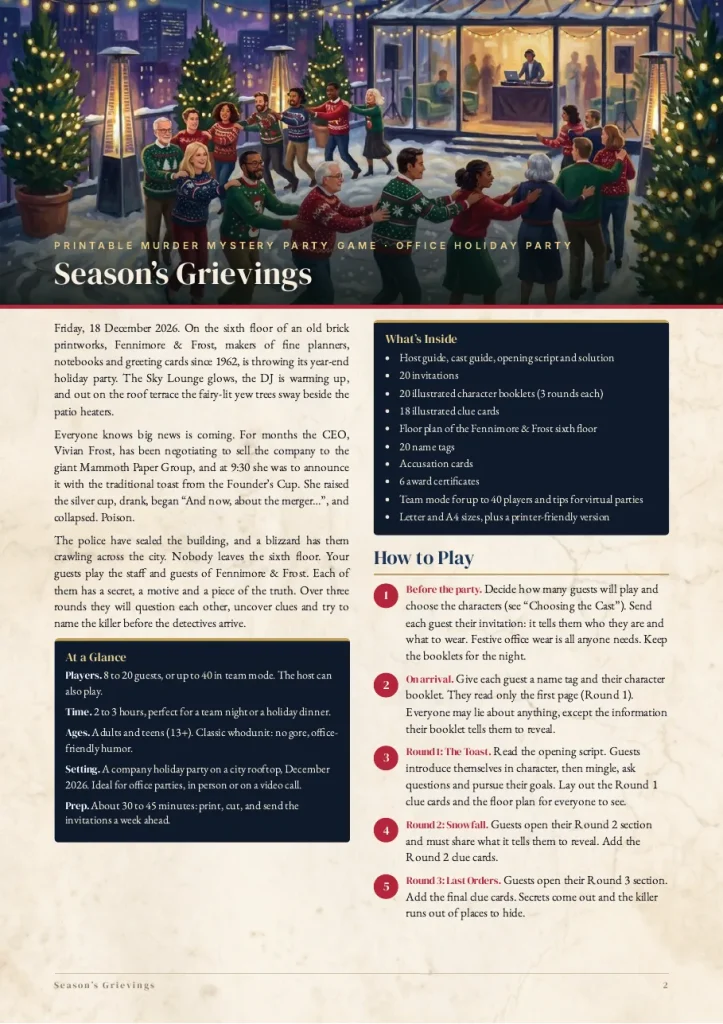
Season’s Grievings is written for exactly this crowd. It’s set at a company holiday party on a fairy-lit rooftop: the CEO raises the Founder’s Cup for the traditional toast, begins “And now, about the merger…” and collapses. It plays with 8 to 20 guests, or up to 40 in team mode, where some characters become duos. It’s for adults and teens 13+, with no gore.
Three office-specific tips. Give senior leaders optional characters, never core ones: the core characters carry the evidence, and the VP pulled into a call at 7:15 can’t take the case down with them. With a big group, seat the core characters at different tables, as the host guide advises. In team mode, pair anyone who hates acting with a colleague who loves it.
For more than 40 people, run two copies in two rooms with two hosts, keep the rooms apart until the accusations, then hold one joint reveal. Our host’s guide covers casting and the reveal; the Christmas murder mystery party for adults is the version for friends at home.
2. A game show with department teams
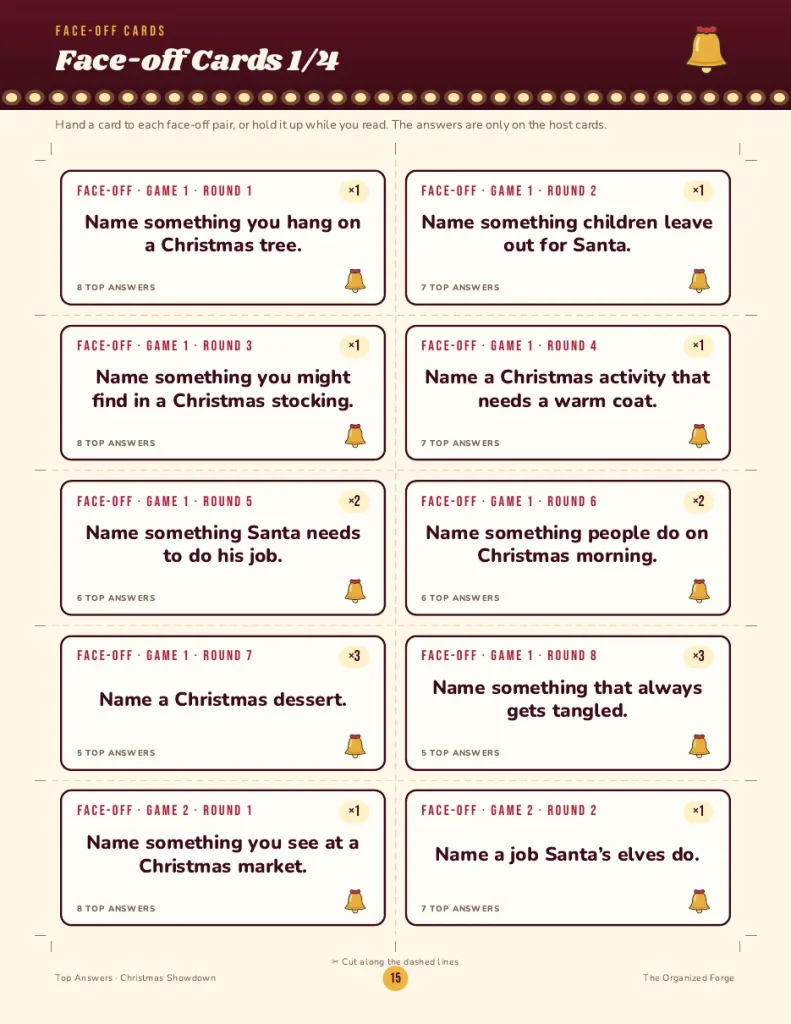
The survey-style game show (two teams, face-offs, three strikes, a steal) fits a lunch hour, and anyone can follow it after one round. At work, build teams across departments, never one department against another, or you’ll replay the year’s real tensions. And give the audience a job: if the steal misses, the first audience member to raise a hand can take a shot at the answer for a candy cane.
Top Answers: Christmas Showdown has a TV answer board that you fill from a laptop, so it also works on a shared screen for remote colleagues. It’s built for 4 to 20 players in two teams plus a host. With 40 people, play one full game with two teams of ten on stage and rotate a new pair of teams in for the second game. For a lunch slot, play only rounds 1, 3, 5 and 7 of one game (the kit’s quick-game variation).
3. The year-in-review quiz
Teams of four to six at their tables, five rounds of six to ten questions, one answer sheet per team, swapped and marked after each round. Make one round about the company’s year: the month the new coffee machine arrived, which product launch got the most messages in the team chat. Fill the other rounds with winter, food and music questions so newcomers can score too. The rule for the company round: nothing about anyone’s mistakes, salaries, layoffs or performance.
If writing all of it sounds like a weekend, the Christmas Party Games Mega Bundle has 50 general Christmas trivia questions in five rounds, with an answer sheet and key; use three of its rounds and write your company round and one more yourself.
Quick office Christmas party games (5 to 30 minutes)
4. Colleague bingo
Print a 5×5 grid where each square reads “Find someone who…”: has worked here less than six months, has never seen snow, can name every floor’s coffee machine, speaks three languages, started in a different department. Guests get a signature from a different person for each square. First full row wins, but keep going for 15 minutes. For 50 to 200 people it’s the best mixer, since all it takes is a pen. Avoid squares about family, religion, health or drinking.
5. Pet photo match
A week before, ask for photos of pets (opt-in, one per person, a plant or a car counts for anyone without a pet). Number them on slides or print them on one sheet. Teams match pets to owners in ten minutes; reveal them one by one, and the owner only has to stand up for a second. It works the same on a video call.
6. Guess the colleague
Collect three harmless facts from volunteers through a form (“I once worked on a cruise ship”). Read one set at a time and let tables guess who wrote it; twelve to fifteen sets fill 15 minutes. Screen the answers beforehand for anything touching health, family or private life.
7. Gingerbread HQ
Teams of four to six get one gingerbread house kit, a tray and 30 minutes to build their office building (or the office everyone wishes they had). A guest judge, ideally someone from another floor, scores it on resemblance and ambition; neatness earns nothing. It keeps hands busy for people who would rather not talk. Ask about allergies in the RSVP: gingerbread kits contain wheat and often dairy, so order a certified gluten-free kit for any team that needs one, and make eating the build optional.
8. Oven-mitt wrapping round
Each pair gets one empty box, a roll of paper, tape and five minutes, all while wearing oven mitts. Teams cheer from the side, and the judge picks the best-wrapped box, so speed counts for nothing.
9. Sticky-note tree
Each team gets three pads of green sticky notes, one yellow pad and five minutes to build the best Christmas tree on a window or wall, star included. The supply cupboard already has everything you need. Photograph each one before someone peels them off.
10. Ugly sweater contest with a secret ballot
Make wearing optional and voting universal, so people in plain clothes are still part of it. Use categories so more than one person wins: most handmade, most lights, best accidental sweater (someone who just happened to wear red). Collect votes on paper slips in a box during the first hour and announce winners with the other awards; until then it takes no stage time at all.
Office Christmas party games for large groups: a station rotation
Split the room into stations: colleague bingo runs all evening, and teams of six to eight rotate every 10 minutes through the sticky-note tree, the oven-mitt wrapping, a table of quick word games and a photo corner. One circuit of four stations serves four teams, about 30 guests; for 60 or 100, set up two or three copies of each station side by side, each with its own volunteer, timer and score sheet. A bell or a song change marks every rotation, and a full lap takes 40 minutes. Finish everyone at their tables for the quiz final round and the awards.
A team scavenger hunt also works at this size: our Christmas scavenger hunt ideas include an office version with find-it stations and a video-call variant.
Virtual Christmas party games for remote and hybrid teams
Remote colleagues shouldn’t be an audience of small boxes at the edge of the screen. Pick games where the screen is the board. The game show works with the answer board shared on screen, the quiz works with answers sent by private chat, and pet photo match needs nothing but slides. For the mystery, the Season’s Grievings host guide covers remote play: booklets emailed ahead, clue cards shared on screen, breakout rooms for private chats, accusations by private message. At a hybrid party, pair each remote guest with someone in the room.
A few rules keep a video call from dragging. Keep a games-only call to about an hour, and if you run the full mystery, add a 10-minute off-camera break after each round. Ship anything physical (gingerbread kits, ballots, a paper crown) 10 days ahead. Make cameras optional and say so in the invite. Collect votes through the platform’s poll or chat instead of unmuting people one by one. Give the emcee a co-host who runs the breakout rooms, admits latecomers and shares the screens.
Kim Clark, quoted by Great Place To Work, recommends putting the budget into an online event catered to time zones so all employees can attend: a 5 p.m. kickoff in New York is 2 p.m. in Los Angeles, and colleagues abroad may be logging in near midnight.
Who runs it, and who shouldn’t
You need one emcee, one scorekeeper per 20 guests, and someone who is not the emcee watching the time. The emcee should be good at reading a room, not necessarily senior; a department head emceeing can make people feel graded.
Before you hand out jobs, check one legal detail with HR. Under the Fair Labor Standards Act, non-exempt (hourly) employees generally must be paid for party time if attendance is mandatory or they’re asked to work at the event; Woods Rogers’ employment lawyers cite making name tags and running a raffle. Scorekeeping and timing a station are similar tasks, so give them to exempt (usually salaried) staff, or pay non-exempt volunteers for the time.
Not everyone on your team celebrates Christmas. Keep games about winter, food and the year you had together, and if part of the team celebrates Hanukkah, a dreidel table from our Hanukkah games works as one of the stations. The same Great Place To Work article advises skipping strobe lights and setting aside small tables away from the crowd.
A sample run of show: a 3-hour evening for 30 people
Time
What happens
6:00
Arrivals, name tags, character booklets handed out; colleague bingo during arrivals only, cards collected at 6:20
6:20
Emcee welcome (two minutes, no speeches), opening script of the mystery
6:25
Round 1, 35 minutes
7:00
Buffet opens, sweater ballots collected
7:30
Round 2, 35 minutes
8:05
Round 3, 30 minutes
8:35
Secret accusations read aloud (in team mode, one card per duo keeps it to about 20), then the reveal: allow 25 minutes
9:00
Awards: sweater winners, bingo winner, the mystery’s awards
9:10
Done. People who want to stay can; nobody feels they have to
For a 45-minute lunch: 15 minutes for food and seats, one minute of rules, 25 minutes of play, and the winner announced with four minutes left to get back to desks.
The print list, game by game
Print a test page first (US Letter or A4, at 100%), then cut everything the day before.
Murder mystery: one invitation and one booklet per character in play (a duo shares one booklet, and each booklet is two pages), one name tag per guest, one set of clue cards and one floor plan per table if the room is big, one accusation card per character in play (a duo shares one) plus five spares, award certificates on card stock. The host guide and solution are for the host only.
Game show: host answer cards (host only), the 40 face-off question cards for the players at the bell, the Strike, Steal and Play-or-Pass cards, and one scorekeeper sheet, plus the Fast Round score slips. Without a TV, print the answer board and slip it into a sheet protector.
Quiz: one answer sheet per team (or one per round if you write your own rounds), plus 20% spares, because a coffee will go over at least one.
Colleague bingo: one card per guest plus 10%, and a cup of pens on every table.
Ballots for the sweater vote: three per guest.
Put each game in its own labeled envelope with pens, and keep the host materials in a separate folder that never leaves your hands.
If the party starts to sag
If this happens
Do this
The games start after two hours at the bar
Run the main game early, while people are sharp, and serve food before the second round
A game puts one colleague on the spot
No solo singing, dancing duels or “most likely to” prompts about work habits; switch to teams and paper ballots
The boss becomes the punchline
A leader who volunteers for a silly role is fine; a game that roasts a manager in front of their team isn’t
The rules explanation passes two minutes
Stop and play one sample round instead
Teams get too competitive
Keep prizes small: a paper crown, first pick at the dessert table. Cash prizes turn a party game into a performance review
Remote colleagues can’t find the link
Send links, files and the schedule with the calendar invite, not on the day
Book the slot and the room today, pick the anchor game, and send the save-the-date with a line saying what the games are and that watching counts as joining. If you’re running the mystery, invitations go out seven days before the party, so cast it now.